Live-streaming US shootings: Reminder of dangers to ‘objective journalism’

Mark Frankel
BBC News social media editor. Twitter: @markfrankel29
Dramatic live-streamed footage of last week’s US shootings and their aftermath has again asked questions about the exponential growth of this kind of eyewitness media. The events in Louisiana, Minnesota and Dallas should heighten concerns for traditional news providers, says Mark Frankel:
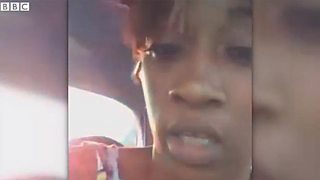
Lavish Reynolds live-streaming from the car where her boyfriend Philando Castile lies dying.
Imagine a hypothetical position where a news organisation just ingests and re-broadcasts eyewitness live-streamed footage with captions. Say three people are filming in a breaking news situation from three locations: you establish that they are where they say they are; contact them all to check it’s OK to use the material; ingest the footage; cut three minutes from each and get a reporter to voice over the pictures.
What have you ended up with? Someone else’s footage that you have had no control over. It wasn’t filmed by you and so you have no sense of whether you’re telling the story in the best possible way.
As we speak, no mainstream news organisation is doing that. There was an explosion of live-streaming in Dallas, as five police officers were gunned down by a lone sniper, but no news organisation, as far as I’m aware, broke into their transmissions to put the material out live.
The BBC, for instance, used some live eyewitness footage of the shootings – though not straight to air – with agency footage, plus our own material, and packaged it up. Everything I saw from other broadcasters was also contextualised.
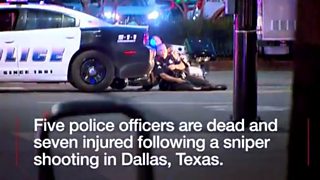
Live-streamed footage was used in this BBC News report on the Dallas shootings.
But there’s a very real danger in the extent to which live-streaming could disrupt the editorial process. As the propensity increases for anyone with a smartphone and a social media account to go live on breaking news, so the temptation for media organisations also to go live with this footage will increase.
There has been a fair amount written in the last week about how Facebook, in particular, is being challenged by this surge. So what about traditional news organisations? How do we reconcile people using more and more opportunities to go live, with what we broadcast to our audiences?
In the last 18 months – even since the Paris attacks – we’ve seen a marked escalation in the use of live-streaming technology. Now, in a breaking news situation, everyone’s a reporter. But there are a few things worth remembering:
- Not everyone live-streaming an event is going to be located in the right place. If someone isn’t truly in the thick of it – in the heart of downtown Dallas or wherever else – they may not necessarily be experiencing what they think they are.
- They’re probably filming from the perspective of what they believe to be the most interesting aspect of the story, but they’re not necessarily journalists. Any member of the public can point a phone and starting talking about what they see. Any trained journalist will tell you that it’s the way you film, the words you use, what you choose to focus on and linger on, and how you interact with the people around you that are critical too.
- As soon as members of the public go live on their phones they become part of the story. Anyone who uses Facebook Live, Periscope or other popular live-streaming platforms is not just pumping out live video, they’re including other people in the conversation. Anyone who sees the live stream can comment and respond. If hundreds are commenting, the account holder cannot moderate or reply in a considered way and at worst, risks drawing in an angry crowd. (The BBC has conducted a number of live-streams on Facebook but we choose the subjects carefully and put as much effort into moderating comments as selecting stories to film.)
- By broadcasting an eyewitness stream live, you may end up telling the story in a partial way. You’re taking the commentary too, which is someone else’s interpretation of events, AND you’re getting all that live comment and reaction – a far cry from the distance and context you would want as a journalist.
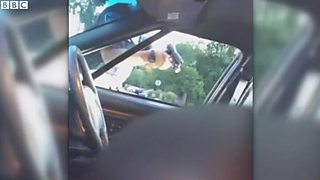
Live-streaming of a police officer pointing a gun into Philando Castile's car was shown on BBC News.
BBC News used the very dramatic footage from Minnesota, streamed on Facebook Live by Lavish Reynolds as her boyfriend Philando Castile lay dying in the back of a car, but not without a discussion about how much to use and not without commentary, as part of a reporter piece.
With context, we also used some of the Facebook live footage from Dallas the following day. I’m certainly not suggesting we shouldn’t use interesting live footage: it’s a case of how, how much and how we signpost it.
I suspect the high volume of live-streaming we saw in Dallas may have been encouraged by the Minnesota video. The BBC and other traditional news broadcasters take the safety of the public in these situations very seriously. We make it explicit that our number one priority is for them not to endanger themselves by doing things they think will be of interest to us. But clearly, a by-product of the public’s increased ability to go live is that more people will feel it’s important for them to do it.
Editorially, my concerns also centre on the volume of footage, and the temptation to use it without enough thought. From a traditional news media perspective, we need to realise that when someone live-streams footage they’re only telling us a fragment of a story, so we should not be tempted to take it unchecked or to point audiences directly to it without due context.
And however we use increasing amounts of available live-streamed material, it means that our packages may come to resemble a montage of other people’s film. How can you then know that what you’re broadcasting is objective truth and commentary?
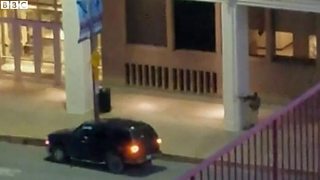
Amateur video of the Dallas gunman firing at police. Other footage was too graphic to show.
There are things you can check, of course:
- That the person is where they say they are – through conversation and geolocation
- That their social media profile adds up – look at their history, activity and followers
- That the kind of footage they’re sending tallies with other available material from news agencies – same buildings, demography etc.
What you can’t check is this person’s ability to tell a story in an objective way.
We can’t put the genie back in the bottle and no one would want to limit access to this technology. But social media began as a community to share content and ideas, it was never designed at the outset as a simple means of broadcasting. And now, if someone is dying in a car or running away from gunfire, the danger is that there is a barrage of content and no moderation of reaction.
What’s clear is that news broadcasters – schooled in editorial values and approaches – have a responsibility to audiences in terms of filters and warnings, but also to help make sense of what’s happening. Otherwise, what’s the point of journalism?
Other BBC Academy blogs by Mark Frankel
#Paris: Streaming video apps mean we’re all reporters now
Social media verification: UGC Hub
Our mobile journalism blogs by Marc Settle
