
The BBC News style guide has finally had a long-awaited update.
As I reported recently, a number of changes had been recommended, though getting final approval and incorporating them into the guide takes time.
Among the headlines is the hyphen. We have wrestled with the prefix "cyber" for too long.
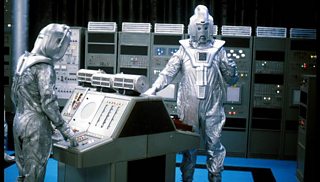
From 1985, but now with added hypens
While "cyberspace" and Doctor Who's Cybermen have been with us for some time, other entrants have joined the fray.
Creating one-word compounds seemed logical - until we heard of cyberattacks and cyberjihadists. They looked odd and were not comfortable to read, and we felt adding a hyphen would help our audiences.
And while we were happy with "cybersecurity" the government seemed determined to plough its own furrow, with bodies such as the National Cyber Security Centre.
So now all words prefixed by cyber will be hyphenated. Is it a perfect solution? Possibly not, but it meets key criteria in that it is consistent and (we hope) easy to remember.
Another area where we have had to move with the times is company names. They used to begin with a capital and it was all down from there.
Now caps, numbers and even symbols crop up – easyJet, QinetiQ, More Th>n - which we have tended to ignore.
We have decided to change our policy in that we will respect how companies describe themselves - within reason.
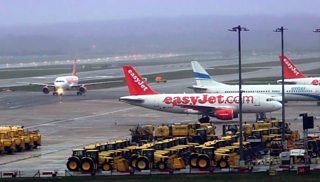
We'll take its "J" but not its first "e"
All (or most) names will continue to begin with a capital letter on our pages but we have relented on other stray capitals. So BlackBerry, which we previously rendered as Blackberry, has now regained its middle "B" and EasyJet its "J".
Yes, there will continue to be exceptions such as iPhone and eBay. But we hope this change has brought us nearer to some form of consistency than our previous guidance.
In other areas, we thought it useful to set out our stall where guidance had not previously been considered necessary.
We don't mind actress, or comedienne for that matter. But a group of actors (of whatever gender) is also fine.
We now clarify when a baby becomes a toddler (“A toddler is generally aged one or two”), that dashcam should be one word and why there’s a difference between being a state broadcaster and a national broadcaster. (A state broadcaster is “a broadcaster whose output is controlled by the state. That’s not the same as being a national, or public, broadcaster, such as RTE in Ireland, Australia’s ABC and of course the BBC”.)
Some guidance has simply been overtaken by events. It’s no longer appropriate to call civil partnerships “gay weddings” now that same-sex marriage is legal in most of the UK.
And occasionally we admit getting it wrong. Our style has recently been “yogurt” because that’s generally what you find on the supermarket shelves. However, writers have expressed their views by stubbornly continuing to include the “h”. After further consideration, it has been reinstated.
The public have also contributed to our guidelines.
Among our new entries is a section on guns, a technical area where writers can easily trip up. Thanks to regular correspondent Mike from Cumbria for prompting that. So, for instance, we now advise that “armed police in the UK are not carrying machine-guns - they use semi-automatic firearms”.
And yes, being laid off is not the same as being sacked or made redundant. And it's correct that Sellafield is not a nuclear power station but a reprocessing site.
We can’t reply to all the feedback we get from the audience but we do read and digest.
What do these changes tell us? Probably not much, other than that how we use language needs to be monitored for the benefit of our staff and our readers.
A hyphen here, a capital letter there; if it makes things simpler and clearer, it's a step in the right direction.
Also by Ian Jolly:
What's wrong with ‘alt-right’ and other usage questions from 2016
