Why evocative sound comes first in radio storytelling - Hugh Sykes

Kris Bramwell
Assistant digital content producer, BBC Academy
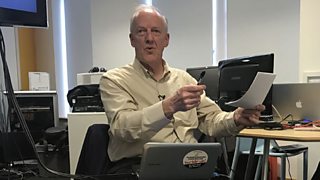
BBC correspondent Hugh Sykes has been telling stories on radio for four decades. Kris Bramwell joined the audience for his talk at the recent Leicester Storytelling Festival for tips on using sound creatively to engage a radio audience and bring important world stories to life:
As I write this, I’m listening. I’m not sitting anywhere special. The tenth floor of BBC Birmingham is open plan and the windows look out on to a series of restaurants and the canals down below. Through the gaps in the blinds to my left, the jigsaw design that makes up a cube-shaped building’s exterior and a large, bold sign which reads ‘The Mailbox’ in block red lettering dominate my vision.
The sound I’m picking up illuminates my setting just as much. There’s the usual office hubbub of multiple people murmuring away. Behind me I can hear distant laughter, to my right, hand dryers are whirring away as the toilet doors open and close and a mobile phone has just rung in front of me - a rather upbeat ringtone - and a man has answered by announcing he’s going to make a cup of tea.
I can hear colleagues having a discussion about how to organise some images taken at a recent photo shoot. This is the soundtrack to my blog. And sound is the radio equivalent of pictures.
That’s a concept that veteran BBC foreign correspondent Hugh Sykes places at the very heart of his work. A BBC presenter and correspondent since 1974, primarily for radio, Sykes has reported from dozens of countries across the world, concentrating on the Middle East since the 2003 invasion of Iraq. For him, the soundtrack to a radio package often comes first.
“The joy of radio for me is simply the sound. Sound is very evocative of place. Instinctively, I think of the soundtrack almost before I think of the content,” Sykes told his Leicester audience.
This is done to draw the listener in, to engage someone who may surrounded by many other distractions, he explained: “You’ve got to grab them.”
Sykes will record sounds randomly, not knowing if he will use them. He now has the luxury to do that, thanks to the five-hour recording time of his equipment.
In August 2006, Sykes was reporting from Beirut as the southern suburbs were being bombed by the Israelis, following provocation from Hezbollah.
In a hotel room just two miles from the attacks, he used his long record time to good effect - “gingerly” leaving his device on a windowsill for the night to capture the scene, whilst remembering his BBC health and safety training.
“We’re all told that if bombs are likely to go off, leave your window open and then the glass is not going to shatter and fly into your body. But pull the curtains [taking care not to] make a profile in the window frame for any snipers in the neighbourhood”.
More good advice was to come. One of Sykes’s golden rules concerned headphones: “A radio reporter has to wear headphones like a camera operator has to look through the view finder.
“You don’t know what you’re recording unless you’ve got headphones on, however experienced you are,” he instructed.
Another tip was to keep the recorder running, said Sykes, who began working in radio at BBC Oxford as a student in 1970, in the days of reel-to-reel tape recorders with a maximum recording length per reel of 15 minutes. Happily, modern recording times provide plenty of scope to record links at a scene.
“It’s more authentic if you’re there. You’re more likely to spot something you suddenly think is worth describing”.
The alternative for a foreign correspondent is to go back to the hotel and record your script on your bed, under a quilt to exclude the sound of the traffic outside - a less authentic option, but something Sykes has had to do, often.
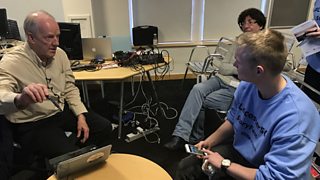
Hugh Sykes takes a questions from Leicester media production student Coby Allen
In Iraq, he recalled the sound of distant bombs each morning, juxtaposed with a bird’s chorus and a rooster’s morning wake-up call. Violent protests greeted the days after the war in 2003 - anarchy was never far away in Baghdad and everybody had a story they wanted to tell. “In a way,” said Sykes, “I had quite an easy job because all this stuff was happening and all I had to do was record it”.
Over four decades, he has found the anonymity that radio provides makes people more likely to talk. His experience of interviewing potentially vulnerable people, including those traumatised by war, is telling: far from being viewed as intrusive, Sykes said that he has often been welcomed because as a journalist, he is somebody neutral to whom people affected by tragedy can tell their stories.
Of course, reporting major world stories is not as simple as Sykes makes out. Amongst other things, it takes a certain ability to stand your ground - covering last year’s Austrian elections was a recent case in point. In a demonstration against border controls in the town of Brenner, police ‘kettled’ protestors at Brenner station. Sykes asked to be let through. The police allowed it.
“Quite often a reporter’s instinct is to think ‘there’s a police line you can’t go through it’. Well I would say, try. And if they do say no, ask them why. They shouldn’t be stopping journalists from carrying out their assignments”.
Sykes feels very fortunate to be doing the job he does. Complex packages that can take 72 hours to create, with the odd bit of sleep thrown in, are not something a lot of programmes have the budget for any longer.
And in the era of so called ‘fake news’, Sykes views the journalist’s role as more relevant than ever. In fact - amid much journalistic uncertainty and reassessment - his mantra couldn’t be more positive: “[As a reporter] you’re the one who is likely to be the expert in assembling the facts in the most efficient and coherent way.”
Hear more from Hugh Sykes on creating stories with sound in this podcast.
