A Theatre-Broadcast conversation

Hannah Khalil
Digital Content Producer, About The BBC Blog
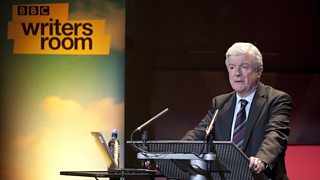
On Monday 21 October 2013, BBC Writersroom held an event called: “Theatre-Broadcast Conversation” at the Radio Theatre in New Broadcasting House. It was hosted by the BBC’s Creative Director of New Writing and Head of Writersroom, Kate Rowland, but the first person to speak was BBC Director-General Tony Hall (pictured above).
The fact that Tony almost introduced himself as Chief Exec of the Royal Opera House (his previous position) was somehow appropriate, as the afternoon was playing host to representatives from over 50 British theatres to launch Writersroom 10 (an initiative begun last year partnering writers and theatres, see video at bottom of post) and look at how the BBC can work with those theatres to enable writers of the future.
“It is a privilege for the BBC to host you, British theatre is the best in the world,” he said, “storytelling matters to us all”. Tony continued, “without our theatre companies, great television drama couldn’t happen.” He referred to the BBC as a “creative catalyst” and said, “I want the BBC to be a place where people come to be creative, excited, inspired.“
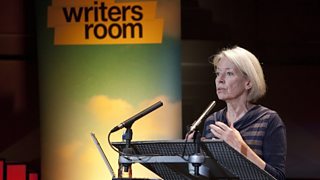
Kate Rowland (pictured) took the podium next and talked about the power of partnership – how BBC and theatres can collaborate, engage and think about new ways of innovating and working together in the future. She talked about how the Writersroom has new found ways to work alongside a host of UK theatres and gave an insight into the work the Writersroom does to find and nurture new writing talent.
She was followed by Peter Maniura, Creative Director/Curator at The Space, who talked about the success of the initiative - a new way to experience the arts, live, free and on demand - which was launched in 2012.
Peter highlighted that The Space is the first arts service in the world enabled for all digital formats, equally watchable on a tablet or phone, and brilliant in HD.
He went on to say that The Space pilot ends on 31 October and after a short time of evaluation it will move to its next phase in 2014.
These initial speeches were followed by a
panel debate and then a wider audience discussion that fell into three broad
categories;
- Theatre arts and the digital space (film, TV and online)
- Audiences
- Risk and developing writers
The impressive panel featured: award-winning playwright and screenwriter Abi Morgan (who recently won an Emmy for The Hour), Playwright in Residence at the Royal Shakespeare Company Mark Ravenhill, award-winning playwright Roy Williams OBE, Artistic Director of the Royal Court Theatre Vicky Featherstone and Artistic Director of Northern Stage, Lorne Campbell.
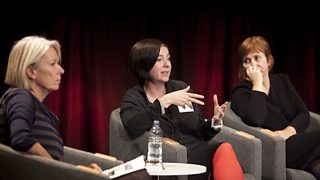
Kate Rowland, Vicky Featherstone and Abi Morgan
Vicky Featherstone, whose inaugural season at the Royal Court features three plays by writers who have made a big impression on TV – Dennis Kelly, Abi Morgan and Jack Thorne – kicked off the discussion saying: “TV has a huge responsibility, the risks we take in theatre enable people to come to television confidently.’
She went on to talk about how the BBC has a responsibility to continue to program to Reithian ideals, as this will help theatre: “we want audiences who aren’t intimidated by difficult subjects and conversations.”
She welcomed the BBC’s initiatives saying, “The BBC needs to be supporting feedbed places where writing starts.”
Mark Ravenhill talked about the difficulty of being an artist and a ‘cultural commentator’. Lorne Campbell said, “A space of innovation is required”, he talked about it being exciting when a new space for storytelling is achieved in any medium.
Abi Morgan confessed that, “Often writers go into TV because you have to make money”. She asked the question, “Where do you put your artist in broadcasting?” making the point that broadcasting is not about single vision but instead a collective endeavor. She also talked about writers going back to theatre to “replenish themselves”.
Roy Williams suggested that writers’ schemes should help develop writers’ careers not just their writing skills.
The panel then moved to the subject of digital initiatives, like screenings of theatre events. Vicky Featherstone said that while she broadly felt this accessibility was a good thing, she warned of the danger to touring theatres and the wider “theatrical ecosystem” in the regions (who may lose out on bookings in favour of a screened event). Abi Morgan talked about the difficulties for writers when pieces written for the stage are filmed and screened, saying that if the writer knew their work was going to be screened they might have written it differently.
Then the discussion was opened up to the audience.
There was a comment about how ensemble and devised/scratch/work-in-progress performances happen in theatre a lot to encourage innovation and experimentation. The question was asked how the BBC might open up opportunities for artists to experiment with form. Kate Rowland highlighted that The Space was a perfect environment for this kind of innovation.
There was also discussion around the fact that TV is expensive and that development in TV is all about “beating out risk” – hence the length of time things take to come to fruition. It was acknowledged that, “theatre is all about risk”. The suggestion was made that, “Perhaps it’s about finding a way of making cheaper TV”. Peter Maniura talked about The Space as a cheap and accessible way to experiment and said, “we need to think about the ways we share technology”.
The conversation then moved to the “dominance of genre” and how it can be “the strait-jacket of broadcasting”. It was pointed out that crime or medical drama shows or other genre pieces can often be “Trojan horses into other themes”, but the question was asked of genre-based shows: “do the audience watch because that’s what we provide, or do we provide because that’s what the audience wants to watch?” However, the planned development of BBC iPlayer as a destination for new, original content in its own right was sited as the beginning of a change in how drama is commissioned and watched.
The writers on the first BBC Writersroom 10 scheme, talk about their journey so far.
The afternoon was rounded off with a film introducing Writersroom 10 (above) inviting theatres to nominate up to two emerging writers they’d like to support and develop with the BBC through a £1,000 seed commission. Applications are invited from UK theatres between 23 October and 22 November 2013.
In the words of Kate Rowland, “the BBC is trying to reach all audiences and they are hugely diverse audiences”, and what better way to do that than through a diverse range of new, exciting voices mined from writing talent across the country.
Hannah Khalil is Digital Producer, About The BBC website and Blog.
- Read about Writersroom 10 on Writersroom website
- Read the Press release about Tony Hall’s speech at Theatre-Broadcast conversation
- Read a blog about the BBC Writersroom TV Drama Writers Festival
