How far would you go to save the family who gave you up? BBC One's three-part drama One Child is part of the BBC Two's China season and began on Thursday 17 February 2016. In this post Guy Hibbert explores the challenges he faced creating characters for the series.
When setting out to write a script set in one’s own city or country, there is a lifetime of memories, locations, incidents and characters stored in the conscious and subconscious with which to work. There is so much to draw on and, in this respect, writing becomes effortless; one can just sit down at one’s desk and start, confident that these experiences will rise to the surface when required.
However, starting out to write a drama set in a country outside one’s own experience presents all kinds of problems for the writer.
Having decided to write ‘something about China’, I had to embark on months of research before even opening the computer and writing that first line; not only do I have to feel confident of writing in a culture that is alien to me but I also have to lay down in my memory a whole load of locations, incidents and characters which I have to gather on research trips.
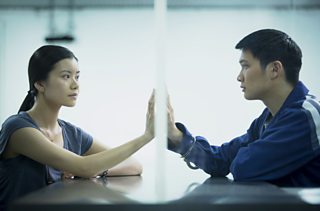
Adopted Mei returns to China and finds herself leading a fight for justice for a family she is only just coming to know, in a country she is is only just beginning to understand.
Take one example in episode one of One Child: Our heroine, Mei, was abandoned by her Chinese mother when she was a baby and then adopted by a British couple. As One Child opens, Mei is in her twenties. She gets a message from China that her birth mother is desperate to meet her. How to write that first encounter between mother and daughter? I don’t know the culture - the behaviour that stems from that culture - and so I don’t have the confidence to write that scene. I have to research it - and then I discover that the mother cannot even look at her daughter because she has too much shame. It creates a wonderful opportunity to write a fascinating scene.
So, every scene one writes is preceded by the question: What would happen here? How would he react? What would she do? Sometimes I have to guess and then get it wrong; this is why I had every scene in the script thoroughly checked by Chinese friends and Chinese consultants. There is no point in me presenting a false picture of China; one of the reasons I write dramas in worlds unfamiliar to us Europeans is to open the window onto a real world and not onto my fantasised image of the world.
Every character you see in One Child is either based on someone in particular or inspired by someone I have met: the billionaire’s son who has arrogantly profited from China’s extraordinary trading renaissance, the post-Tiananmen Square activist trying to create an alternative structure for society, the African trader buying clothes and flip-flops for his market back home, policemen, lawyers, journalists, professors, private detectives, city officials, even an executioner. All these characters in the drama I can trace back to people I met on my research trips. In a piece like One Child, I hope that one of the interests in the drama is to enjoy taking a journey through what is not familiar.
I based the character of Liu Ying, the mother who had to give up her daughter as a baby, on a mother I met in Guangzhou. Her home was a claustrophobic living area - I can’t really describe it as an apartment - in an old part of the city. (Incidentally, in tone, very accurately reconstructed by director John Alexander and his team.) This mother I met shared a bed with her daughter and her elderly mother. Her brother had been given a life sentence for a crime he did not commit and he was serving his sentence two thousand miles away, in the north of the country. A journalist on the local newspaper was campaigning for her because the mother had no connections and no access to any sources that might give her justice.
Though the circumstances are different for my characters in One Child and the bones of the story taken from other research, these two women - and Mei - became the central characters in my own story. I made a key early decision: I wanted to put ‘good’ people at the centre of the drama.
My dramatic instinct is also to tell stories from the ‘bottom up’. My sympathy and interest lies in the lives of those who are the victims of others’ mayhem, rather than in the lives of the creators of that mayhem.
Perhaps Arthur Miller has had the most profound effect on my writing. This is from the greatest play of the C20th, Death Of A Salesman: “Willie Loman never made a lot of money. His name was never in the paper. He's not the finest character that ever lived. But he's a human being, and a terrible thing is happening to him. So attention must be paid. He's not to be allowed to fall in his grave like an old dog. Attention must finally be paid to such a person.” Reflecting on this, perhaps the whole reason for my writing life can be summed up by that line ‘attention must be paid’.
The driving force of One Child is to seek justice for the mother, a migrant worker who has no connections who she can exploit to save her son’s life. As long as people like Liu Ying live in a world from which they receive no justice, how can I write any other story but one which demands that attention be paid to her?
- Watch episode one of One Child via BBC iPlayer. Episodes two and three will be broadcast on BBC One on Wednesday 24 February and 2nd March respectively.
- Discover more about the China Season on BBC Two
