We Are Bradford: telling the city's stories

Sabbiyah Pervez
Communities Reporter, BBC Look North

I was born in Bradford in March 1989. As the city dominated the headlines for burning the now infamous Rushdie novel Satanic Verses, I took my first breath a mile from where the protests took place.
I was 12 when race riots crippled my hometown catapulting us back on to the front pages. I remember it well, the fear, the anxiety and the trauma. I watched as years of community tensions, poverty and frustration spilled out onto the streets. The legacy of the riots lingered like the smell of fire - persistent and jarring.
But that's not all that I remember. My childhood was spent in my parents’ corner shop. Like so many others it was the heart of the community, a place where everyone would come to collect what they needed. In that shop race didn’t matter nor did religion, you got what you came for, had a chat and left. It was a reminder that regardless of what was happening in the city, life always ticks on.
I came to see how Bradford treated its wounds, I saw how people banded together with limited resources but a fierce passion to correct the mistakes of the past. I saw how people fed up with policies made by those disengaged with the streets came up with their own strategies.
And it was all of this that prompted me to join the BBC. Beyond the headlines that Bradford was all too accustomed with, were the stories that people were missing. The stories of the ordinary people living amongst the noise. But while they were passed off as hard to reach or disengaged, in fact these communities are neither. Their key quality is that they can smell a sincere journalist from the opportunistic one. And Bradfordians are frustrated at being used to pursue a narrative that no longer fits them. They want to tell their own stories on their own terms.
We Are Bradford
So when the BBC announced it would be piloting a project to reach underserved audiences and its first venue would be in Bradford, following an idea from David Sillito, it made sense to hand the microphone back to the people.
At the same time within my role on the Under 30 news panel I had arranged a meeting for James Stephenson, Tim Smith and Rozina Breen with twenty young people from across Bradford. It was clear that they wanted to tell their own stories and they craved authentic voices.
So we brought them on board for We Are Bradford, and it was a huge success. The BBC received 850 ideas for We Are Bradford stories from the public - either in person, online or via social media - and more than 50 stories have now featured online. We Are Bradford stories were accessed over 5 million times online and on social media in that week alone and many more times since then.
Committing to the city
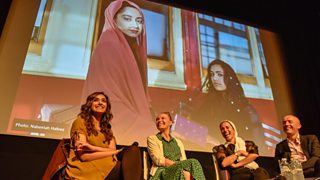
L-R Sajidah Shabi from Speaker’s Corner, Jo Quinton-Tulloch, Director, National Science and Media Museum; Sabbiyah Pervez and Tim Smith, Acting Head of BBC Yorkshire
From the offset it was clear that We Are Bradford couldn't be a one night stand with the city, it had to be a long standing relationship. With that comes commitment, investment and a legacy. But for me it also provided us with an opportunity to inject some aspiration and excitement into the city.
Bradford is one of the youngest cities in the UK. It has tremendous potential but a real lack of aspiration amongst its youth. Growing up I never thought I could have a career at the BBC. It wasn’t because I didn’t think I could do it, just because I never thought it was for me.
I want the young people of Bradford to know and feel that the BBC is theirs too, and that we care about their voices and stories as much as we do about anyone one else across the country.
This month’s event looking at the media portrayal of Bradford helped us explore how the media can affect the self-esteem of a city, how it can amplify voices and the work we need to do to regain trust.
We talked about how We Are Bradford and the National Science and Media Museum’s project Above The Noise: Stories From Bradford, worked together with people from Bradford to find stories that both the people and the media were interested in and concerned about. We also looked at why so many people in Bradford are creating their own DIY media, defining their own experiences of our city.
We Are Bradford has pushed opened a door, it's our job now to ensure that door never closes.
It’s not just Bradford
BBC News is going to communities all over the country to find their stories. Back in April, BBC News launched We Are Middlesbrough to build on the success of We Are Bradford.
From 23 September BBC News will also be launching We Are Stoke-on-Trent, again making sure news from the city reaches a wider audience.
We are Bradford was just the start. It’s important that these towns and cities get the chance to show a side to them that the people living there know, but the rest of the country rarely gets to see.
Find out more and submit your suggestions to We Are Bradford, We Are Middlesbrough or We Are Stoke-on-Trent.
