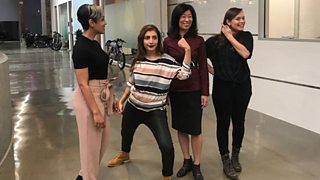
Rumman Chowdhury, Roya Ramezani, Lori Nishiura Mackenzie, Natalia Margolis
Sarah Buckley, lead producer and Liz Gibbons, executive producer of BBC 100 Women season introduce the fifth iteration and outline what's new this year.
We aren’t just reporting on issues facing women around the world this year, we are seeking ways to solve them, as part of the BBC’s commitment to “solutions-focused” journalism.
So we have given teams of women in four global cities five days to come up with ways to tackle four big problems that women face around the world.
The first challenge ran in Silicon Valley. Four women living in California from the worlds of academia and tech had working week to find a way to help crack the glass ceiling.
Why Silicon Valley? Well, because fewer than one in ten senior positions there are held by women and recent scandals have thrown a light on a pervasive culture of sexism in the tech industry.
Dubbed #teamlead, the quartet of women had never met before the BBC brought them together. We told them they could call on help from other experts - women and men - and they had the resources of a Silicon Valley makers’ space, The Playground, complete with state of the art 3d printers, at their disposal.
We also introduced them to two women who felt they needed help navigating the world of Silicon Valley. Erin, a data scientist, finds it cripplingly hard to speak up in meetings, and Lea – a recent Stanford Graduate who has experienced first-hand the sometimes sexist culture of Silicon Valley whilst an intern at various start-ups. Our team lapped up their stories, and used them as a basis for their solutions. More on those solutions later...
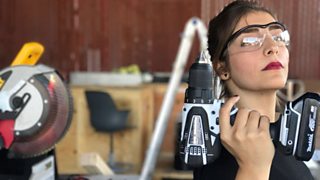
Roya Ramezani
So what were the editorial challenges in producing this 100Women Challenge? Before we even started the shoot, the main difficulty was access. We would find a case study who said she had problems with meetings, only for their company’s HR/PR to then turn down any possibility of us filming them in the office. It took many many weeks of searching to find a company open to this. And as for casting our experts on #teamlead, we were mindful that we needed a mix of personalities and expertise. So that meant including an academic who could ground any innovation in the latest gender research and a flamboyant product designer who was not afraid to take incredible risks with her ideas.
During the week itself, there was a moment on the day before the big reveal of the team’s products when we ourselves felt a bit like candidates on The Apprentice. The presenter Nuala McGovern was demonstrating power poses for a Facebook live interview with social psychologist Amy Cuddy, the producer was ironing jumpsuits for a social experiment, and the fixer was negotiating with the Palo Alto police to allow us to drag an art installation into the streets to test on the public. It was nerve-wracking and, well, challenging.
We live-blogged the Challenge on 100 Women social media handles and a BBC News Live page, and we did regular live updates on the World Service, and UK and World News channels. Plus we were following all the action for a documentary to air on World News in November. So there was a lot of instant decision-making, a lot of video files flying around, a lot of laughs, and very long hours.
So what did our women come up with? By Friday, we had some great ideas to demonstrate to our invited audience, including:
- A working prototype of an app called all.ai which uses voice recognition technology to track participation and linguistic dynamics in workplace meetings.
- A piece of wearable tech jewellery, which allows the wearer to accept supportive messages from “allies” via a connected app;
- An art installation called #metoo – which uses audio testimonials of everyday sexism in the workplace and “flips” the gender of the speaker to confound the expectations of the participants.
How did our Challenge team find the week? They’ve vowed to stay in touch, they plan to fine tune their creations and get them to market, and they accepted a fair few business cards from interested parties at the reveal event. They may not have smashed the glass ceiling in a week, but they certainly put a dent in it.
Sarah Buckley is lead producer and Liz Gibbons, executive producer of BBC 100 Women
