Delivering debates in Zambia with BBC Media Action
Clemency Fraser
Production Trainer, BBC Media Action
Tagged with:
Clemency Fraser is production trainer for BBC Media Action, the BBC’s international development charity, and her work has taken her from Afghanistan to Zambia, with a few more in between. She helps produce a series of TV debates that help people in the developing world hold those in authority to account.
The programmes that I work on are part of wider efforts at BBC Media Action to help communities raise issues of local concern that are overlooked in the media, or give a voice to those who are often left out of local and national decision-making.
For many of our audiences, it’s their first ever encounter with people in authority, including politicians. And producing the debates is never without challenges.
This year, I trained and worked with ZNBC, the state broadcaster of Zambia, on a two-part debate series called The Forum, linked to the UN Day of Social Justice and International Women’s Day.
For the first programme, there was a buzz of activity with a fair share of disasters right up to the last minute, like the set arriving at the eleventh hour with the backdrop printed horizontally instead of vertically! But the show went on and was worth every minute of worry when we saw the debate between the audience and the panel.
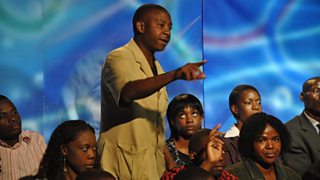
One of the biggest issues for Zambians today is unemployment, and the audience really challenged the Minister for Agriculture – who until recently had been the Minister for Commerce – about what the government was doing to create jobs. A pre-recorded video segment from the town of Kabwe featured residents speaking about their difficulties in finding work and providing for their families, with one man asking, “Where are the jobs? We are still starving.” A member of the opposition United Party for National Development, Dr Choolwe Beyani, demanded of the minister that government plans, “should be made available to the citizens so that they understand what government is talking about. Because right now, it’s like hot air.” This was greeted by pretty enthusiastic applause in the studio!
However, it wasn’t over. International Women’s Day was just around the corner and this time there was even more pressure. As everyone had seen the success of this new format, expectations for the second episode soared and ZNBC senior management told the production team they “cannot fail”. We flew into action, deciding topics and the panel, where our audience was going to come from and what stories were to be told in our video segments.
But it was not long before the bad luck bug hit. The ZNBC producer secured a great panellist who then pulled out, she secured a perfect replacement and another panellist dropped out and so it continued. The tireless producer gritted her teeth and chased every contact until finally, less than 24 hours before show time, her panel was confirmed.
Then we learned that the main panellist, a government representative, had just been spotted boarding a flight to Germany. This was a potential show stopper; without a member of the ruling party, we didn’t have an editorially balanced panel and the programme couldn’t go ahead.
Our ever resilient producer called the Director General of ZNBC and put out an SOS. At 10pm the DG confirmed that we had a top government representative appearing on our programme. We were saved! So episode two went ahead; but what did viewers take from it?
Some of the audience feedback shines a light on why it mattered. One man told us, “I was very impressed to see the ruling party and the opposition on the same table [debating]. I have not seen this in Zambia in a long time.” Another welcomed: “direct confrontation between the people affected by an issue and those with the responsibility of providing services”.
So the shows are not just about getting the set right, the segments recorded and episodes out the door on time. All these parts – and the unavoidable near misses and bitten nails – come together to create something much more valuable. Quite simply, it’s what Joseph Warungu, presenter of our Kenyan debate show, calls “proximity between people and power”.
Clemency Fraser is Production trainer, BBC Media Action .
- The Forum was made with funding from the UK Department for International Development (DFID).
- Find out more about BBC Media Action in Zambia and Zambia’s media environment.
- Read more about BBC Media Action's ongoing work on its dedicated blog.
- Follow BBC Media Action on Twitter and on Facebook.
