
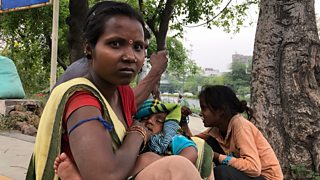
In the middle of a nationwide lockdown for over 50 days, imposed by the Indian government to curb the spread of Covid-19, I was covering the tragedy of thousands of migrant workers on the road. These migrant workers had lost their jobs. With no means of support, they were literally walking back to their villages.
In the midst of a lockdown there is no public transport, buses or railways operating. I was interviewing a heavily pregnant lady on Facebook for BBC Hindi. She was trying to walk back to her village home, hundreds of kilometres away from Delhi. During this live interview I saw young children with their parents trying to find their way on the other side of the road.
My colleague Piyush Nagpal and I decided to reach out to them. Struggling through the speeding traffic, we somehow managed to cross the road without getting run over, all the while going live on Facebook. When I started speaking to the family I realized that they had already covered 250 kilometres by foot from Ambala, in the northern Indian state of Haryana. They told me that Delhi was just their transit city and they had more than 700 kilometres to cover to reach their village in Chhattarpur, situated in the state of Madhya Pradesh - the midlands of India.
The women and the children appeared completely drained as they told me it took them six days to reach Delhi by foot. Kailash, the head of the family told me that he somehow gathered 500 Rupees to buy a broken bicycle so he could carry his belongings on it. He broke down whilst narrating his story of how they were beaten up by policemen for violating the lockdown and walking on the road. The police, he alleged, didn’t even allow his family to rest under the shadow of a tree and were pushing them away from one check post to the other.
He needed the shoes more than me
As the Facebook live continued, under the scorching heat of the summer afternoon, with heat fumes rising from the tar road, I noticed a young man carrying a baby in his arms. To my dismay this man was standing barefoot. He broke down when I tried talking to him. In a flash of a moment, I realised that this man needed shoes more than I did. Seeing his state I got moved to the extent that I could not control my emotions during the live interview. I took off my shoes, handed them over to this young man and carried on interviewing others standing next to him. Now when I look back, it all happened in a spur of a moment.
A few minutes later when the Facebook live ended, I looked around but there was no trace of the family and I was shaken with a sense of guilt that I hadn’t done enough for them. I had in fact lost their trail. That night I couldn’t eat or sleep properly and kept wondering where the family would have got to by now. I opened my laptop, decided to take the help of Google Maps and calculated the distance they would cover over the next couple of days and on the third day I set off to look for them again.
I managed to get them to a shelter house
To my relief, I spotted them on the highway and interviewed the family live on BBC Hindi’s Facebook page. This time I shuddered to hear their horrendous journey of the previous two days where they walked through to go through a sewage canal instead of the road, after being stopped by the police at the border separating Delhi from the next state of Haryana.
As I was talking to them, the local police arrived and asked the family to go back to the border which meant going back 20 kilometres. I intervened and tried to reason with the policeman by saying that the situation was not a ‘law and order issue’ but an unprecedented humanitarian crisis due to the nationwide lockdown. In the end, the policeman called his superior who I tried convincing as well. Thankfully, it worked and the superior agreed to permit the family to spend the night in a makeshift shelter home in a closed school building nearby. Some local people stepped in as well to provide food and clothes to the children. They spent the night at the school under the basic comfort of fans and wash rooms. The following afternoon some people arranged a bus for them and to my relief Kailash, his wife Saroj, and the children finally made it back to their village home.
BBC Hindi's viral video triggered an overwhelming response
Amidst reports of many migrant workers unable to make it back home, facing road accidents or dying of physical fatigue due to walking extremely long distances without any food and shelter for days, BBC Hindi’s viral video triggered an overwhelming response. Many in the country realised the essential need of the hour. Soon the pictures started to pour in from different parts of India where people had started to distribute footwear to these unfortunate individuals walking back to their villages by foot. Some organisations even took the initiative of arranging private buses to take these migrant workers back home.
