
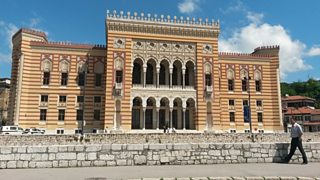
The newly rebuilt VijeÄnica, Sarajevoâs City Hall.
Last Saturday, BBC Radio 3 broadcast a concert via the Eurovision network given by the Vienna Philharmonic Orchestra from the VijeÄnica in Sarajevo. The event marked 100 years since the assasination of Archduke Franz Ferdinand and his wife Duchess Sophie. In this post Live in Concert presenter Sara Mohr Pietsch reflects on her return visit to the city.
When it comes to musical ambassadors of peace, the Vienna Philharmonic isn’t the first orchestra that springs to mind – the Simon Bolívar Youth Orchestra or West Eastern Divan are more obvious beacons of artistic hope. Firmly rooted in the past, the Vienna Philharmonic Orchestra (VPO) is one of the sole survivors of Austria-Hungary, an empire whose collapse began with a shot fired at Archduke Franz Ferdinand on 28th June, 1914.
But last Saturday, 100 years on, with conductor Franz Welser-Möst at its helm, Vienna’s historic orchestra made a symbolic gesture when it performed in the very place where the assassin Gavrilo Princip unwittingly ushered in a century of war. Once again – with the European Broadcasting Union (EBU) beaming the concert to almost 60 TV and radio stations, including BBC Radio 3 - the eyes and ears of Europe were on Sarajevo.
For Sarajevans, the most important thing about this concert wasn’t so much the VPO or the WW1 anniversary, but rather the hall where it took place. Just a few hundred yards along the river-front, to the east of the street corner by the Latin Bridge where the Archduke fell, stands the newly rebuilt Vijećnica, Sarajevo’s City Hall. Built under Austro-Hungarian rule to a neo-Moorish design, the Vijećnica was Bosnia’s national library until 1992, when both the building and two million of its priceless manuscripts were burned in a Serbian mortar attack during the siege of Sarajevo. Now, with the help of 9 million Euros from the European Union, it’s been resurrected as a symbol of national hope. It’s not a concert hall, but there was no more fitting place to stage the event.
My last visit to Sarajevo was ten years ago. Then, burned-out cars lined the roadsides and Viennese stone facades were pock-marked with bullet holes. Today, the streets are full of brand new cars, most of the bullet holes have been filled in and you no longer have to watch out for falling masonry from derelict buildings. But Sarajevo is still a city overshadowed by its past: the surrounding forest hills are dotted with white clusters of gravestones, and locals still talk about their lives in terms of the war, rather than the peace which followed.
Radio 3 producer Janet Tuppen and I arrived in Bosnia’s capital on Thursday to record interviews for our live broadcast of Saturday’s concert. The air was humid and threatened rain, which eventually came in torrents and wrecked our plans of recording outside. Instead, we postponed our interview with Allan Little until the following morning, when the sun came out. Allan is a BBC correspondent who was in Sarajevo during the devastating siege. He talked about the significance of the Vijećnica, the difficulties faced by the current Bosnian government, and the country’s endemic poverty.
Our next visit was to the National Theatre, an impressive municipal building on what’s now called Susan Sontag Place (a mark of respect for the American who pioneered theatre in Sarajevo during the siege). There, we met Ivan Šarić, an opera singer who performed in Saturday’s concert as part of the National Theatre’s Opera Chorus. Ivan has a deep bass voice and a story like so many others of his generation: born in Sarajevo, he fled the war as a child with his family, moving to Sweden and returning to Bosnia as a teenager. He’s a charming, energetic and positive young man, hard-working and comfortable in the familial atmosphere of the opera company, but he shared his frustration that they can only afford two productions in rep each season.
From there, we walked to Hotel Europe (by reputation, Bosnia’s finest) for a press conference hosted by the concert’s production partners: the VPO, EBU, EU and mayor of Sarajevo, Ivo Komšić. Amid diplomatic pleasantries, Clemens Hellsberg (violinist and Chairman of the VPO) spoke passionately about a musician’s obligation to offer an invitation of peace and reconciliation through art. He and Komšić expressed their disappointment at the notable absence of officials from Bosnia's Republika Srpska.
Our final stop was the Vijećnica itself, for the dress rehearsal of the concert in the building’s hexagonal atrium, its stone and marble colonnades decorated with colourful Moorish designs. Under a stained glass ceiling, the Vienna Philharmonic performed Haydn, Schubert, Brahms, Ravel and Berg to an invited audience. Afterwards, conductor Franz Welser-Möst, in Sarajevo for the first time, spoke about the buzz around the concert – every taxi driver he met knew about it.
To my mind, the best way to get to know a city is to walk its streets at dusk; so, at the end of a long day of recording, Janet and I headed into the ancient heart of Sarajevo. The Baščaršija is one of the remaining vestiges of Ottoman rule: a tightly packed grid of cobbled bazaar streets, lined with wooden shop fronts jostling for attention. They sell tourist trinkets, Turkish rugs, copperware and Bosnia’s answer to fast food: ćevapčići sausages and sour cream in a bread wrap. On Friday night, the streets thronged with people, mostly locals taking an evening stroll or milling in the courtyard of the central mosque. Sarajevo felt vibrant and at peace.
I fell asleep that night to the call of the muezzin from one of the pencil-thin minarets which pepper the city, and woke to the peal of church bells: sounds symbolic of Sarajevo’s embodiment of coexistence. Ironic, then, that the city should be so in need of a gesture of solidarity and peace from the VPO, a renowned inheritor of Austro-Hungarian culture.
- Live in Concert from Sarajevo forms part of Radio 3's exploration of music from World War One. Janet Tuppen wrote about the programming on the About the BBC Blog last week.
- The Vienna Philharmonic Orchestra concert is available to listen via BBC iPlayer.
- The BBC News Live Coverage of 28 June 1914: Archduke assasinated and other World War One coverage is available via the BBC's History and bbc.co.uk/ww1.
- Follow Sara Mohr Pietsch on Twitter.
