How BBC News Korean covered the Trump-Kim summit in Singapore

Su-Min Hwang
News Editor, BBC News Korean
Tagged with:
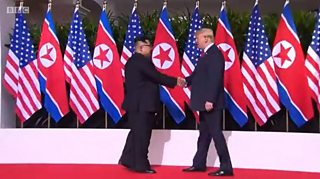
The summit between the leader of North Korea, Kim Jong-un, and US President Donald Trump in Singapore on 12 June was one of the most talked about events for the BBC and other news providers.
Up until last year North Korea was launching missiles and conducting nuclear tests on a frequent basis, so it was surprising to see the sudden turn of events that led to the summit, and until the last minute we at BBC News Korean, like many other journalists, couldn't be quite sure if it was going to happen or not.
As soon as we heard that it was going to be in Singapore, we booked hotels and flights and arranged logistics because we knew the media from all over the world would be there. We booked refundable tickets in case the summit was cancelled. We also made plans for a few non-summit related stories to do in Singapore.
It was important for us to figure out early on what we would be offering, not just to Koreans but also to wider international audiences. Our small team creates radio and online content for the Korean Peninsula. Radio is one of the few ways that North Koreans can access news from the outside world, while we know that our online content is accessed predominantly by South Koreans and Korean-speakers across the globe.
They’re very different audiences, their awareness of the world is different, the use of language and culture can be different, and so the content for each platform has to be distinct.
On radio, we broadcast 20 minutes of news. What we always bear in mind is that North Koreans may not have the full picture, as their predominant source of news is state-run media. So when we reported on the summit, we made sure our broadcast provided the background of how the summit came to happen, and included the international perspective and voices about the event.
Beyond the minute-by-minute updates, we wanted to offer something that was original and that could provide a deeper understanding for our audience. So we focused on giving in-depth analysis and context, and offering feature-style content and finding human stories that related to the summit.
The topic of North Korea is heavily covered in South Korea, so it was important for the BBC’s Korean service to find an interesting angle to make content engaging. For example, when North Korea announced that they would demolish the Punggye-ri nuclear test site, we found defectors from the area, and they recounted for us what the place was like before it became a nuclear test site. They told us about its wildlife and natural landscapes, and how the region changed. That was a unique interview which brought colour and a human side to a political story.
On top of producing content for the Korean-speakers, BBC News Korean also contributed to coverage for the wider BBC audience. One of our team helped update the BBC website’s live online newsfeed, explaining the local reaction and Korean politics involved. The live page received 2.4m views.
Two of our videos, on what Singapore taxi drivers thought of the summit, and analysis on how South Koreans are viewing the meeting between Trump and Kim Jong-un were, respectively, the BBC’s most watched and fifth most watched on the day.
And a more light-hearted video on how to address Kim Jong-un was one of the top stories on BBC online on the day, with more than a quarter of a million views.
The public image that Kim Jong-un presented in Singapore came as a surprise to the whole world. Selfies with him were posted on Twitter and his meeting with the Singaporean Prime Minister was broadcast live on Facebook. When he took a night walk in the city, people screamed ‘I love you’, posting pictures of him on Instagram.
The public had their first encounter with Kim Jong-un, a hugely controversial leader from the most isolated country on the planet, so this was quite incredible to see.
