The long and windy road - The London Marathon
Jenny Sheahan
Editor & Strategic Planner, BBC Press Office
Tagged with:
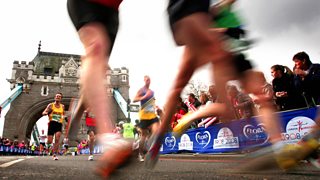
Keen runner and honorary member of the About the BBC blog team, Jenny Sheahan explains why the London Marathon is appointment to view TV for her and millions of other running fans across the UK.
As soon as the music* starts, and the horns start calling out that certain rhythm, I can feel myself become emotional. It happens every year. The BBC’s coverage of the London Marathon is a must-watch for me. I love it, even if I can’t quite explain the attraction of watching people running for over four hours. I am not alone: last year’s coverage on BBC Two was watched by around 3 million viewers with almost 4.5 million at its peak.
I run – I have run four marathons including two London Marathons (and Brighton and Dublin since you asked) - and I watch the race every year. It is an appointment-to-view.
There is something completely compelling about the aerial views of Greenwich Park and Blackheath as thousands of runners amass for the start (the elite men and women, and the wheelchair athletes, start separately, ahead of the Mass Start which itself has three separate starts). Presenters interview celebrities who have agreed to run the 26.2 miles for a charity but who suddenly realise the enormity of what they are about to attempt. It is quite a long way, after all.
Sophie Raworth (presenter, BBC News), Helen Skelton (former Blue Peter presenter), Giles Peterson (presenter, 6Music) and Jonathan Pearce (footballer commentator, Radio 5 live) are among the BBC personalities who have previously run the London Marathon.
And then the constant sea of runners begins. Just over six and a half thousand people took part in the first London Marathon in 1981. Now in its 35th year, over 35,000 runners are due to take part this year. Some will take almost 20 minutes to cross the start line, so huge are the numbers of people who want to cover the marathon distance.
The elite runners, the club runners, the train-five-time-a-week runners lead off, followed by the thousands upon thousands of people running (or walking/jogging) to raise money for charity. Apparently over three-quarters of all finishers last year raised money for good causes, and since the event began a rather amazing £716 million has been raised for Charity.
When I ran in my first London marathon there were not many ‘fun runners’ but now it’s regarded as a festival, with many runners dressing up. There is great competition in setting Guinness World Records: ‘Fastest marathon in an animal costume’; ‘Fastest marathon in school uniform (male)’; ‘Fastest marathon dressed as an astronaut’ and ‘Fastest marathon dressed as a toilet’….
Lots of people put their names on the front of their running tops. When I ran my first marathon I was amazed how many people knew ‘Dave’ who I was running alongside for much of the race - until I realised he had his name on his shirt. I put my name on the front of my top the next time and it really does help when people cheer you on.
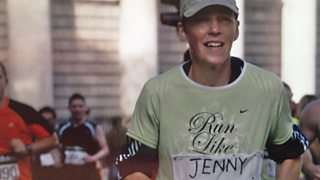
Jenny running in the Dublin Marathon 2007, complete with name tag
And there is a lot of cheering. It makes your ears ring after a while. And then there are the ‘high fives’ with children standing at the barriers, holding out their hand. Loud music is played out of huge speakers; live bands play on the street corners, with bongos, banjos - and anything else that makes a noise.
Trying to spot someone you know in the mass race is all but impossible – you may think that wearing a pink cap will make them stand out from the crowd, but suddenly every other runners seems to be wearing the same coloured apparel. Runners nowadays wear a timing tag on their shoes: their personal race time will start when they cross a mat at the start and finish when they cross over another mat the finish. Supporters can track the progress of specific runners online, which is a great innovation.
The camera bikes and shots from the helicopter show off London as the route of race takes the runners around many iconic landmarks including the Cutty Sark, Tower Bridge, and of course the final miles along the Embankment before the Mall and that all-too-welcome finish banner.
I like watching the mass race. Some of them stop to be interviewed by the BBC on route and many have fantastic inspirational reasons for completing the race: raising money for a local hospice or cancer charity. Many will take 5-6 hours or more to cover the distance; some people take over 7 hours. Being on one’s feet for so long is (almost) harder than running it in half the time.
But what I really like to do is to use Red Button and watch the elite men and women. I admire their pace, the apparent ease at which they run. But then, of course, they don’t have to weave their way amongst people dressed as rhinos.
Last year Mo Farah started – but didn’t finish - the race, publically announcing his intention to drop out at half way which he duly did, with mixed reactions amongst fellow runners. And this year another British Superstar - Paula Radcliffe – is due to take part. Paula, who is now part of the BBC’s commentary team at athletics events, has announced that this will be her final race after years of injuries; she has won the race three times, including 2003 when she set the current Women’s World Record of 2:15:25 (that is equivalent to 4:42 minutes per mile – for each and every of the 26.2 miles of the race. That is Very Fast).
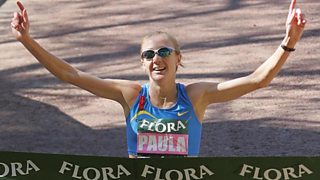
Record holder Paula Radcliffe
So I will watch the elite runners, enjoy their athleticism and be in awe of their strength and stamina to hold such incredible speeds over such a long distance. And then I will switch over to BBC Two and the mass event and be inspired by all the very human stories.
And, after watching hours of people running, I will go for my own long run: 12-13 miles around Suffolk countryside. Somewhat of a different environment to the crowded streets of London but inspirational to me, in its own way.
Jenny Sheahan is Editor and Strategic Planner at the BBC Press Office.
- You can watch coverage of the 2015 Virgin Money London Marathon on Sunday 26 April on BBC Two (8.30-10am); BBC One (10am–2.30pm) and listen on Radio 5 live (8.30am-12.30pm). Red Button: 8.30am-12.30pm – Elite Races; 12.30-1pm – Marathon Stories; 1-2pm – Finish Line Coverage (available online/connected TV 1pm-4pm).
- Highlights of the race are on BBC Two (6pm-9pm)
- The main coverage will be presented by Gabby Logan on BBC One and Two.
- 'Paula Radcliffe: The Marathon and Me' is broadcast on Saturday 25 April on BBC One at 1pm
- * The Trap, written by Ron Goodwin for a 1966 film of that name, and performed by the BBC Philharmonic Orchestra, is the iconic piece of music used by the BBC for its coverage of the London Marathon.
