Life Changes: looking at how we respond to change

Steve Titherington
Senior Commissioning Editor, BBC World Service
Tagged with:
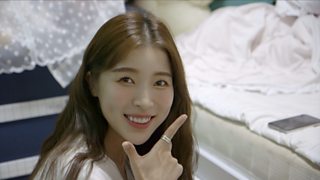
Kang Nara: A North Korean defector to South Korea who is now an online celebrity streaming and telling stories about life north of the border.
A new season of programmes and features is launching across the BBC’s global TV, radio and online networks exploring the theme of change - how we change ourselves, our lives, and how we respond to changes in the world around us.
Reporting from across the world - from Ethiopia, Korea, Rwanda and Paraguay to Egypt, the US and Russia - the documentaries and digital stories cover a diverse range of topics, from sexuality to sustainability, from peace to war, and from neurodiversity to migration.
Why Life Changes?
Early on in the Coronavirus Crisis someone asked me how much I thought life would change as a result. I have no idea, I made clear - I am a journalist, not a sociologist, politician or that newly discovered profession, an epidemiologist. The only thing I knew for certain, I suggested timidly, was that it would not be how we might predict.
And so it isn’t. China apparently moves on and Europe and America are in the midst of a pandemic claiming many thousands more lives.
With life changing so much and so grimly, why now have a season of programmes called Life Changes - prepared over the last year - in what now seems like another age?
Here’s why
Coronavirus is something so big, affecting so many countries that everyone feels they are sharing in it - and by and large we all are in one form or another. Most news is not like that. Mostly the wars and famines that devastate communities, even countries, leave the rest of the world looking on hopefully with compassion and concern, but life goes on.
The experience of those caught up in disasters remain theirs not ours.
To understand those experiences and to break down the barriers between one person and another that may prevent that understanding is one of the jobs of good journalism. If you want to understand how a person’s life is changing you must hear their story.
Life Changes is not about Coronavirus, but it is about understanding what changes us and what can make us happier, more peaceful, and stronger. As it turns out, all that may be quite useful right now.
The Community
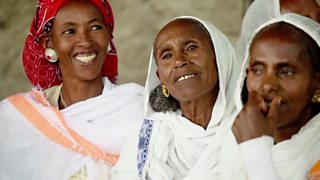
Women living on the Ethiopia Eritrean border, opened after 20 years of conflict but then partially closed again.
Life changed forever for the border town of Zalambessa when Ethiopia and Eritrea went to war 20 years ago - separating families and communities on either side of the border. It changed again when that border reopened just 18 months ago thanks to a rapprochement between the two countries. Lives are being transformed. Our film Between The Earth And The Sky begins with a family in their Sunday best walking across the huge flat plains where there is so much sky the earth seems to float in the dazzling sunshine.
The family set out to cross the border. It’s a religious festival so they stop to bow and kiss the hand of the priest walking the other way. It looks like peace itself has been made real. As he walks the young father points to the mounds and dips along the route. They and the old trenches, he explains, and we are taken back to the shelling, the trench warfare, the suffering that has kept their community in aspic. But this is a film infused with life and hope whether it’s imagining a hotel being built or prayers at a baptism.
Elsewhere in the season, we look at how North Korean defectors are turned into celebrities in South Korea, but do the popular reality TV shows and social media platforms the exiles front give a real picture of the North and give them the best chance to integrate into the new home they took so many risks to find?
The Individual
In ADHD And Me, one BBC reporter with the condition decides to find out if our world is really ready to accept those who might see things a little differently to the herd. Once seen as nebulous or problematic, as Saeedeh Hashemi - herself diagnosed with ADHD - will show, there is now increasing understanding that living with the condition also brings positives. She meets others who, for all the downsides of the disorder, feel that life without it would be like “living cramped within a frame” and who would not give it up an element of themselves that has fundamentally shaped their personalities.
Integration
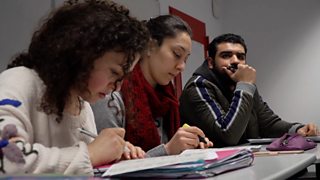
Refugee teachers retraining to teach in schools in Germany.
Naomi Scherbel-Bell looks at the integration of refugees into German society and asks whether teachers are the key to matching Germany’s needs and the newcomers’ skills. But as special retraining courses reach completion and despite a huge shortage of teachers in the country, being a refugee teacher to German children might not be as popular as they hoped.
The Millennials
The BBC has tried hard to improve diversity of its workforce and the age spread - so that many departments have a good number of millennials. Now they are full of anxiety as we hear from Ekaterina Venediktovaa in Quarter Life Crisis as she talks to those her own age in four continents and finds that coming of age in the world where old social patterns do not work and uncertainty is a permanent feature means they have only one thing in common - uncertainty.
Orgasms
Yes, that’s right; the BBC World Service is talking about sex, and never more frankly than here.
According to one reasonably recent US based study, 90% of heterosexual men said they climaxed during sex, while only 60% of women said the same. So is there a way to bring more equality into the pleasure equation? To find out we look at Rwanda and debate over the controversial practice known as gukuna that involves labia elongation. Lily Freeston and Kayleen Devlin present a candid examination of whether the Rwandan experience indicates a more open attitude to discussion about sex, or is there still a long way to go before equality is really found.
The Life Changes season is the result of the BBC World Service’s annual ‘Creative Challenge’ in which BBC staff, regardless of their role, can pitch their own ideas for programmes.
My colleague Natalia Touzovskaya, Creative Challenge Editor, described this as the ideas journalists come up with are never dull when told with passion and curiosity. The people you meet as a result of that passion and curiosity in these programmes represent something hopeful, but realistic; life changes and mostly, but not always, for the better.
Life Changes is available now on BBC World Service.
