
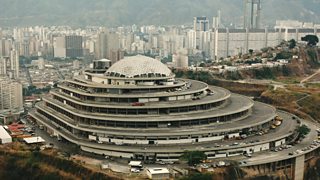
El Helicoide: The Shopping Mall That Became A Torture Prison is an interactive documentary which tells the story of one the most extraordinary buildings in Latin America, told through the eyes of those unfortunate enough to have lived and worked there.
What is El Helicoide?
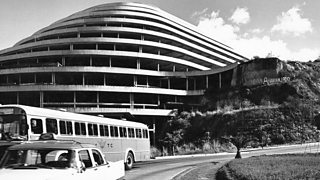
El Helicoide was supposed to be an iconic shopping mall, but it's now one of Venezuela's most notorious political prisons, and home to the country's feared secret police.
In a months-long investigation, reporter Karenina Velandia uncovered shocking cases of alleged human rights abuses at the jail, including systematic use of torture by the Venezuelan security services, as told to us in extremely rare interviews with former security officers.
The building itself is as much a part of this story as the events taking place within it. It can be seen as a metaphor for modern Venezuela, which like the Helicoide, has witnessed a dramatic change in fortunes.
The luxury shops that had been envisaged back when the El Helicoide was designed in the 1950s are now squalid, makeshift cells where both criminals and political prisoners are held in cramped and overcrowded conditions.
Getting the story
Very few images exist from inside the jail, but the vivid descriptions given to us by those who know the prison well, along with the information we were able to gather form elsewhere, allowed us to reconstruct spaces and events that have taken place inside the Helicoide using 3D graphics.
From the outset we planned to present this investigation as an interactive, 'VR' documentary. This format allows us to present these reconstructions front and centre as 360-degree panoramic images. We wanted to give the audience the tools to view and navigate these scenes at their own pace, rather than letting the reconstructions flash by solely as cutaways within a video package.
In order to do this we gathered as much information as possible from a variety of sources, speaking to around 25 people including former guards, detainees, family members, solicitors, NGOs and academics.
Most importantly, we spent a few days with each of the contributors who agreed to speak to us on camera, sketching floorplans, taking measurements and creating preliminary 3D models, in order to recreate virtual environments that would accurately portray the conditions within the jail.
Rebuilding El Helicoide

We were able to compare this information with archive material, kindly shared with us by Proyecto Helicoide, an organisation dedicated to promoting the architectural, cultural and social history of the building. This extensive archive included images and floor-plans of the building's interior prior to its use as a prison.
Karenina was in regular contact with the interviewees to double-check facts, confirm details and receive updates of the situation inside the prison. We spoke to some of the detainees while they were still imprisoned, who have since been released. Some were able to share images from inside the jail, which helped us to visualise what the inside looks like today.
The end result is almost like an image used in architectural visualisations. The 3D environments were built from scratch using 3D modelling software, and each scene is populated with 3D characters frozen in a moment of time. Each scene captures a snapshot of life inside 'El Helicoide', as described by the prisoners and guards who shared their experiences with us.
We worked with Holoscribe, a VR development company, to package each of these 3D scenes as an interactive story. Each chapter gives you a 360-degree scene to explore, by clicking, swiping or using your phone's gyroscope to open up a window into the jail. It's a combination of a long-read, a documentary film and a point-and-click adventure.
Read El Helicoide: The Shopping Mall That Became A Torture Prison here.
