
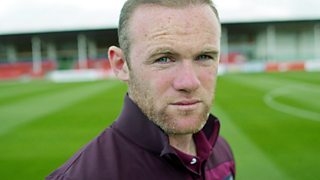
Executive Producer of a soon-to-be-aired documentary about Manchester United footballer Wayne Rooney explains how what kicked off as a sporting achievement documentary soon turned into an unexpectedly unguarded glimpse into the life of the man behind the tabloid headlines.
They say perception is reality, but I’m not so sure that’s right. When we started working on an access documentary with Manchester United and England footballer Wayne Rooney, I was intrigued by the public’s relationship with a man who, by any measure, should have been held up as a national hero.
Having grown up on a tough Liverpool council estate, Wayne rose up through a combination of talent and dedication to become captain of his national team. Moreover, as we started on the project, he was on the brink of breaking Sir Bobby Charlton’s England goal-scoring record.
And yet Wayne’s reputation was mixed, with the media and wider public unsure how to feel about him. He was something of an enigma, known as much for tabloid stories as his impressive footballing feats.
Over the course of a lengthy production, I came to realise that the Wayne Rooney described by the media and people in general bore almost no resemblance to the man himself. Everyone who knew him seemed to love him. Everyone who knew him only from the tabloid stories didn’t.
This was intriguing and led us to change the approach of our production. In fact, the film we delivered to the BBC is almost unrecognisable from the programme I originally pitched. But at this point it’s worth rewinding, because the evolution of the project has a number of interesting aspects. The seed of the idea came from my mate and long-time collaborator Tim Mackenzie-Smith, a director at Deadpan Films. We’d worked together on a number of projects, including Keane & Vieira: Best Of Enemies and our recent Gary Lineker-authored FA Cup doc.
“Have you seen how close Wayne Rooney’s getting to Sir Bobby Charlton’s record?” he asked me. It was true: Sir Bobby’s record of 49 goals was still some way off but Wayne was into the 40s and, if anything, his goal-scoring for the national team was speeding up.
We decided the best way to persuade Rooney to take part in a documentary commemorating his achievement was to ask the man stuck on 48 England goals to make the approach. So Gary contacted him on Twitter and Wayne replied that he was interested. Tim and I agreed that our companies, Goalhanger Films and Deadpan, would co-produce.
Gary and I then met with Wayne’s agent Paul Stretford, who said Wayne was keen to mark the prospective historic moment, but unwilling to allow us extended access to his private life.
So I pitched Wayne Rooney – England’s Greatest Goalscorer, as it was then called, to Alison Kirkham, the BBC’s football-loving factual head. She agreed immediately.
We thought we were making a 10.35pm documentary about a man on the brink of a notable sporting achievement. But then things started to change.
First, we recorded a lengthy master interview at Old Trafford. Wayne seemed more relaxed and unguarded than I’d seen him in previous interviews.
He next agreed to drive me around all his old haunts in Liverpool, showing us where he’d first dated Coleen, the playing fields on which he’d forged his reputation and, of course, his beloved Goodison Park, home to Everton, the club he supported as a boy.
We agreed to film for an hour, but Wayne was happy to let his guided trip around the city run for two more, talking in an extraordinary way about subjects as wide-ranging as his love of writing poetry and his insistence on driving Coleen back to Merseyside from their Cheshire home for the birth of his two sons.
Then came the transformational moment: Wayne invited us to his house to spend time with him, Coleen and their two young boys, Kai and Klay.
There we discovered a family entirely recognisable to parents up and down the country.
They told us about their approach to parenting and their weekly date nights. Coleen made a plate of sandwiches for the crew and when we left, Wayne gave us a lift to the station.
Having worked in sports TV for 20 years, I thought the days of getting real access to Premier League football stars was over. Training ground interviews have pretty much become the only way for the media to talk to the players and, consequently, a distance has grown between footballer and fan.
Yet here was England’s biggest star, captain of both his country and Manchester United, providing access on a remarkable scale.
And guess what? It’s impossible not to like the man as he emerges as a three-dimensional human being.
Alison watched the film and championed it for a 9pm slot. It was no longer just a football story. I suspect Rooney – The Man Behind The Goals will significantly change the public’s perception of Wayne.
Hopefully, it will also encourage other sports stars to think again about their reluctance to allow the public a glimpse into their lives.
This article first appeared in Broadcast Magazine.
