
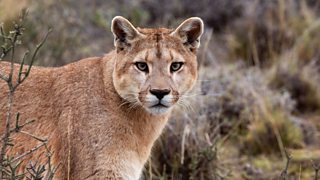
A female puma on the hunt in Torres del Paine, National Park, Chile.
In the southern tip of South America the Andes rise like bones from a carcass. The landscape in the Torres Del Paine national park is both severe and spectacular. Once you leave the single road it is not the easiest place for a film crew to get around but that is the challenge the team from the South America episode have set themselves.
Their goal is to film puma; the puma’s goal is to hunt and kill guanaco, a relative of the camel that, most notably, is two metres tall and at least three times the size of a puma. It is 'the continent’s most challenging prey', according to episode producer Chadden Hunter. Cameraman John Shier has been coming here for eight years. He’s never witnessed a successful puma hunt.
The team start early. A dawn of peach-pinks and purples with surreal lenticular clouds is startling but, as series producer Scott Alexander puts it: “The guys are so focussed on the pumas they don’t even notice the sunrise.”
“This,” says camera operator Bertie Gregory as he looks out to the 90 square kilometres of glacial blue that is Lake Sarmiento, “is puma paradise.” There are gulleys and caves in the sedimentary rock for resting, and then down by the lake layers of calcium deposits have created a natural nursery for young puma. At dawn the cats move as a family from their resting places by the lake to their hunting grounds in the plains and hills. This is when the team’s ace spotter, Diego, plans to pick them up and track them.
The easiest way to spot a puma, it turns out, is to ask Diego to spot one for you. He has been coming here for 15 years and has a preternatural ability to separate well-camouflaged big cats from bushes and tufts of grass. There is another way, he tells me: watch the herds of grazing guanaco. They see the puma first because if they don’t, they are dead.
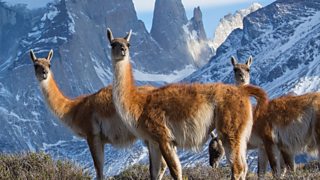
Guanaco in Torres del Paines, Chile
“You need to know where to hang out, read well the signs… And then be patient,” says Diego.
Much of wildlife photography is watching and waiting. As Seven Worlds, One Planet executive producer Jonny Keeling puts it: “To watch an animal and to try and work out what the animal is doing, when it's going to do it and anticipate that in a way that you can then film it… that is one of the greatest pleasures. It’s the ultimate in mindfulness: when you stand there, you're just watching and watching and listening.”
For several hours in the Torres Del Paine national park that is exactly what we are doing. I can’t see anything; Diego instantly points to a guanaco up on the ridge:
“Tranquillo,” he says. Which means there are no puma nearby.
Today, on location, patience is a necessity not only for the guanaco and puma but for the team too. One of the lead cars keeps overheating. It is the one with the Cineflex giro-stabilised camera mounted on the bonnet (so that the camera itself hangs at headlight height, tracking the animals at their eye-level so the viewer feels immersed in the hunt). But with the car overheating the metal rig holding the stabilised camera has become welded to the car’s bumper. So the Cineflex is out of action; we head out on foot.
Roberto, another of the ace spotters, catches sight of a female called Rupestra. She is down by the lake with her two cubs. Though a large part of the Seven Worlds, One Planet team’s task here is to film a puma hunting a guanaco, for natural history film-making these days merely photographing the kill is not enough. The sequence has to come with context and a story. In this case pumas are a good news story: Recent conservation efforts in the national park have provided the cats with a safe haven from hunting by humans. Numbers are increasing. But families of cats like Rupestra’s will only flourish if they can find food - this is why the guanaco hunt is still central to the story.
Down by the lake one of Rupestra’s cubs appears to be playing a game with the other. It is hiding down among the warren of calcium deposits, waiting for its sibling to amble by and then ambushing it. Bertie Gregory, the crew’s drone pilot, quickly unpacks his machine and sends it skywards with its quiet whine and peculiar tilted glide. Now the puma are on the move, skirting the shore. They head north towards the hills with Bertie’s drone following them in and out of the mata negra bushes. He controls the drone and its camera with two iPads and two remote controls, fingers and thumbs working in precise consort (he later admits to having honed his skills on Playstation). He tracks Rupestra and family for nearly 20 minutes, until he suddenly presses a single button and the drone returns home.
“The drones have a habit of choosing the worst times for a firmware update.”
We change batteries and walk another half mile to a new position. John Shier is way ahead in the distance - Shier is known as Robocop to the team. He works on foot, yomping all day through the shrubland with a heavy tripod and long lens film camera over his shoulder. He radios back to tell us about a herd of guanaco 70 strong and once again Bertie Gregory sends up the drone. Quickly he is able to film a tracking shot where the camera pulls back to frame the guanaco with the ‘torres’ of the torres del paine behind them - three vast granite peaks like rotten giant’s teeth.
“That,” says Gregory with his face glued to a viewfinder, “is one nuts backdrop.”
John Shier, meanwhile, has circled back down to the shore. There’s a single guanaco that has attracted Rupestra’s interest. She has laid down stock still by a bush. When the guanaco, still more than 100 metres away, puts its head down to eat, the puma creeps towards it, so slowly as to be barely moving at all. When the guanaco lifts its head, the puma stops. It is a game of grandmother’s footsteps, albeit one with fatal consequences - for both the guanaco and the puma with mouths to feed, a hunt could mean life or death.
John Shier radios Bertie Gregory. The drone is up within minutes, only 30 feet overhead, yet neither the guanaco nor the puma, senses on high alert, are disturbed. The stand-off continues, the puma approaching metre by metre, the crew all silent now, waiting and hoping. And then the guanaco raises its head, makes a strange guttural noise and skips off out of range.
“That’s the alarm call,” says producer Scott Alexander. “They’ve clocked Rupestra.”
So the hunt is off but the shoot goes on. The puma head back down to the lakeside and the mother instigates more play time. The cubs scrap over a bone, they bundle their mum, they play the ambush game again, and all the while John Shier films them at eye level while Bertie Gregory’s drone looks on from above. They shoot until the light runs out, because the family story is important too.
“Sometimes,” says producer Chadden Hunter back at the BBC Natural History Unit in Bristol, “there are animals that have been elusive or shy for so long because of human pressures. It's nice to find some stories where they've found a safe haven and they're feeling more relaxed.”
