
For my work as reporter for BBC News Urdu, I’ve met women whose individual stories have made an impression on me, stories that I’ve strived always to report faithfully and accurately to our audiences.
But today I want to bring you the story of “Asma” - someone who doesn’t really exist but through whom I want to tell you about the silence and whispers that surround women’s health in Pakistan. Through Asma, let me pull into a single thread the experiences of many, many Pakistani women, from youth to old age. Let me tell you the story of a womanhood in the 21st century.
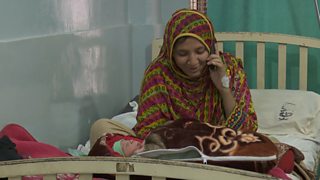
Asma is a girl of 13 in a village of 50-60 houses in Punjab. She has been lucky enough to grow up in one that has a washroom. It’s in that washroom one day that she sees blood oozing out of her – and she’s shocked. Something has happened to me, she whispers to her elder sister. Having ascertained the situation, the sister whispers back to her that it’s that period stuff. That’s how she comes to know about periods. She is perplexed and wonders: why did nobody warn her that this was going to happen to her? The silence and whispers about her womanhood, the taboos and stigmas about her physiological functions are to accompany her throughout her life.
Asma has awful menstrual pains - like someone kicking with full force on her lower belly, she says - but does she tell anyone? When she does, the response is that she’s behaving like a child and that every girl has to go through this valley of pain and have to bear these things. So Asma suffers on her own, she has to as this must be an inseparable part of being a woman. She’s told that she just needs to take some rest and she’ll be fine. And when her father or brother come back home, she should be as usual as they should not know what that silly thing happening to her is. She will hear these instructions in social propriety throughout her adolescence. As she is not married, she can’t seek a gynaecologist’s help. What will people in the village say if her mother takes her unmarried daughter to a gynaecologist?
Asma is in her twenties and she is getting married. The only talk is of fancy clothes, jewellery and the wedding party. Nobody has spoken with her about sex life and she has a vague idea of what to expect of her married life and what is expected of her. But when, three months into her marriage, she hasn’t conceived, this is everybody’s business and concern. Is her reproductive system good enough to produce babies, they whisper. She is not barren is she? Asma is told she needs to be taken to the doctors - but it’s village quacks she is seeing. If she is lucky, she might be seen by a gynecologist - or, again, by someone who is said to be one.
Asma is pregnant, and there is so much to learn and to prepare herself for - and she is told to eat a lot of desi ghee (butter) because it will help to deliver baby easily, and to eat for two people. They tell her to stay away from dates, dry fruit - and mangoes because they are garam (warm in nature).
During the birth, Asma has to undergo a C-section - how will she walk during the next few weeks? Can she climb stairs? What should she be eating, how should she restore her health? The womenfolk around her are advising her to eat fatty foods to restore her strength. And who will help her cope with her postpartum depression? She hasn’t even heard such a term. Nor has her partner - and he is hardly available for talking about these things in the first place: her husband isn’t even expected to be around her when she is in this state following the baby’s birth. When she shares her worries with her mother, she is told that she is lucky she has a baby now and she should be thankful to the Almighty!.. Blessed with a baby, and she is talking about this nonsense, her mother says.
Blessed she is - milk is dripping from Asma’s breasts, but her baby hasn’t latched yet, so all that stale milk in her breasts gives her fever. She’s lethargic and anxious that she can’t feed her baby - and there’s nobody to properly guide her.
More pregnancies? They need a boy - daughters are a burden and would-be dhiyaa'n dhann paraya, “property of the others”, as they say in Punjab. And just one boy? No, there should be at least a couple of them, they keep telling her. But they are not telling Asma much, if anything, about contraception methods - so she can't avoid unwanted pregnancies.
Throughout her life, Asma’s health is seen as not important - and she spends her life without talking about her health. Even when an opportunity presents itself, she is hesitant and often confused. She whispers, even in her mature age, when she talks about her menopausal body and female infirmities. Having a female medical condition for her is also a social stigma, and as such it further erodes her wellbeing...
The story of Asma could be the story of millions of women of Pakistan - particularly those from poor and lower-middle-class backgrounds. As they go through their womanhood, they face at least one of Asma’s challenges. And all these challenges are shrouded in silence or whispers. As I worked on the content that would help inform women on some of our health issues, I could see once again how the silence and taboos surrounding women’s health continue to exacerbate the difficulties women face throughout their lives, medical and social. I could see the urgent need to break the taboos and the silence, and bring the conversation into the open. And, importantly, the need to offer a reliable resource in their language, Urdu, for women who find themselves faced with issues hardly anyone will talk about.
I also saw that it was difficult to get them to talk to the BBC about these issues, share their feelings, experiences and pains - even those from urban middle to upper-middle classes are reticent. When conventional methods of trying to get these stories out all but failed, I joined some of the many closed social-media groups where Pakistani women feel safe enough to share their issues and seek advice. Even there most women got offended when I tried to inbox them with questions. And even when we found those who were willing to share their experiences, in most cases their husbands or wider families weren’t too happy and they withdrew consent. But I persevered, and eventually we connected with enough voices who, despite all these hurdles, were ready to engage in an open conversation. These Pakistani women have spoken to the BBC about their health issues, such as polycystic ovarian syndrome, C-section, postpartum depression, nursing - and shared their questions with millions of our users. To address them, we brought in experts with their advice and guidance.
It feels great to break the silence and to speak up. And it’s only the beginning.
