Aim High with BBC Northern Ireland and Northern Ireland Screen
Dominic Coyle
Assistant producer/ Director
Tagged with:
Applications are open for this year’s Aim High training scheme, a partnership between BBC Northern Ireland and Northern Ireland Screen. Here, former recruit, Dominic Coyle looks back on his participation in the scheme in 2011/12 and reflects on how the training helped him achieve his goal of directing and producing his own documentary.
In 2011 I was working various part-time jobs, supporting my ‘voluntary’ (re: unpaid) job as a musician. I had little previous media experience, apart from a short stint taking listener’s calls at BBC Radio Ulster. I really liked (and still do) speech radio and was hoping to find work in radio production.
I found out about the Aim High scheme through the newsletter sent out from the Careers section of the BBC website. All BBC trainee schemes are advertised here and it is well worth signing up to the mailing list. I was interested in the potential creative side of television production and so applied.
It was a fairly long application process with many stages, culminating in a ten day ‘bootcamp’ to select the final trainees. The bootcamp was an intense week and a half at BBC Wood Norton training centre. Whilst there, we were given many talks and several tasks to work on both individually and in groups. One task was to make a short documentary film using the basic filming/editing techniques we had learned. We also filmed an episode of a studio-based current affairs discussion programme, taking turns at working in various parts of the production (gallery/camera/floor managing etc.) These tasks were more about finding out how we worked under pressure and with others, rather than to simply see how much we alreadyknew about making television. There was a huge amount of pressure on at this competitive stage, but this was good grounding for the everyday challenges that occur in television production.
When I first got accepted onto the 18 month scheme in October 2011, I had no idea about which part of TV I wanted to work in, let alone the role I was best suited for. Aim High trainees could be placed in either a BBC Northern Ireland department (factual/current affairs/entertainment/radio) or in one of Northern Ireland’s several successful independent production companies.
I ended up working only for independent production companies during my time on Aim High, mainly making programmes commissioned for the BBC. My first two placements saw me working on the development of entertainment/game show formats. I really enjoyed the creative side of this role, and spent a lot of my time coming up with fun gameplay ideas. There were also drama/film placements available and some ended up working as trainee Assistant Directors/Sound Recordists on Game of Thrones and The Fall.
We formed a tight group on the course right from the start and I am still in contact with most of my fellow trainees, who are all continuing to develop their careers in various parts of the television and film industries. I currently work in the same BBC department as a fellow past ‘Aim High-er’. There have been moments where we have been working together on particularly exciting shoots and caught each other’s eye in disbelief, recognising the fun we’re having three years on from being fresh faced recruits.
The Aim High scheme is individually tailored for each trainee, and real thought from the scheme’s organisers is put into which placements would best suit each trainee. Training was mainly organised through NI Screen (BBC’s main partner in the scheme). We received frequent training in everything from story-telling to self-shooting camera courses. The scheme provides each trainee with a mentor. There were mentors from senior parts of both the BBC and the indie sector. My mentor was Dermot Lavery from Double Band Films, who gave me invaluable guidance on how to make the most of the Aim High scheme and beyond.
All of the trainees were quite worried about whether or not we would find work after finishing Aim High. We all did soon after the end of the scheme. I got my first TV job within BBC working on an observational documentary. I then went on to work on The One Show for the next 18 months (BBC NI has a small team making around 50 VTs for the show each year). Being a former Aim High trainee seemed to be well regarded, and thankfully the BBC were keen to help me progress with my development.
After one year as researcher on the show I was sent on a single camera directing course and was given a handful of films to produce and direct for The One Show as a trainee director. My first film was with Warwick Davis, taking him back to the home where he grew up. Warwick couldn’t have been a better person to work with on my first film – he was very funny and at ease and the finished piece turned out well.
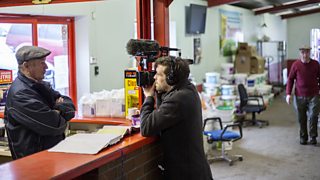
In February 2014, BBC Northern Ireland made a call for documentary ideas. I submitted an observational documentary idea which I had been thinking about for several years (before I had even worked at all in media) about life at Clogher Cattle Mart (one of NI’s largest cattle markets). I had already filmed a little with some of the potential characters and was able to show a taster tape to help get the idea fully commissioned. I spent the last three months of 2014 in the countryside among farmers and their cattle, self-shooting material which I then edited at the beginning of 2015.
The programme aired in April 2015 and, much to my relief, it went down very well with both the people of Clogher and within the BBC. This has been my proudest moment in my career so far - seeing an idea right through, producing and directing from beginning to end. It was just a little over two years ago that I was pushing to get my first researcher credit, and I think it’s completely thanks to the training and support provided by the Aim High scheme that I have been able to progress so quickly to producing and directing my own film.
Aim High is open to people of all ages and backgrounds, ensuring that the industry finds its new creative talent from the largest possible pool of people. These schemes recruit on a what you know, not who you know basis - the way it should be.
Those who are thinking of applying should look at the application now - don’t leave it in until the night before the deadline! I can’t recommend that enough. There’s quite a bit of thinking required and it’s well worth reading the questions and thinking for a day or two about how you could answer before typing anything. It’s worth writing a draft version of your responses and having someone else read through them to ensure your answers are clear, concise and are actually answering the question you have been asked.
Dominic Coyle, Assistant Producer and Director
- Watch Dominic's films To the highest bidder and Making a bullock
- Read the press release about Aim High
- Apply for the Aim Higher scheme (Deadline 24 July 2015)
