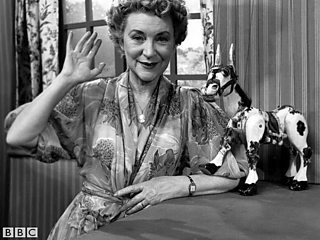
Hello Muffin! Annette Mills and Muffin The Mule wave at their loyal audience.
It's hard to believe that it's already ten years since the children's channels, CBeebies and CBBC launched: the first for pre-school, the second aimed at 6-13 year-olds. In marked contrast to other digital children's channels, they were free of advertising and largely British in content (90% and 70% respectively).
A useful moment perhaps to reflect back - to the first ever children's broadcast on the BBC, which came right at the very start of broadcasting itself. Just under 90 years on 5 December 1922, engineer A E Thompson (later called 'Uncle Thompson') made broadcast history when he presented a few minutes' entertainment 'just for children'. He told a story of Spick and Span, two dwarfs, and played a gramophone record called Dance of the Goblins. From that moment on, children's programming never left the BBC...
It's easy of course now to laugh at the many BBC 'Uncles' and 'Aunties' who popped up on air in the 20s/30s - they had great names such as Uncle Mac, Uncle Rex, Uncle Caractacus, Aunt Sophie - and their patrician tone. Easy too to mock the safe world the early radio programmes conjured up, with those memorable opening words: Are you sitting comfortably?
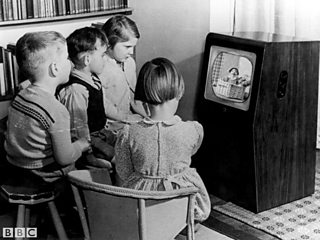
Children watching Andy Pandy
Later, TV gave us Muffin the Mule, and the unforgettable cast of Watch with Mother: Andy Pandy, Bill & Ben, The Woodentops etc. But all these programmes were based on a real desire to talk directly to its child audience, and to give them a small, safe broadcast island. In essence, no different to Children's broadcast aims today.
But behind the scenes in radio and later on TV, it was a bitter battle for children's airtime and funding. The current digital channels come at the end of that. Valiant champions - invariably women producers - fought for the importance of children's broadcasting both inside and outside the organisation. Many traditional voices castigated it: even as recently as 1991, Schools Minister Michael Fallon called BBC Children's programmes 'wicked, brazen and sinister'. To and fro went children's programmes in the 1950s and 60s: to Adult Programmes, to a Family Unit, and back to Children's TV again. And finally to where it is now, in one creative centre, defined, safeguarded and globally successful. Spick and Span, Muffin, Andy Pandy, Bill & Ben, would all, I think, be pleased and proud.
