
Whenever people talk to me about the licence fee I feel confident in pointing out what great value it is it is at £2.80 a week.
Compared to 20 years ago, when there were two televisions stations and five national radio stations, our audience today has got four times as much television, twice as many national radio services plus iPlayer, apps and a global web service.
It all shows doing more for less has clearly been a mantra at the BBC for a long time.
Back in 2010 the BBC’s settlement with Government brought about a six year licence fee freeze, at £145.50, and the Government allocated a significant portion of our funding elsewhere to national broadband roll-out, the World Service, S4C and local television.
This meant the BBC faces 26 per cent less in real-terms to spend on public service content than it otherwise would have by 2016/17. Our plan to cope with that change was to increasingly cut our annual costs so we were saving £700 million by 2017.
That plan, named Delivering Quality First, placed a particular emphasis on finding efficiency or recurring savings - ways of saving on costs on an ongoing basis. Two-thirds of the money would come from improving the way we work on a day to day basis, securing better deals when buying-in goods and services, cutting property running costs, reducing staff numbers and finding more efficient ways of working. A small increase in commercial income from BBC Worldwide was also projected. Then the remainder would come from reducing the scope of services such as shared evening programmes across local radio in England and changes to the BBC Two daytime schedule.
We have a good track record. Last week a group of influential MPs commended the BBC’s efficiency. Today we have been given our mid-term report card by the National Audit Office who have confirmed that our overall savings of £374m to the end of 2013-14 exceeded the projected milestone of £367m.
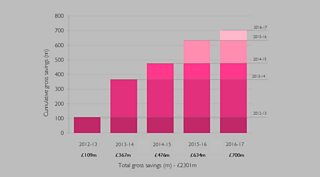
BBC savings bar chart
We have done this in large part by renegotiating existing contracts saving millions, working in fewer buildings, keeping headcount down and limiting salary increases. Public service broadcasting staff costs came down by 17 per cent in the first two years of the programme.
Proper financial tracking meant we were able to anticipate some time lags between implementation of projects and the fruition of savings. As a result we have already offset any differences through one off savings to ensure that our financial targets are still met in full. The evidence suggests that greater efficiency has not been at the expense of quality output. For us and our audiences that is essential.
That is why 91 per cent of the spending we control now goes on content, distribution and related support costs – exactly where the public wants to see it spent. The remainder goes on the professional support needed to run the BBC and we’ve cut that proportion by a quarter in the last four years.
Overall we expect cumulative savings across the whole Charter period to reach £1.5 billion a year. This is a significant sum as we have discretion over £3.2 billion of licence fee funding.
Yes, we still have more to deliver to meet our financial targets for the end of the Charter. The NAO is right to say that the remaining savings will be a “greater challenge” and the pressure on content and services will inevitably increase, but we are on track to meet our targets.
There are no major areas of spending that the BBC has not reviewed. We have saved more since the NAO completed its analysis. We are right on track to hit our targets for 2014-15 and have identified more opportunities to make savings. Applying our strategy of “compete or compare” – extending competition wherever possible and comparing what we do with the best practice in the market where it doesn’t – will help us find ways to reduce cost beyond 2017.
We have taken a step in that direction already by announcing the creation of BBC Studios – first within the public service but potentially in future, subject to discussion with the Trust and Government, becoming a wholly-owned subsidiary of the corporation - to produce bold programme-making at great value for money for you.
Since this Royal Charter began the number of people we reach has gone up, people’s trust has gone up, and your view of our quality has gone up, too.
So we know that the BBC of today is leaner, and I am confident we're ensuring we get great value from the licence fee. The challenge now is to keep on innovating and finding ways to do more with less to deliver the rest of the savings we need to make.
Anne Bulford is Managing Director, Finance and Operations
