
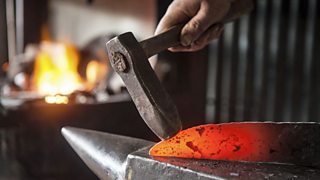
Metal. Part of the Handmade series broadcast in the BBC Four Goes Slow season
BBC Four has a special series of unhurried programmes airing this weekend. Amongst these unrushed TV shows are three 'Handmade' films. Director Ian Denyer explains how the programmes - Glass, Metal and Wood - were produced.
When the commission for Handmade was first discussed we knew it would be ground-breaking television, in part because the ground itself was old. These films would be a celebration of programme making in a way not attempted since the single-shot interludes seen on the BBC in the early days of TV in the 1950s.
The brief was brief: no words, no music, long, very long held shots. I added my own restrictions to this – no shot less than ten seconds, and no movement. On the first recces I investigated the possibilities of single shots lasting five minutes. Having grown up being constantly asked to move the camera more and cut faster, this was a joy. All the action would come to the frame. This was a chance to celebrate craft on both sides of the camera.
The soundscape - recorded on location - would be of paramount importance. Film sound recordist David Harcombe came on technical recces and opted for a Neumann stereo rig for most close-ups, augmented by cardiod plant microphones. The sound was the starting point for some shots - when Bladesmith Owen Bush first appears he moves around his forge yard between an array of microphones, but is also wearing radio mics inside his shirt and taped into his turn-ups to deliver the delicate crunching of boots through drifts of steel waste.
Under time pressure, most factual directors must concern themselves with performance and narrative, and leave much of the camerawork to the Director of Photography. In this case, having broken down the process, I was free to indulge my first love, which is composition, something I share with Director of Photography Andrew Muggleton. We’ve worked together for twenty years, frequently on film. Executive Producer Richard Bright and I agreed his painterly eye and minimalistic approach to lighting would allow us to shoot as far as possible by available light.
Shooting process - breaking down sequences into their constituent parts - is one of the best ways to learn how to make films. This job took all of us back to basics. The challenges were the sheer number of elements involved, the occasional need to telescope time without losing the thread of the process, and the need to help artists see their tasks, for the first time, as a series of movements rather than a single smooth action.
So much of what they did was instinctive. The worst of working with animals is that with the honourable exception of sheepdogs, they never do the same thing twice. These craftspeople always did the same thing, but without really knowing it. To watch it once was pretty much to know how to shoot it.
My hope for the series is that viewers will quickly overcome the desire for things to move on, that the absence of so much of what modern TV attention-grabbing – fast cuts, supportive music and voice-over – will be a relief. Just observing, hearing without actively listening, understanding by watching are passive activities we all enjoy in real life.
Now that I’m back to using all the usual tools, making Handmade seems like a holiday.
- The Handmade series is part of BBC Four Goes Slow, a selection of deliberately unrushed programmes giving audiences the chance to sit back, unwind and watch some very unhurried television.
- Handmade: Glass is on Monday 4th May, 9pm. Handmade: Metal is on Monday 4th May, 9:30pm. Handmade: Wood is on Weds 6th May, 8pm.
- For more information on the programmes in this series take a long look at the BBC Four website.
