
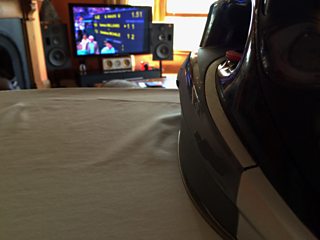
This week I have been following the Wimbledon Championships whilst tackling joyless household tasks, like ironing. Tennis distracts from the depressing inevitability and irretrievable dullness of everyday life.
My recent success confronting the childhood trauma that stopped me watching and enjoying football in adult life is now the talk of the office. People I’ve hitherto only nodded hello to sheepishly in the corridor now stop and talk. I feel drawn into the inevitable pre-meeting football-related small talk engaged in while we wait for meeting rooms to be vacated. And, thanks to a colleague, I now understand the offside rule. Breaking news: it’s nowhere near as difficult to understand as everyone makes out it is.
There is another unexpected consequence. 'Getting into the football' has reminded that I have, for a long time, quite enjoyed tennis and, having exposed myself to quite a lot of soccer over the past few weeks, that appreciation of tennis has deepened. I have become more entwined with the racquet game. I think I might be a bit obsessed by it.
I am a man transformed.
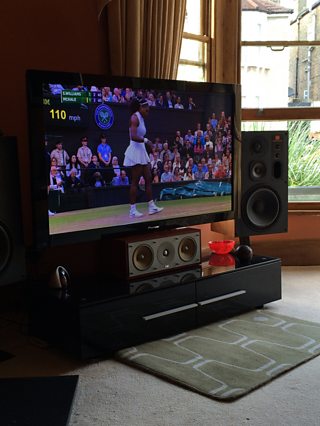
Wimbledon 2016 on our TV. Yes, it's big. Don't tell the other half, but I'd really be just as happy with just a radio.
Tennis is, for me, the easiest sporting endeavour to understand – two people locked in a battle of skill, agility, and stamina, hitting a ball about a court. It's a game subject to endlessly gratifying permutations, and one which can, at a moment’s notice, turn things on their head. Drama stitched into underlying personal narratives. Whilst there are procedures, stages, and a journey to follow - the structure appeals to the same side of my brain that appreciates left-hand justification, a well-chosen font, or chairs tidied away under a meeting room table. There are, at the same time, no certainties with a game of tennis. Nothing is assumed. Things can take a wholly unexpected turn at a moment’s notice. For those reasons tennis, I adore you.
The BBC introduced me to tennis, filling the void at that difficult in-between stage when children's TV was increasingly failing to meet my gangly teenagery needs. After-school on a Friday was an especially dead time while I kicked my heels waiting for West Suffolk Youth Wind Band rehearsals to start at 6.30pm. I wasn't alone. Principal flautist Caroline Lloynes - a contemporary of mine at school - faced a similar problem. Being one of those irritating kids at school who was good at music, her studies and sport, she had something to fill the gaping void before rehearsals - watching tennis on the TV. And seeing as my parents needed her parents to take me to Wind Band rehearsals, being introduced to tennis whilst round at Caroline’s house was, perhaps, inevitable.
The BBC might have been broadcasting events on TV, but it was Caroline who explained the rules in a clear and concise manner, worthy of the lawyer she told me she wanted to be in later life. I watched her kneel in front of the TV, all pony-tailed excitement. We watched some of a match together.
We were in a weird kind of trance watching that match. Until then, I'd always wanted the wait before Wind Band to race by. Being in somebody else’s home after school felt like an intrusion or an imposition. It wasn’t my home. I wanted the time to pass so that the painful squeaking, misplaced rhythms, and agonising teenage ambition would be over and my weekend proper could get underway. But, watching the tennis, I and Caroline sat in silence transfixed by the rallies; I actually wanted stretch out for as long as it possibly could.
Such is tennis's enduring appeal for me even now. Tennis promises summer will go on forever. Afternoons - normally a juggling act between available time, tasks which must be completed, and jobs which are far far easier to put off - can extend far longer than scheduled or even dreamt of.
My preference is radio commentary. And my preferred device is my iPhone. "I find it difficult to visualise every shot," says Simon, my partner, when he comes into the kitchen to find me slowly chopping onions, "I can't keep up with the commentary. Why don’t you watch it on TV? It’s a 52” screen for goodness sake. You can watch it in HD.” I tell him to keep the noise down.
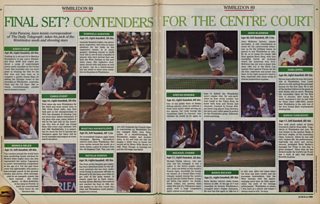
Wimbledon '89 previewed in the Radio Times (image from genome.ch.bbc.co.uk)
Simon overlooks two key things about radio commentary. First, the concentration required to follow the episodic progression of the match helps focus the mind when it needs to be employed in dull tasks. In that way the beauty of tennis, and in particular Wimbledon, distracts from the depressing inevitability and irretrievable dullness of everyday life.
Listening to tennis on the radio actually gets the jobs done which had previously been relegated* to the bottom of my to-do list. During Wimbledon fortnight, I’ve planned my summer of Proms concerts, ironed bed linen, watered the plants, and completed some long-overdue website updates. More breaking news: tennis gets results.
More importantly is the sense of place radio offers. With TV I'm watching other people at Wimbledon, wishing I was there myself. With radio commentary I imagine the commentators squeezed into their tiny commentary box, watching over proceedings, surrounded by all sorts of necessary paraphernalia. Radio commentary is as much about them in their box as it is about the players on the court. Radio put me in the box with them too.
I notice on day four, for example, when I’m doing some writing in my office at home, how I’ve arranged things on my desk. Everything is crammed on the small surface I sit at. There’s just enough elbow room for my hands to rest of the narrow keyboard. Every space around the laptop has been filled with things I don’t actually need. No matter. It’s as though I'm in my own commentary box. Radio's inherent intimacy prompts a similar approach to my immediate working area. I wouldn’t do that if I was watching on TV.
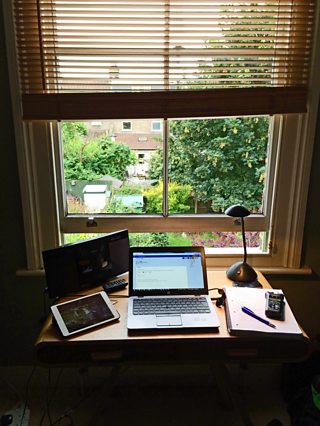
My own special commentary box in SE6.
From my desk, I can do the work I need to do whilst maintaining a close eye on my neighbour methodically watering her bedding plants. Give me a microphone and I’ll commentate my way through the entire scene. It will, inevitably, lack the drama you’d normally hear from SW1 but there will be peaks and troughs, and imaginary commentator pals will chime in from time to time.
Such is the spell that 5 Live’s tennis commentary cast over me, that I find I’m inseparable from my iPhone during People’s Sunday. iPlayer Radio is on all the time. I’m listening to it in the bath, in the kitchen, out in the garden, whilst using the toilet.
And it’s still blaring out from my pocket - the gripping Isner/Tsonga match in all its nail-biting tie-break joy - when I reluctantly answer the front door to another neighbour, Viv, at 4.30pm. “Didn’t want to interrupt,” she says looking slowly down towards my feet, “Just wanted to invite you and Simon to our party next Saturday.” I make the appropriate noises, smile appreciatively, and close the door. Then I look down to the floor and realise I’m still in my pyjamas.
This same week, I’ve visited Wimbledon for the first time. A friend offered me an unwanted ticket and I booked a day’s leave. I sat in Centre Court and watched proceedings play out in front of me, marvelling at the beautifully choreographed ballet of ball boys and military personnel, gripped by the energy and attitude of players on the court. Six hours later, I turn to Hannah and say, “I think I need to go now.” And what I’m thinking to myself is, “I think I’d really want to listen to this stuff on the radio.”

Wimbledon Centre Court, earlier this week.
It’s there I realise something rather obvious. Broadcasting has made tennis, and in this country Wimbledon, a popular sport in a way that, arguably, football didn’t need so much. Until broadcasting rocked up at SW1, tennis was loved by those who played it and those who paid for membership of a club. Wimbledon existed long before the BBC did, but the reason I derive so much pleasure from tennis now is because the BBC, and its broadcasting of it, brought tennis to me. In my world that makes tennis a broadcasting story as well as sporting one.
Sport isn’t quite so alien an experience as I first thought at the beginning of the Euros. It’s given me something else to think about. It’s helping me appreciate how sport is the ultimate kind of storytelling - the most compelling, and most gripping, unauthored, and unscripted, kind of tale. It promises a collective audience experience that classical music hints at, and it is something which connects me up with so many other people I never realised I needed to feel connected with.
I’m already planning the next post. It’s going to be about the cricket.
*I’m particularly impressed I’ve used this word.
Jon Jacob is Editor, About the BBC Blog
- Read an exclusive interview with Wimbledon reporter and commentator Annabel Croft.
- Wimbledon coverage continues on BBC One and BBC Two, BBC Radio 5 live, with live HD video streams available on the Red Button, online, mobile, desktop and on connected TVs.
- Follow @BBCSport and @BBCTennis on Twitter
