BBC Scotland's quirky approach to BBC Four's Alien Nation season
Marcus Herbert
Executive Producer, BBC Scotland
What does the word “Scotland” bring to mind?
Within parts of the BBC, the answer seems to be large glass structures. And a slightly quirky approach to science TV programmes.
The in-house team that makes most of BBC TV’s science output is based in London and Glasgow. Both parts of the team make all sorts of ambitious programmes for all the BBC’s channels. But if you want to film some strange science in a box, then BBC Scotland has become the go-to place.
It started two years ago, when we built a large glass box in Edinburgh Zoo, put a kitchen and garden inside, and watched it all rot. For two months. The result was a programme for BBC4 called After Life: The Strange Science of Decay, which lifted a rather smelly lid on the normally obscure subject of decomposition, and revealed it to be both essential to life and surprisingly beautiful.
It also gave us a TV version of the “difficult second album” problem. What else could we put in a glass box and watch for weeks? That might make good telly. The answer was ants. One million of them.
Anyone who has owned the sort of mini ant farms you can buy in the shops knows how fascinating these creatures can be. And full-size, natural ant colonies are true wonders of nature - huge, complex societies, able to achieve extraordinary feats of organisation. But being buried deep underground, they are also incredibly hard to film or study in the wild.
So we decided to build a full-size ant nest that we could see inside. The result was an elaborate construction of glass boxes (of course), tubes and tables, which went on display within the Glasgow Science Centre for a month last summer. To populate it, we brought in a colony of leaf-cutter ants from their native Trinidad. We chose leaf-cutters, because they display some of the most elaborate forms of social organisation – which is what we wanted to explore. They’re also considered a serious agricultural pest in countries like Trinidad, so we were actually re-housing a colony that was due to be destroyed.
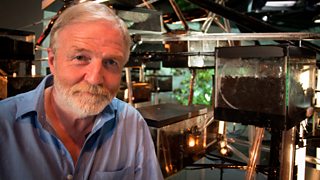
Dr George McGavin with the man-made leaf cutter ant colony.
As with After Life, we used the latest microscope cameras and time lapse photography to capture every aspect of the colony’s story. And we spoke to researchers in the UK and the US to see what ant behaviour can teach us about our own world. So (amongst much else) you can see how ants can help guide space probes in the resulting programme, Planet Ant: Life inside the colony, which opens BBC Four’s insect-focused Alien Nation season at 9pm on March 12.
Planet Ant is just one of three films that BBC Scotland has made for the season. And although Insect Dissection: How insects work and Metamorphosis: The science of change(as you can tell, they like really thorough titles on BBC Four) might not feature glass boxes, they are, I hope, just a little bit quirkier than average.
Insect Dissection is about ... er ... dissecting insects. Not on the face of it, the most obvious TV proposition. But seen in ultra close-up, insect anatomy is truly amazing, and is one reason why they are the most successful creatures on the planet. So we borrowed the anatomy museum at Glasgow University, brought in two entomologists – James Logan and Brendan Dunphy – gave them some scalpels and some bugs, and left them to it. Of course we didn’t – we spent a lot of time thinking about which insects would be most interesting to cut open, and how we could film in enough detail to show what they discovered. But one of the things we do try to do in science programmes (and other factual content as well) is to let experts share their knowledge in as direct and natural way as possible. Not always easy to achieve with the cameras and the lights and the rest of the baggage that TV brings. But watching James’s excitement as for the first time he dissected the stomach of a mosquito that was full of his own blood, was a moment when you felt TV had captured real professional passion.
Metamorphosis is quirky in a different way. It’s written and presented by David Malone, a programme maker who tries to bring wider perspectives to traditional science topics. The original idea of the programme was to reveal the process of metamorphosis – the frankly rather bizarre way that creatures like insects transform themselves from one form into something completely different, a caterpillar into a butterfly for example. But David takes this further, and explores how this idea of transformation has embedded itself within our culture, and asks whether we ourselves might be said to metamorphose.
None of these programmes had a particularly generous budget, so the quirky quality is partly a consequence of not being able to afford, on this occasion, the spectacular locations or graphics that characterise other sorts of science shows.
But making them has been a fascinating reminder that some of the best stories can be found close to home. Particularly inside glass boxes.
Marcus Herbert is Executive Producer, BBC Scotland.
