
When I was a young girl (long before I even dreamt of working for the BBC), my grandmother used to take me to a patisserie opposite Harrods and reminisce, over coffee and cakes she could barely afford, about her grand lifestyle in pre-war Berlin. She told me that there was a building, a mere two blocks from Checkpoint Charlie, just inside what was then East Germany, which rightly belonged to the family but was out of legal reach. She longed to recover it. I never thought I would one day try to fulfill her wish. When she died in 1977 she left no documents or proof that the building had ever once belonged to the family.
Many years later I was able to apply the skills I had honed, during my career at the BBC as an investigative journalist, to discover whether her stories were true.
I joined the Corporation in 1981 to work on the Radio 4 Checkpoint programme. Initially, as I came to the team from the Investors Chronicle, I was brought in to work on financial stories. Company law was such that villains were able to “Change the Name and Do the Same” i.e. run a scam under one limited company name, defraud the public, shut down the company and start up a new one doing exactly the same. I exposed quite a few such scams.
But it was not long before I was allowed to cover any topic that came in. Most stories originated from members of the public, as Checkpoint had a loyal fan base, but often we would be tipped off about stories by professionals such as trading standards officers, local council employees, tax officials and, yes, even the police.
It was pretty tough. Having doors slammed in my face, being sworn at on the telephone, posing as a prospective cosmetic surgery patient, finding myself locked inside a warehouse with a villain being sought by the authorities on fraud charges, winning hundreds of thousands of pounds compensation for the victim of medical negligence, and getting the case of a man imprisoned for arson and fraud back to the Court of Appeal where he was exonerated – these were typical of my work as a member of the Checkpoint team. At one point I even had a pack of Dobermans run at me in a remote Welsh hillside farmhouse when I turned up to ask about fraudulent hire purchase agreements on farm equipment.
Being a woman did not mean I didn’t get the dangerous assignments – but I was luckier than the men on the team. Some of them were punched but somehow, even the nastiest of villains never stooped so low as to attack me physically.
It is no exaggeration to say this was my dream job. I had been an avid fan of the programme for years. The editor had decided the office was too testosterone charged and he wanted a woman to join the all-male team. And I was that lucky woman. We travelled around Britain with presenter Roger Cook recording interviews and confronting crooks.
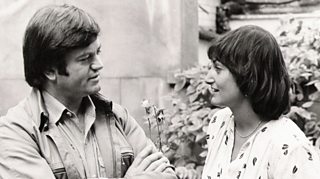
Dina with Checkpoint presenter Roger Cook
After three years in Broadcasting House, I joined BBC One’s Watchdog, first as a reporter and then a producer. It was more of the same, this time with pictures. Again, I learned never to underestimate the value of public feedback – ordinary people were our principal source. One of my contacts in a local trading standards office tipped me off about a firm of plumbers in south London seriously overcharging customers. It was off to see John Wilson, then head of Editorial Policy and the man who gave permission for secret recordings.
We put a hidden radio microphone on a cooperative plumber and sent him in for a training session as a would-be employee. We could barely believe our ears when, sitting in a car up the road, we heard the tutor tell the assembled plumbers “The customer is always wrong” and then go on to detail precisely how to overcharge.
One of the most fun stories of all involved an elderly woman whose much-loved mini had been stolen. We were tipped off that there had been a rash of car thefts in northern England and vehicles were being sold, along with forged log books, to unsuspecting purchasers many miles away. I managed to track down this lady’s car and the programme bought it for a song off the new owner. We invited the lady to the studio under the guise of wanting Nick Ross, who was then presenting the show, to pre record an interview with her about car thefts. As she sat being interviewed, I drove the car onto the set. She was totally overcome and began openly weeping.
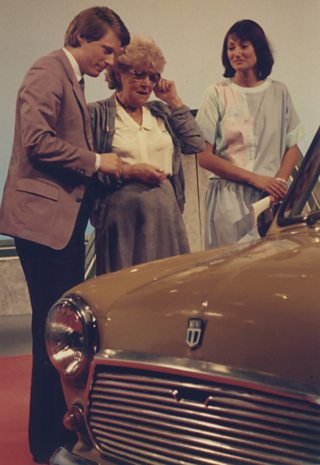
Nick Ross and Dina on the studio floor reuniting owner with her stolen mini
All this work involved examining company documents, persuading officials to divulge information, developing sources and being persistent. I learnt all the necessary tricks: for example that voting registers are public documents and can identify precisely who lives where.
Then, via The Money Programme, I arrived at News Events. I was sent off to Prague to cover the first free Czech elections since the war and not long after to Bonn for the newly unified German elections after the fall of Communism. David Dimbleby anchored from the studio while I was dispatched with Fred Emery covering the proceedings from the CDU headquarters.
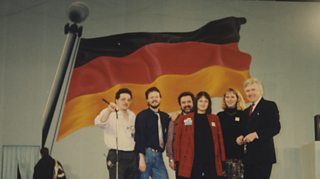
CDU Headquarters
We were broadcasting live inserts into the programme when Chancellor Helmut Kohl arrived triumphantly to greet his supporters. Back in the green room I sat chatting with former Prime Minister Jim Callaghan between his live contributions in the studio.
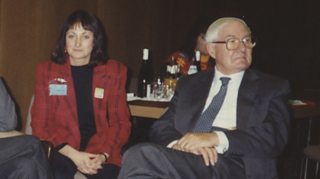
Dina with former Prime Minister Jim Callaghan
Next it was the Editorial Complaints Unit, where I was “poacher turned gamekeeper.” Now I was responding to allegations from the public of wrongdoing by the BBC.
In 2001 I was invited by the head of the Racial and Violent Crime Squad at New Scotland Yard to come on attachment for six months to advise on improved complaint handling. My BBC managers agreed - but fate intervened. I started just six days after the terror attacks of 9/11 and instead found myself setting up a hotline for distressed relatives of those affected and liaising with leaders of various communities, such as Afghans, that might come under revenge attacks.
I also spent a month at Hammersmith police station on Shepherds Bush Road because I wanted to experience first hand everyday police work on a borough. On one occasion, I was in the back of a police car responding to a 999 call as it raced down the wrong side of the Goldhawk Road with sirens blaring. Scary! My attachment to the Metropolitan Police was extended when I was asked by the head of the Directorate of Professional Standards, the unit that investigates allegations of wrongdoing by the police, to conduct a study on how their systems could be improved. My report was presented to the Metropolitan Police Authority.
After I moved on, I kept in contact with Chief Superintendent Anthony Wills, who was Borough Commander of Hammersmith and Fulham during my time at his station. One day he got in touch and asked me if I could help him. He was planning a ceremony in the Conference room in White City honoring the officers who had been on duty on the night of March 4, 2001 when a bomb, left by the Real IRA in a parked taxi, exploded outside TVC. Anthony wanted a "star" to present the awards. Peter Sissons was only too happy to oblige and gave a tremendous speech of thanks for the officers’ bravery, presented the certificates and posed for photos. Everyone was absolutely thrilled.
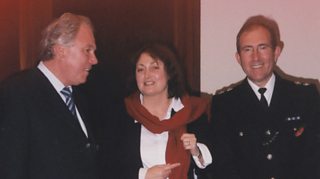
Peter Sissons (left) and Chief Superintendent Anthony Wills (right) with Dina at the Commendation Ceremony in November 2002
My year out completed, it was back to my former position in the Editorial Complaints Unit. If you were a programme-maker you probably didn’t want to hear from me, or one of my colleagues, as it almost always meant that a complaint had been received about some aspect of a broadcast.
In 2008 I emigrated to the USA as my husband, a former BBC News Trainee who had gone on to work for the Financial Times, was offered a job (and, crucially, a Green Card) at a Washington think-tank.
Finally I found the time to sit down and write a book about my grandmother’s stories – and the building she had always told me had been seized by the Nazis. After the Berlin Wall came down in 1989, I used all my training as an investigative journalist to dig deep into the archives in Germany and Britain and discovered the truth.
Dina Gold is a journalist and author and member of the BBC Alumni.
- Find out more about Dina’s book ‘Stolen Legacy: Nazi Theft and the Quest for Justice at Krausenstrasse 17/18, Berlin’
