
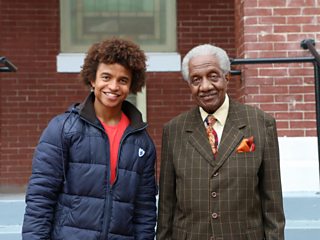
Radzi Chinyanganya and Reverend Fredrick Reese in 'The Walk that Changed the World'
In a special edition of Blue Peter broadcast on Thursday 31 March presenter Radzi Chinyanganya has retraced the path of the 50 mile walk, meeting the survivors of the 1965 march between Selma and Montgomery in Alabama, led by the Rev. Martin Luther King, Jr. We spoke to Radzi and assistant producer Andy Hassall about the project they worked on together.
What are we going to see in this special edition of Blue Peter? How did it come about Radzi?
The idea for this programme was something I pitched to the Blue Peter editor because it was really important to me. For those that don’t know, it’s the fifty first anniversary of the march from Selma to Montgomery this year. Last year I’d just seen the movie about the march (Selma) and remember thinking when I came out of the cinema that I couldn’t recall a single thing taught to me about black history other than my own endeavour and personal research.
When did you first hear about the march, Radzi?
I was aware of Martin Luther King around 10 or 11 years old when I started renting video documentaries about him from the library. I remember that, at the time, there was something about him which really resonated with me. But I didn’t know about the march until I saw the feature film about it last year. Until I saw that film I didn’t know about the challenges the participants faced on it.
What impact did Martin Luther King have on you as a kid and how did that change when you’d seen the film and made this episode?
Being from a mixed race background – my Dad is from Scotland, my Mum is from Zimbabwe – I’ve always felt viscerally aware of my identity. Am I white? Am I black? Where does that put me? Those questions about identity have always been an important part of my life? Some people care greatly, some people care to a lesser extent.
To find out about somebody who essentially dedicated his life to, more than just helping others, but making a sacrifice which would implement change so that people like him were equal – that was a really powerful discovery as a kid. Long before the waters of morality and complexity in society get muddied, kids get a real understanding of what’s right and what’s wrong. Martin Luther King was standing up to people who were wrong. I recognised that as a kid in the documentaries I was watching. I remember thinking ‘I like that man – that man is a hero’.
Then, when I saw the movie last year, I cried. It occurred to me that there were details about the march that I didn’t know. And if I didn’t know then there were lots of other people who didn’t know.
I said to the Editor that I wanted to do something to commemorate the march and my hero, Martin Luther King. The Editor agreed to it. I’d the idea of doing the walk myself, but that was pretty much it.
What happened next, Andy?
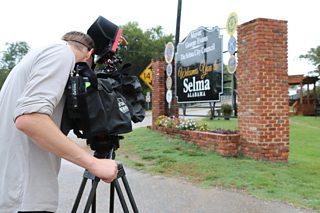
After we’d got the green light to make the programme, it was a case of lining up guests to speak to in the States. Next we had to draw up a script which explained quite a complicated issue to an audience of 6 to 12 years olds in such a way that they didn’t feel like they were at school. It had to be informative and entertaining. We didn’t want them to feel like they were watching a lesson.
Andy, what were the challenges you faced taking Radzi’s idea and turn it into something suitable for Blue Peter?
It was an unusual challenge. Quite often there’s a physical activity which is central to a film. Those things are naturally really entertaining. With this piece, the actual act wasn’t especially exciting – it was walking. The challenge was telling the story clearly, but doing so in an entertaining way.
Was there anything off-limits in terms of the detail?
Yes, there were three marches in total. One march got stopped in quite violent circumstances. The footage from that which was broadcast at the time, was really quite violent. One of the big decisions we had to make was just how much of that footage we would include. It’s a really fine line. It was violent. It was hard. That’s a huge part fo of the story. At the same time, you don’t want to show kids violent scenes – you can’t do that. Those scenes were off-limits. But we still had to describe it without showing the detail.
Our audience today – at any moment when they’re watching CBBC, there are demands made on their attention.
What do you think were the important elements in telling the story?
Radzi
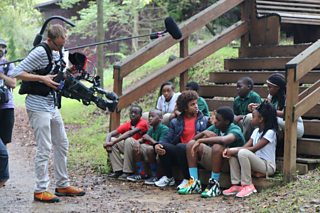
I’ll tell you what Andy did really well in that respect was in selecting the contributors for the programme. We spoke to one lady, for example – Sheyann Webb. She was 7 years old on the first of the three marches when it first happened. When she spoke in the film about her experiences as a child, that was really powerful. I remember thinking that Sheyann was the same age now that my Mum is, for example. That really resonated for me – it was as though my Mum could have been there. We spoke, as well, to local children in the area to find out what the march meant to them now. These contributors and the extract from a speech given by President Obama which we used in the opening sequence shows how we were always trying to link it back to what it is relevant for our audience. That’s what’s important when you’re telling this kind of story for a younger audience.
Andy
There were still elements to the story that were very Blue Peter. It was a 54 mile walk – that’s a physical challenge. There was camping along the way. It was the ideal challenge – the ideal moment to explain the civil rights movement. It was showing people doing a physical thing to help explain something that they believe passionately about. It was a physical challenge which went on to change the course of history.
What was different about this to other things, was that if we’re going to talk about something in a factual way we might try and insert light moments but, at the same time, we still had to treat it with great care. There might be nuances for specific audiences, but when you’re telling great stories it doesn’t matter how old you are.
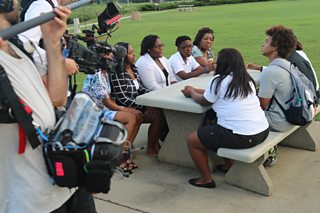
We met a lady called Louisa Miles. She cooked for the protestors as they were marching. In the film, she was cooking grits as she did on the march. All I was going to be doing was asking her questions, but during the interview she suddenly broke into song. When she did that I suddenly started crying. Even the cameraman apologised to me afterwards – he really didn’t have to. He said to me, “I’m sorry. I’m not sure I got all of that in focus. My tears were dropping onto the viewfinder.” It’s those powerful moments – unexpected and unplanned moments – which tell the story in a universal way.
How has making this programme changed you?
Radzi
It made me lighter, that’s for sure - I sweated a lot on the walk.
Seriously though, from my perspective, it’s the work I feel most proud of to date. It’s the work I know I’ll never forget making. I won’t need to be reminded that we made this. Every single thing about it I couldn’t be more proud of. It reinforced the narrative I already knew, of course, but it also reminded me about one of the most important things about making documentaries: that if you back a story and the story is strong enough it will make great TV.
Andy
It inspired me in many ways. Having the chance to speak to people recalling their memories from 50 years ago as though it happened yesterday was an amazing thing to experience. Those people are still willing to come out onto the road and speak to you about what happened. They’re people who are still working towards making things equal around the world. Congressman John Lewis - the last remaining leader of the civil rights movement – who led the march that day, he was brilliant. He was saying that the world has to keep changing, that the march was just the start of it and how us as individuals need to be more human with one another. I remember reflecting on that after filming and thinking ‘these are all still messages we need to apply today and, if we do, people can achieve some great things’.
Radzi
Hearing what Andy said reminds me of someone else who really had a big impact on me during the filming. I spoke to Reverend Reese – the reverend of the church at the epicentre of the struggle at that time. That was where they met before and after the marches, where the prayer happened and where the songs were sung. Speaking to him and looking into his eyes and thinking, ‘at one stage, the light going into their eyes was the light of history and it was their actions that changed history’. Those people are no different from me or you, other than the fact that at one stage they decided to take a stand. That’s what I will remember. That’s what I will take with me.
This blog post is a transcription of a conversation between Radzi Chinyanganya, Andy Hassall and Jon Jacob on Wednesday 23 March 2016.
- Blue Peter: The Walk That Changed The World is on Thursday 31 March 2016 on CBBC
