No. 10, Big Tree Wharf and the BBC Symphony Orchestra

Jon Jacob
Editor, About the BBC Blog
Tagged with:
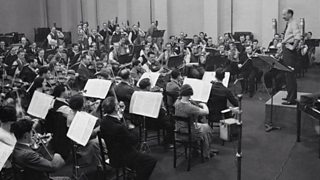
BBC Symphony Orchestra rehearsing with conductor Adrian Boult in ‘No.10’ their new studio on the south bank of the Thames at Big Tree Wharf
It’s 85 years since the BBC Symphony Orchestra began life and, its first ever broadcast on the BBC. The new orchestra was staffed by musicians discovered from across the UK – a first for the UK orchestral scene. We document the orchestra’s first concert and its first home in south London.
The Radio Times lists the first broadcast of the BBC Symphony Orchestra given on 22 October 1930 at the Queen’s Hall (now the site of the BBC’s former office Henry Wood House).
In an article which was later used in BBC Symphony Orchestra concert programmes in late-1930, the BBC declared:
“It is the aim of the BBC that this orchestra should set a standard for English orchestral playing, and should bear comparison with the finest orchestras in the world. With this object in view, not only have the best players obtainable been secured for the principal positions, but the choice of every rank-and-file player has been most carefully considered.”
W.J. Turner introduced the newly formed orchestra in the 14 October edition of the magazine.
“At the Promenades we have had a foretaste of what the BBC’s new permanent orchestra can do. It’s true that at these concerts only about ninety out of the hundred and fourteen players have been taking part, but the new orchestra on the old Promenade orchestra, and musicians may already congratulate the BBC on possessing now a magnificent body of players from whom one may expect excellent things.”
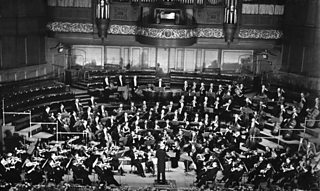
Of the orchestra’s new season, Turner commented:
“The programmes are very well blended, and are, as a rule, not too long. This last is a great merit, for, as a great musician has remarked, music is not to be consumed, but experienced … to listen properly, with due concentration and attention, to music is really tiring.
An hour and three-quarters of intensive listening to exacting music is about as much as most people can manage. After that the attention is apt to wander, and then both playing and listening can become a mere waste of time.”
The opening concert featured Ravel’s Fragments Symphoniques, a suite from the composer’s ballet Daphnis et Chloe which had premiered 18 years before. The programme also included Wagner’s Flying Dutchman Overture, the Saint-Saens Cello Concerto, and Brahms’s fourth Symphony.
Of the concert, the Daily Mail reviewer wrote on 23 October, “So far as the sheer physical quality of the sound is concerned, the reputation of the new BBC Symphony Orchestra was made so soon as it had played the National Anthem at the beginning of last night’s concert at Queen’s Hall.” The Daily Express had this to say: “If the BBC Orchestra continue as they have begun, we should have a combination second to none in Europe.”
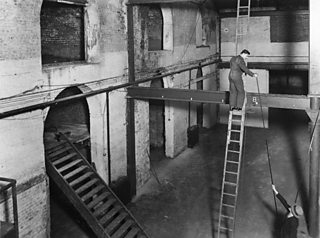
Big Tree Wharf under renovation, soon to be the home of the new BBC Symphony Orchestra
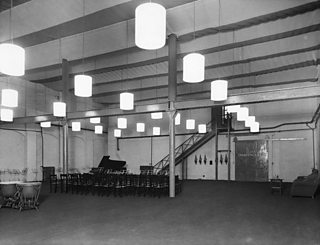
The orchestra’s new rehearsal venue also doubled up as a dedicated studio for the band. ‘Big Tree Wharf’ situated back from the Thames close to Waterloo station, accessed via a dingy alleyway. It was a vast space, suitable to accommodate the orchestra’s 114 players. The orchestra began using the ‘rudimentary’ premises after a month of renovations. According to the Radio Times that week, ‘No.10’ was, “the largest studio in the world”, with 4,600 square feet of ‘emerald green carpet’ and ‘primrose walls 30 feet high’
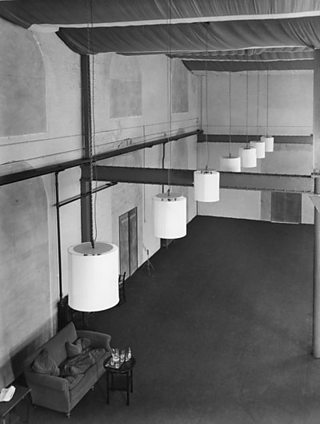
Former Radio 3 Controller Nicholas Kenyon shared anecdotes of rats scurrying up and down the stairs down to the studio which often caught the attention of alarmed players during rehearsals and “a big cloth draped from the ceiling about 20 feet from the ground” contributing to the good acoustics. An on-site strong room provided secure storage for the brass players’ instruments, something of a surprise to a policeman in the area who was reported: “Many a time’s that roof been stripped of lead. They’ll have to be careful of their brass.” It was here that Schonberg, Webern, Stravinsky, Richard Strauss and Bruno Walter visited, rehearsing and performing with the orchestra. According to Kenyon, “No.10 is remembered with much affection.”
The BBC Symphony Orchestra began a long series of Sunday evening concerts the following weekend which ran until June the following year. The series was advertised as including,
“… much of the best-loved orchestral music in the world, music which is so often heard that only its own intrinsic beauty keeps it from any fear of growing stale. And if some names appear, of which the simple-hearted listener is still a little shy, there is no cause for alarm; only such new works will be included as have proved already that they are liked on their own merits.”
Jon Jacob is Editor, About the BBC Blog
- The BBC Symphony Orchestra’s 2015/16 season is currently underway, tickets can be booked via the orchestra’s website. The next concert at the Barbican Concert Hall is on Wednesday 21 October.
- Listen to clips of the Orchestra online
- Find out more about the BBC Symphony Orchestra on the BBC Music website
