BBC Radio 4's 'We British: An Epic in Poetry'' on National Poetry Day
James Cook
Arts and Poetry Editor, BBC Radio 4
Tagged with:
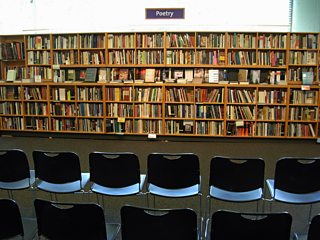
'Waiting for a poetry reading in a Washington bookstore' taken and published by J Brew on Flickr.
Arts and Poetry Editor James Cook introduces Radio 4's contribution to National Poetry Day later this week.
I know lots of people don’t like poetry (or at least find it boring, confusing, a bit serious and occasionally terrible) but I implore you to stay with me. Poets are warm and funny, rude and angry, scared, lustful, political, annoyed, quizzical, devout, profane – in others words they are a bit like us.
I’m the Arts and Poetry Editor at Radio 4, I look after a small (but perfectly formed) poetry unit in Bristol and, unsurprisingly, I’ve always loved poems. I like the way poems hang around and in my head (scraps of lines never whole ones), beguiling me with their beauty or the way some person, across 400 years or more, seems to know exactly how I feel.
And I’ve always thought that poems could tell the story of Britain – from the earliest verses written on these islands to the latest. A different story to the one we’re taught in school, more intimate, funnier, with more gossip, more honesty and in many more voices.
When I said all this to my commissioning editor, Tony Phillips, I didn’t really expect him to take it seriously. But, he did. And so here I am staring at an enormous whiteboard covered in post it notes with ten days go until we’re on air. I’m four fifths excited and one fifth terrified which feels about right.
So what are we doing? Well, over six hours on Radio 4 we’re going to tell the story of Britain in poems – from the 700s to the present day. Andrew Marr is presenting and we’re going to weave in and out of the Radio 4 schedule like a gossipy, sinewy river of words, kicking off a huge pan-BBC season of poetry called Contains Strong Language.
We British preview: The specially-crafted 'Frankenpoem' . How many famous poems do you recognise?
But which poems, whose poems and, firstly, why poems?
Because poems reveal a history of human experience, they tell us what it was like to be alive in Tudor England or Victorian Scotland. They are good documents to an age because poets admit things that other people do not. They say things anew and are often on the cusp of new ways of thinking, new emotions, experimental ways of living. So poetry tells a uniquely intimate history.
But poetry is also the place where we laid down the first stirrings of our national identities, of the really big stories we tell ourselves about Scotland and England, Ireland and Wales.
The challenge is immense – trying to find a way of telling this story that is fair to all the poetic brilliance of our history; that feels like a collective story and yet accounts for the huge diversity in this country both past and present. There’s so much good stuff we’re going to leave out; so many voices that we cannot include. But we’ve made a big declaration so we’ve got to find a way to tell it.
One way to do this, a brilliant way, is to ask Andrew Marr whose grasp of history is profound and passion for poetry immense.
As a result, Andrew and a team of brilliant producers and I have been saying things like ‘but if we have the Rossetti we can’t have the Tennyson’, horse-trading our literary history for the sake of a good story. And it really is a good story; it’s the collective experience of the people who have lived on these islands – of war, invasion, religious change, science and innovation, empire and trade, oppression and class, And the poets have been there all along, writing, chronicling, confessing and describing.
I hope you can join us on the day.
James Cook is Arts and Poetry Editor, Radio 4
- We British: An Epic In Poetry is on National Poetry Day throughout Thursday 8th October starting with Foundation Stones presented by Andrew Marr at 9.00am.
- Poet Murray Lachlan-Young will present The People's Shipping Forecast using submissions made by listeners via Twitter, Facebook and email on Thursday 8 October. For more information on how to take part, visit the Radio 4 website.
The picture at the top of this post was taken and published by J Brew on Flickr. We've used it in accordance with the Creative Commons Licence.
