BBC Radio Christmas Appeal with St Martin-in-the-Fields

Kate Howells
Radio 4 Producer
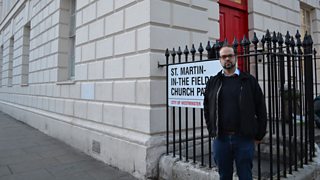
Connection outreach worker, Barry
The church of St Martin-in-the-Fields on Trafalgar Square has a long history of welcoming and supporting homeless people. A BBC Radio Christmas Appeal with St Martin-in-the-Fields to help fund this work is almost as old as the BBC itself – it first appeared in the Radio Times in 1927, so the collaboration is now in its 91st year.
One of the great things about my job as Producer of Radio 4 Appeals is being the Producer of the Radio side of the Christmas Appeal. I work closely with St Martin’s to share with listeners the personal stories behind the work they do.
At the Connection, the day and night centre in the building right next to the Church of St Martins, the aim is get to the root of what made people homeless in the first place. It may start with warm food and a machine to wash your clothes in the basement, and go through one-to-one assessments, housing advice, addiction support, creative and therapeutic groups, skills training, volunteering opportunities, and help with job applications and interviews.
Often the first contact a homeless person has with the Connection is with an outreach worker like Barry, who explains here what a typical night shift is like, helping some of London’s most vulnerable rough sleepers.
Kate Howells is Producer, Radio 4 Appeals
An interview with Stuart (pictured on the right): Stuart is a drummer whose life spiralled out of control when he lapsed into heroin addiction. He was living on the streets for three months before he was referred by an outreach worker from the Connection to the emergency night shelter to give him a place to rest and sort himself out. He is pictured with Paul, Night Centre Manager (The Connection).
Barry's experience as a Street Outreach Worker
I am a Street Outreach worker. I walk along the streets of Westminster, stopping to talk to homeless people who are sleeping in doorways and on the pavements, and in the alleyways behind buildings. There is no such thing as an average day, or “shift” and we work early in the morning and also very late at night.
There is a very different rhythm and lilt of life late at night in the capital. Once the shops are closed and the last of the revellers are on their way home, the streets, theatres, Cathedrals, and Palaces seem far more bleak and isolated places to be.
To give an example, these are just three of the people who we encountered on a recent night shift through the city:
Joe is 44. He’s sleeping in a doorway under a plastic sheet on a busy shopping street in the West End. He feels safer out in public view, although he is unlikely to sleep much. He tells us that he has experienced mental health problems for most of his adult life, and this led to a marital breakdown and him rough sleeping. Joe is reluctant to access a daycentre or a hostel bed, owing to the auditory hallucinations he is having, which he describes as “voices”, telling him the world is ending imminently.
Ellie is 25 and recently arrived from Liverpool. We are worried about her as she is regularly seen in a sleeping bag out in the rain, with nothing more than cardboard boxes between her and the pavement. She doesn’t want to disclose much information, but we will keep returning to talk to her, and to establish what has happened to encourage her into some temporary housing, however long this takes.
Piotr is 37 and he was initially resistant to engaging with any Street Outreach services, and seemed to be intoxicated on several occasions. The people we encounter can often be distrustful of services, as they have felt let down in the past. Our role is to get to know people, what has brought them here, and initiate a working relationship, so that they start to understand that we’re here to help. In Piotr’s case, he has now opened up to us, after many weeks of stopping in the street to talk to him. He told us that he came to the UK to work last year, only to find himself working 12 hours a day for less than £2 an hour on a building site. He was threatened and locked into a cellar room with minimal food every night until he escaped, and was found by us hiding in central London. He is now being supported to return home to his family.
For these people, and so many others, we work towards a route off the streets through The Connection’s services. We’ll find emergency accommodation and longer term housing, as well as access to healthcare, support for enduring mental health problems, and the treatment and counselling to recover from dependencies on alcohol or drugs.
We often hear that homelessness is self-inflicted. That is a matter of opinion, but from my own experience of over 20 years, the reality is far more complex. There are vulnerable people from across the world, for whom one thing, or a series of things have gone catastrophically wrong, leading to them sleeping rough on the streets of London. I am motivated to go to work every day because if we can help even a single person off the streets, then it is a job worth doing.
An interview with Dorothee (pictured on the left) . Dorothee had been working as a school cleaner but wasn’t able to get enough hours work to pay rent in London. She was living on the streets for over three years when a street outreach worker from the Connection encouraged her to come in to the centre. The violence Dorothee encountered on the streets left her traumatised and completely destroyed her trust in people. Dorothee is pictured with Cordelia, Deputy Manager Employment, Training and Education (at the Connection).
The Radio 4 Christmas Appeal funds 25% of the vital work done by The Connection at St Martin's in central London, and 100% of the emergency grants given by the Vicars Relief fund to help people around the country get a safe place to live.
