Women on the front line of rising audience figures for BBC News Uzbek in Afghanistan

Diloram Ibrahimova
BBC News Uzbek TV Editor
Tagged with:
Audience figures for BBC News Uzbek exceeded all expectations this year, with our new Monday to Friday television bulletin reaching an audience of 1.8m.
It is aimed at the sizeable Uzbek minority in Afghanistan, and launched on Mazar-e-Sharif-based Arezo TV last September as well as streaming on our own digital platforms.
The service is run by a team of four, including presenters Firuz Rahimi and Luiza Iskandariy, and based in London and Afghanistan.
Responses have been positive to the 10-minute broadcast: “I like it because I don’t understand other languages very well. It also provides the latest updates about my country and the world,” wrote one viewer. Another said: "Long live the national unity of the noble tribes of this land. End all the tribal and linguistic ignorance.” In Afghanistan, linguistic and ethnic issues are highly sensitive, and we have also received messages of support written in Pashto and Dari, demonstrating the service’s appeal beyond only Uzbek speakers in the country.
With any topic we cover, be it about thousands of Uzbek families displaced internally in the northern areas or the continuing violence and its human cost, our journalists make sure we also show these events through women’s eyes and give prominence to strong female characters.
One such story was a day in the life of Afghanistan’s first female district governor. Soyra Saddot is the Governor of Fayzabad, a district in the volatile Jawzjan province on the front line with the Taliban and so-called Islamic State. Our audience witnessed her daily routine, inspecting troops, negotiating with field commanders, checking on a school’s construction and encouraging youngsters to pursue their education.
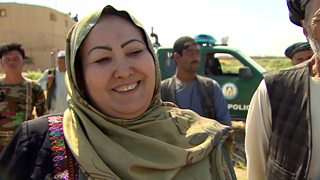
Soyra Saddot, Governor of Fayzabad
We’ve also highlighted another heroine, the only Afghan Uzbek policewoman who works in the remote town of Darzab in northern Afghanistan. Lateefa Yadgar showed viewers how she fearlessly defies the Taliban and IS by continuing to police the area despite threats from militants. Viewers praised Lateefa’s bravery and determination, with one stating that her courage is worth that of 40 men.
Wherever possible, we add the female angle to our reports. For example, in reporting about an Uzbek restaurant in Mazar-e-Sharif we included a veiled woman who said that she often invites her guests to eat out there, rather than cooking for them at home - this is considerably out of the ordinary in Afghanistan.
While featuring veiled women in our television reports, sometimes we have to go further and disguise identities entirely, to protect their safety.
‘Hadicha’, a pseudonym, was the subject of a story about female drug addiction in Afghanistan. Of the country’s two and half million adult drug users, a million are women. Firuz Rahimi talked to Hadicha in a special family clinic for drug addicts, where women are treated alongside their children. The story of Hadicha, who was encouraged to take drugs by her in-laws and has been an addict for more than 20 years, focused on the plight of affected women and their children.
Narcovillage, a feature by our Kabul-based Uzbek reporter Fazel Yalghuz, was about a small community in Takhar province where 90 residents have been executed in Iran for drug-related offences. Central to the narrative was a mother whose two sons were hanged while a third awaited execution in Iran for drug trafficking. The grieving mother lamented that the villagers had to buy back from the Iranian authorities the bodies of their loved ones so that they could be buried in their homeland.
However, it’s not all about war and heartbreak - there are lighter stories in Afghanistan. We showed a video report about chess lovers in Mazar-e-Sharif, who meet weekly in a makeshift club. For the members, chess is a way to forget the troubles around them. The story was syndicated to many other BBC bulletins around the world.
In our coverage of social topics, we show women who rely on their own strength and start businesses to support their families. One of many such stories is about a group of local female entrepreneurs who set up a street bakery chain in Balkh.
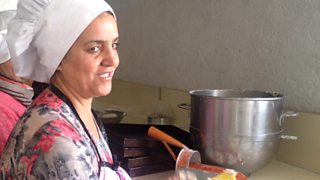
Women entrepreneurs have established a chain of street bakeries in Balkh
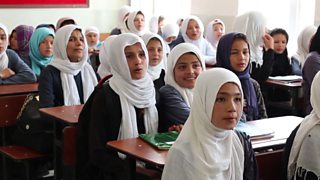
Uzbeks are among some ethnic minorities that still can’t study in their own language at primary schools. Our story about a girls’ school in a remote village featured determined Uzbek girls, eager for their education.
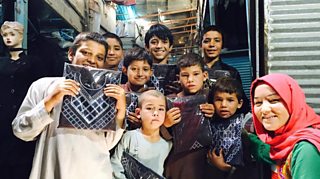
We also tell our younger viewers about their peers from around the globe and bring them inspiring success stories of Afghan Uzbeks, for example a student from Boston University, Ayrukhsh Fayz, who set up the Eidana charity for street children in Mazar-e-Sharif (see image below).
Our next ambition is to extend our current format to half an hour, with two supplements for women and young people, as part of the BBC’s World 2020 strategy to better engage with our audiences.