Friendly Radio: Five lesser known facts about BBC Local Radio

Gareth Roberts
Head of Local Radio Development
Tagged with:
Ahead of BBC Local Radio's 50th anniversary on November the 8th, I've spent quite a bit of time recently contacting editors, presenters and colleagues at all of our 39 stations to find out more about the local radio story. We’ve collected some incredible tales and also compiled a list of the very familiar radio and TV names who began their careers at local radio stations across the country from Carlisle to the Channel Islands. To spread the word we’ll be producing a couple of short films and we also commissioned a one hour radio documentary Friendly Radio which aired on BBC Local Radio stations Sunday 5th November.
But as a taster - here are five things I’ve learnt about BBC local radio recently.
Local radio is the place so where so many household names started.
For the 50th Anniversary we wanted to compile a list of household names who had started out on BBC Local Radio. We set out thinking we had to get at least 20 to make it worthwhile but in fact very quickly we had over 80 names. The 'stars' include Jeremy Paxman, Kate Adie, Richard Bacon, Jo Whiley and Clive Myrie.
The list also highlights a really broad range of talent, from comedians Chris Morris and Victor Lewis Smith to leading journalists Laura Kuenssberg and Liz Mckean, all of them had their first on air moments at a local radio station. I am sure there are many more than 80, but we’ve got the list down to 50 for a special anniversary film 50 at 50.
'50 at 50' 50 stars who began their careers on BBC Local Radio
Local radio quickly found its place in a local emergency.
These days our listeners expect our stations to be there when there’s a local crisis - when the snow falls or the roads shut, people know local radio will have the info they need. Back in the 60s this was all new. Our first station on air was Radio Leicester and early on in its history it covered the great flood of 1968 when over 500 houses in the city were left underwater, the service was a new local lifeline from the BBC. Similarly a severe snowstorm in December 1967 forced the manager at Radio Brighton to put the station on air two months earlier than planned.
Local radio pioneered the open plan radio office
Coming from commercial radio where programming, sales and news all tended to work in different offices I was struck by how BBC Local Radio stations are usually situated in one large office with everyone from news to programmes and often (though not always) the editor all sat together. Of course open plan offices are standard these days across the industry but I discovered local radio was an early adopter. John Musgrave who opened Radio Blackburn in 1970 housed the station in a used car showroom. This meant the production area was a vast open plan space, so all the production teams had to talk to one another, and thus the idea of sharing content was born, moving towards sequence programmes.
Local radio has always had to innovate
Our stations led the way in the use of radio cars across the BBC, although they were available to network and nations it was local stations that really discovered their value in getting us out of the studio and into the communities we serve.
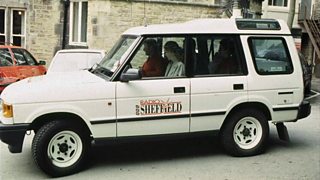
BBC Radio Sheffield's car in 1998
The use of completely 'self-op' radio studios in the BBC was also largely driven through local radio and presenters have been battling with levels ever since.
Even the early local radio jingles were ground breaking. Delia Derbyshire from the BBC Radiophonic workshop, probably best known for creating the Doctor Who theme, was commissioned to create distinctively local sonic logos for our earliest stations. Steel knives and forks were used for Radio Sheffield’s music, pots and dishes for Radio Stoke and in an interesting digital reference to Robin Hood, an electronic bow and arrow featured on the station sound for Radio Nottingham. It certainly sounded different.
Local radio has always had to improvise
Local radio marketing budgets have always been tight, so editors have often found creative ways to get noticed. My favourite example is from Phil Sidey, the first station manager at Radio Leeds, he had a feud with the Yorkshire Post, who refused to write about the station. So he bought a greyhound, called it Radio Leeds, and when it won at races, the papers had to print the name.
Gareth Roberts is Editor BBC Coventry and Warwickshire and Head of Local Radio Development.
- Find your local station.
- Listen to 'Friendly Radio', a one hour documentary about the history of BBC Local Radio.
- Find out more about the history of BBC Local Radio.
