#UnseenKashmir: To Srinagar, with love, from Delhi – and back, also with love

Divya Arya
Women Affairs journalist, BBC World Service
Tagged with:
Divya Arya, the Women Affairs journalist for BBC World Service, gives the background to the letters from the BBC’s “Kashmir – the unseen and unheard” series which ran on BBC World Service English, BBC Hindi, BBC Tamil and BBC Urdu (#UnseenKashmir).
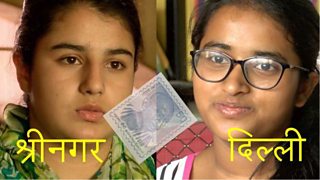
Duaa and Saumya had never met or spoken to each other before.
15-year-old Duaa lives in Srinagar. Saumya, 16, born and bred in Delhi, had never been in Kashmir, nor had any friend who was from there.
I was the only link they had. A journalist knocking at their doors, asking them to become pen-pals and write ten letters to each other. Urging them to refrain from looking each other up on social media, and communicating only via letters.
As part of the BBC’s Kashmir – the unseen and unheard series that focused on understanding the conflict there through the eyes of young people, I was hoping to find, through them, answers to an adult’s questions in an intimate but considered teenage conversation. What is life like for a young girl growing up in one of the most militarised zones in the world - Kashmir? And how different or similar is it to that of a girl living in India’s capital Delhi?
Duaa began with a ‘warm salaam from a place called jannat [paradise] on earth’, descriptions of ‘chil-e-kalan’ (the harshest period of their winter) and the experience of being in seven-feet deep snow in Gulmarg – the town known for its skiing slopes.
Despite geographical distance and difference, common grounds emerged in these very first letters. Both girls lived in nuclear families and were fond of the same western music bands.
But the outward bonhomie had undercurrents informed by where they lived and what they had been told over the years about the other side. I was witnessing a mix of innocence and ignorance as questions flew back and forth.
Saumya wanted to know if only Muslims lived in Kashmir. Duaa responded with claims of communal harmony among Kashmiris of different religions, laced with couplets in Urdu and examples of people helping each other across faiths. She had felt like she was her people’s ambassador, she would later tell me.
As weeks went by, curiosity would only get deeper and the questions sharper. Buried in between conversations around picnics and summer holidays, Saumya wanted to know about the girls who pelt stones, and the security forces that were meant to protect them but instead ‘fired’ at them.
Duaa would never skirt any question. She’d tell stories in her letters, urging Saumya to put herself in Duaa’s shoes to find the answers she was seeking. I saw a surprising boldness which did not push them away but brought them closer.
Saumya shared her fears about threats of sexual violence in Delhi. She wrote that ‘girls in Delhi do keep some things with them for self-defence but even then they are harassed’.
But then the letters got delayed. There were reports of violence, of a historically low turnout at elections in the State, of a man tied to a jeep and used as a human shield by the army. Anger erupted. Schools were closed. A ban on internet and social media in the valley followed.
As the heat of the summer intensified, a cold dread crept up my spine. Would Duaa stop writing?
But she did not. And Saumya became acutely aware of what ‘shutdowns’ and ‘bans’ really meant. She wrote, ‘one can’t even imagine life without internet’ and then simply asked, ‘don’t you get tired of all this? Don’t you want to study in some other part of India?’
A week later, came Duaa’s eloquent reply, ‘we have become habitual to all this, and when something becomes a habit, you don’t tire of it’.
She was also scared: ‘I don’t want to study elsewhere in India, as students have been thrown out of the college in the dead of night just for being Kashmiris.’
Silence, distance and probably the nature of writing on paper, opened up a rare scope for empathy between them. But even that got tested when Saumya asked Duaa what Kashmiris meant when they asked for ‘azaadi’.
‘Freedom from cruelty of the world, freedom from indiscrimination, freedom from the people who think that we are inferior to them’, Duaa responded.
I heaved a sigh of relief. That was neither an easy question to ask, nor one simple to answer.
And then there was more.
‘I was hesitant to ask you about the freedom of Kashmir but I couldn’t hide my curiosity and I really liked your reply,’ wrote Saumya. ‘The kind of freedom that the Kashmiris want is something that the whole humanity seeks.’
The ten letters had been written. A conversation had come full circle. From common ground to shared understanding.
But the girls, they had just begun. Their last letters closed with the same line, ‘I hope we keep writing to each other’.
Divya Arya is Women Affairs journalist, BBC World Service
- The letters from the BBC’s Kashmir – the unseen and unheard series can be read in full at bbchindi.com, bbctamil.com, bbcurdu.com and bbc.com/news - #UnseenKashmir
