
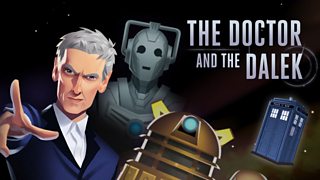
Doctor and the Dalek online coding game goes live later this week on the CBBC website
Ahead of The Doctor and The Dalek game going live later this week, Future Media Director, Ralph Rivera and Director of TV, Danny Cohen shared their thoughts on how the BBC is inspiring a new generation to get creative with coding and digital technology in its new initiative Make it Digital.
The interview that follows was conducted on Tuesday 14 October 2014.
Q: Tell us about the Doctor Who game The Doctor and The Dalek
Ralph: There are a number of things which are important about this exciting new game. For me the first thing is how we’re using a great brand like Doctor Who to help engage audiences into coding and computational thinking and digital creativity: the ‘doing’ of coding is really important – actually getting people to get a taste of it. Additionally, the key characters in Doctor Who are about technology - there’s science and technology woven into the very fabric of Doctor Who. Using that to showcase coding and the use of technology in a game, I think, is phenomenal.
Q: Is this about making coding more interesting?
Danny: I don’t think it’s about making it more interesting to people. Rather it’s about introducing it to people who don’t know anything about it. If you go to parts of the UK where coding and engineering are driving the economy – it’s really exciting. So I think it’s about introducing it to new audiences and new young people so they understand the opportunities around it. And the way its transforming the way people work and the way people enjoy themselves. The better we get at that, the better the country is going to be and the more young people we’re going to have who are successful.
Doctor Who is something our audiences love. It’s going to be a fantastic game voiced by the wonderful Peter Capaldi. It has its own story. Between each level there will be puzzles which introduce people to basic programming principles and computational thinking. Of course, the game is focussed on young people, but we’re hoping that older audiences will get something out of it too.
Q: The Doctor Who game is part of the BBC’s Make it Digital campaign, a wider commitment to promoting digital creativity and getting more people interested in coding. How important is Make it Digital?
Ralph: When I first arrived at the BBC, one of the things I learned about was the BBC Micro. 30 years ago the BBC Micro inspired a generation of people, many of whom went on to become world class video game developers. We know there’s a technology skills gap and so we want to capture the spirit of that initiative for the digital age. We pick up language to learn how to communicate with other people but now computers are pervasive, they’re everywhere – communication, entertainment. Being able to acquire the language to communicate with computers is going to be as fundamental as writing. What I hope is that Make it Digital has a similar impact: that it inspires the next generation to engage with coding, to help them to learn a new language.
Danny: Increasingly people use a range of different devices to enjoy different kinds of content and other experiences. So it’s absolutely right the BBC uses a variety of different platforms to inform, educate and entertain people. This is a good example when you can bring together a huge TV show with a huge audience and introduce people to something they haven’t tried before. The BBC is going to be at its best when it can do this across a range of different platforms and services and harness the power of the BBC and its brands to do bigger and bigger things.
Ralph: For me, media has a simple definition which is the intersection of storytelling with technology. That’s been true throughout history: Papyrus; the Guttenburg Press; radio; television or online. When you look at storytelling online you have to look at the characteristics of online as a medium. It’s social; it’s interactive; and, it’s not linear. So, how do we learn to tell stories in that way? I don’t mean just using online as a platform for distributing what we’ve already broadcast on TV or radio, but using online natively as a form unto itself. So for me, with an initiative like Make it Digital, we need to be digitally creative with how we tell stories and the Doctor and the Dalek is great example of that.
Q.What else can we expect to see from the Make it Digital initiative?
Danny: Make it Digital is a really big initiative for the BBC in 2015. The ambition is to celebrate this country’s digital heritage. But additionally it’s there to inspire young people – people of all ages. It’s there to get involved in digital creativity, to learn about coding and to understand how coding can help the future of the UK. And because we’re a creative organisation we want to do that through a range of creative different ways. We’ve started a little early this autumn with a range of content from BBC Learning, the Doctor Who game, Appsolute Genius on CBBC with Dick and Dom, Technobabble and Nina and the Neurons: Go Digital for younger audiences.
Ralph: And in support of the new computing curriciulum, we’ve delivered over 100 Bitesize guides on the topic. Take a look at the Keystage 3 Computing introduction to computational thinking, which breaks it up into deconstruction and algorithims. Look at that and you’ll see how I think.
We’re also launching two pieces of iWonder content: one is a timeline from Piers Linney telling the story of how code has come to run our world - from the invention of binary just 330 years ago, to the first computers in the 40s and 50s, and the transformation of music, architecture and business. And a guide from Lauren Laverne coming soon. It asks Is Code the language which rules the world? Just for the record, I think it is. The guide takes us on a trip to a record shop, to her car, and looking for ingredients for a recipe, all the while showing us how code underpins our daily lives.
There will be more to come over the next few months and throughout next year. We’re looking at Make it Digital as a catalyst around digital creativity and coding, but also looking at establishing an ecosystem of partners who are already doing a lot of great work here. It’s not just us doing this by ourselves, it’s actually bringing in the various parts together, whether it be the schools focussing on coding (of which there are several), or other big organisations.
Ralph Rivera and Danny Cohen were speaking to About the BBC Blog editor Jon Jacob in an interview conducted on Tuesday 14 October 2014.
Jon Jacob is Editor, About the BBC Website and Blog..
- The Doctor and the Dalek will be available freely at bbc.co.uk/cbbc from Wednesday 22nd October.
- Read a press release about The Doctor and the Dalek on the Media Centre website.
- Read Jessica Cecil's blog 'Coding and digital creativity - planning for 2015'
