
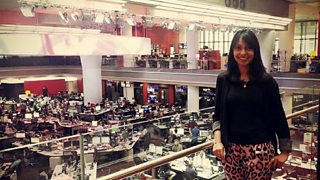
When I found out that the BBC had promised to make real commitments to improve the levels of diversity when it came to senior roles, I was initially sceptical. It wasn’t the first time senior managers had tackled the challenge of homogeneity at the top, so why would these plans be any different?
I watched intently as the Director General unveiled schemes to encourage diversity at every level of the BBC – at the top with the six Senior Leadership Development Programme places, the Commissioners of the Future scheme, and an emerging leadership scheme for people at the same substantive grade as me. We were reminded of attempts already made to improve diversity elsewhere, for example, with the BBC’s partnership with the Stephen Lawrence Charitable Trust for new entrants. Boundaries were being broken too with the launch of GWiN (the Global Women in News network) and the Expert Women programme aimed at championing female voices.
But I had no idea when I applied for a place on the emerging leadership scheme for BAME candidates that just within a few months, I would be exposed to cultural leaders, be part of industry-wide peer review groups, and actually feel that we’re on the cusp of a real change – not just at the BBC but across the media landscape.
By applying for the emerging leadership scheme, I was in a position to get one of the two places on a residential course offered in a new partnership between the BBC and Clore Leadership. It changed my whole mindset and gave me a fresh perspective on life and work. I came back revitalised. I’ve already also attended a joint event organised by Clore and the BBC Academy where I’ve collaborated with other high profile, inspiring leaders from a variety of BAME backgrounds. I now have contacts in pretty much every other part of the BBC – including some departments which I previously hadn’t worked with. These schemes are giving people like me the chance to find out how to become senior leaders in this vast organisation and how to remain in top roles.
Diversity shouldn’t just be a box-ticking exercise – it should be about bringing a variety of experiences forward so that there is not a single licence fee payer who doesn’t have someone to identify with and be inspired by at the BBC. People like Ritula Shah, Raphael Rowe and Brenda Emmanus are just some of the fine journalists I have been fortunate to work with and who inspire me on a regular basis. Yet I and others from under-represented backgrounds need to be aware of and motivated by even more talented role models at the top.
A former print journalist, I entered the organisation via the BBC’s Journalism Trainee Scheme and have steadily spent my career involved with some of the best programming the corporation has to offer. I have worked at Radio 1 Newsbeat, Radio 1Xtra, Panorama, the BBC News website, BBC Knowledge & Learning, World Service and the User Generated Content (UGC) Hub. The organisation is so vast and my desire to tell stories is so overwhelming that I’ve not yet wanted to leave. Although things are improving at the BBC, it’s not perfect and I wouldn’t want to say it is, but opportunities like this give people like me confidence to try to reach for the very top echelons.
Eight years’ ago, the late Claire Prosser, the then head of the BBC’s trainee scheme told me about the BBC Academy’s plans to bring fresh talent into the organisation and make it a place where everyone felt welcome. She passed away in 2014 but it’s been important for me, and the other trainees whom she brought in to shake up the BBC, to continue that work. It’s in her footsteps I follow when I seek out opportunities at the BBC to make me a better journalist, storyteller, leader and person.
I’m involved with the John Schofield Trust – a charity which puts together young journalists with experienced mentors; I’ve been involved with GWiN’s working committee since its beginning and it’s great to see the changes it’s driving by having women at the forefront of its agenda. I was introduced to the BBC’s BBAF (Black and Asian forum) when I first started and they’ve been a great help in trying to navigate the organisation during my time here.
I believe there is potential for a radical sea-change in the way the BBC operates due to the implementation of schemes such as this. It’s just a question of making sure everyone in the BBC – from the controllers to the managers to the fresh entrants – ensure their support for this over the longer term.
But for me, one of the biggest issue challenges in the media industry is class. If the BBC is at the vanguard of tackling the lack of diversity when it comes to class, the industry as a whole, I guarantee, will change. By targeting class, we’ll be of more value to our audiences, no matter where they come from or who they are.
We need to make sure that just because someone cannot afford to do unpaid work experience or a postgraduate in journalism, that they are not put off from applying to the BBC. That’s why it’s great to hear about moves to tackle this such as the Journalism Apprenticeship Scheme and the outreach work being done to inspire our next generation of storytellers.
Dhruti Shah is a Broadcast Journalist working on the User Generated Content Hub, BBC News.
