
Today, BBC Director of News and Current Affairs, James Harding, spoke at City University about the global challenges and opportunities for online news.
Alongside his speech we are publishing a new report examining how the UK digital news sector might evolve in the future. Increasingly, Britain’s success in news is being recognised around the world – from the popularity of British news websites to the profile of UK journalistic leaders (paid content).[1]
In the UK we have one of the most competitive journalism markets in the world and since the advent of the internet it has gained access to a global audience. There have been well-documented challenges. Yet there are big opportunities too.
This is why we’ve published today’s report by Mediatique. The report finds strong evidence of some of the benefits of digital for both British news businesses and UK audiences.
UK news providers
For UK news providers, total digital revenues are now close to half a billion pounds (see figure 1). They’re growing fast. Digital advertising and subscription revenues for newspapers – which represent the bulk of total revenues – are up by two-thirds in the past two years alone. This growth is accelerated by overseas audiences, who now represent two-thirds of the users of the leading UK news websites.
fig 1:
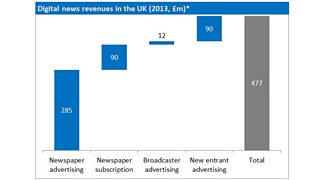
Source: Mediatique. *Regional and national newspaper titles only, excluding FT; broadcasting sites do not include any share of Sky subscription (bundling Sky News access); new entrant figure is estimate based on review of company announcements. Broadcaster advertising represents the UK advertising revenues accrued by the websites of commercial broadcasters. New entrant advertising represents the ad. revenues accrued by ‘digital only’ news providers in the UK (eg. Buzzfeed, Huffington Post)
UK audiences
Alongside the business benefits, there is growing choice for UK audiences. New analysis contained in the report shows UK audiences on average use five different online news sources, up a third in the past two years (see figure 2). They turn to different sources for different reasons, getting more entertainment and interaction with social media, more in-depth coverage and expertise thanks to newspaper sites, and the most trusted and accurate news from broadcasters.
fig 2:
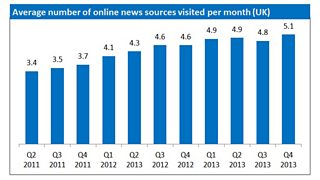
Data relates to computer based internet usage only. Source: BBC, comScore MMX
This corroborates existing research on the different ways people consume news. Broadcasters are rated highest for impartiality for example, while newspapers are favoured for readers’ ability to choose their titles according to their political views.
The BBC’s digital news plays a complementary role in this environment. Among the first digital entrants, BBC online has since 1997 been helping grow the overall market for digital news. A decade after launch, almost one in 10 UK internet users cited the BBC website as one of the main reasons they went online. Today, it has a wide reach, serving the BBC’s universal mission. Yet it represents just 1% of time spent online in the UK. This is in part because the BBC helps its users find the best of UK journalism by linking out to other news providers. The average BBC online user is more than twice as likely as the average internet user to access the Guardian and Telegraph websites. We are trialling new ways of linking to further widen the range of voices and perspectives available to users.
The future
In the years to come technology will undoubtedly shake up the news industry further, and future changes will respect no national boundaries. What Mediatique’s report shows is that the UK sector is among the best positioned to navigate these changes successfully.
Daniel Wilson is Head of International Policy.
- [1] “City that never sleeps wakes up to the power of British influence”, Financial Times 11/12/14 on the ‘British charge’ on the top jobs in the US news market.
- Read the Mediatique report - The provision and consumption of online news – current and future.
- Read Director of News, James Harding's speech on The Future Of BBC News And Current Affairs In A Global Digital Age
