
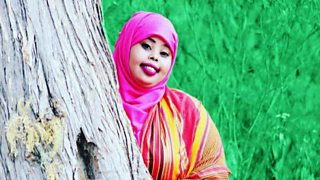
This year’s winner, 26-year-old midwife Kaltun Nasir Hussein
“Women are up against very strong forces - not of nature, but of man,” says Jimeh Saleh, head of BBC News Hausa. “When a woman speaks, people listen.”
On Hikayata (My story), the BBC’s short-story contest for female writers, women speak in Hausa, narrating the human drama. The drama of polygamy, early marriage and divorce, domestic abuse, sexual harassment and rape, life with HIV, drug abuse, maternal mortality, street children, poverty, and armed conflict.
The contest occupies a unique place on the Hausa-language cultural scene. But female authors writing in Hausa thrived long before Hikayata. In fact, Saleh explains, it was inspired by a BBC programme about the stunning success of romance novels in Kano, Northern Nigeria. Written in Hausa, and mostly by women, these stories interweaving fantasies and daily realities are eagerly read by men and women alike. With Hikayata, the BBC invites female story-tellers to express their creativity in a short-story format. Along with the cash prize, the contest’s big promise is to broadcast the winning story to the tens of millions who tune in to the BBC in the Hausa language, and to share it on the BBC’s digital platforms.
Now in its fourth year, Hikayatareceives hundreds of entries, attracting both budding and established authors. Their stories offer fascinating perspectives of the daily challenges faced by women. The inaugural award was won in 2016 by a mother of three, Aisha Sabitu. Her Sansanin ’Yan Gudun Hijira (Refugee Camp) is a story of a woman struggling to make sense of life. Falmata found herself in an IPD camp after Boko Haram ransacked her village and killed her parents and brother. They raped and abducted her. Falmata’s story is of surviving barbarity and cruelty, and finding peace through helping others. As they handed victory to Aisha, the judges said she was a master thriller writer. There was no acceptance speech. With tears of joy flowing down her cheeks, all she wanted then was to have a few minutes to herself, to take in her life-changing moment.
The winner of the 2017 award, Maimuna Sani Beli, is an established writer. Like Aisha Sabitu, she was married off in her early teens. She joined a school for women after having her second child. The heroine of her story Bai Kai Zuci Ba (Not from the Heart) is a mother worrying about her children. So worrying that she is daydreaming of what might befall them if she dies. If that happens, she wants her husband to marry her best friend who, she knows, loves children and so will help take care of their kids. She daydreams of coming back from the dead to check on her motherless children.
The judges noted Maimuna Sani Beli’s bold writing style, taking the reader from the land of the living to the spirit world. “Not every writer is confident enough to take on subjects like life after death,” said judge, Professor Ibrahim Malumfashi.
"Women have been at the forefront of literature in Hausa communities," says Saleh, referring to the work of Nana Asma, the daughter of the 19th century Islamic reformer, Usman Dan Fodio: “Her poetry is still studied in universities around the world”. Hikayata has had among its judges Balaraba Ramat Yakubu, another acclaimed female writer.
On the other side of the continent, another literary tradition has women at its heart - the poetry of Somali nomads. Lifestyle changes have threatened the very survival of this folk art. The BBC News Somali competition for young female poets showcases and preserves this oral art form. “In Somali, just like in English, we have the expression, ‘mother tongue’,” says BBC News Somali head, Abdullahi Abdi Sheikh, “because we believe that women play a definitive role in preserving a language.”
Just like the contest in Hausa, this BBC competition is unique - nobody else does anything of the kind in the Somali language. Sheikh says that, since the competition started three years ago, more Somali women have been seen sharing their poetry on social platforms. In particular, they engage in silsilat- essentially a show-off of poetic prowess, where a verse initiated by one poet is picked up and continued by others. Sheikh believes this phenomenon was a result of the BBC’s poetic competition that itself has now become part of the discourse on the Somali-language digital scene.
But what do the young Somali female poets say in their poetry they send to the BBC? Although social issues are raised (2018 first runner-up poem was on how FGM affects young lives), the dominant theme is pride in the traditional Somali culture and way of life, and a desire to preserve it.
“Judges look for poetic quality - rhyme, structure and rhythm,” says Sheikh. “In Somali poetry, the first syllable of a poem defines the sound of the rest of it; so if it begins with a word starting with ‘ba’, there has to be as many words as possible that start with the same… Among our entries, we have seen specimens of amazing beauty.”
Deeqa Nouh Yonis, a student who won the first award in 2017, spoke in her poem about the significance of the Somali culture and sang her praise of the life of pastoralism. This year’s winner, 26-year-old midwife Kaltun Nasir Hussein, marvels at the gifts of her native land, concluding:
Of land blessed with riches, and seas accumulated with wealth,
In which our people no longer depend on foreigners,
A time of bliss when the beauty of our land is brought to the light,
When such time comes, success won't remain a mirage to chant
Inside our prosperous land - then I will rejoice.
Commenting on Kaltun Nasir Hussein’s poem, the famous poet and song writer, Abdinur Allale, said that very few people are left who can compose, like her, a poem that brings the best of the Somali poetic tradition. Eighteen-year-old student Shugri Jama Ibrahim in her winning poem of the 2018 competition praised Somali culture and craftsmanship: “So, agitate, o you all, for our lost deftness and refurbish your craft! Dust off the neglected artifice – let's have it shine!”
Ibrahim says she is now recognized as a poet and is invited to poetry meetings. Over in Nigeria, before coming second in a Hikayatacontest, Balkisu Sani Makaranta worked as deputy head in a girls’ school. She had been pleading with her husband to allow her to study for a master’s degree - but it was only following her performance at the BBC contest that he agreed to it.
Safiyyah Jibril Abubakar teaches agricultural science at a secondary school outside her hometown, Zaria, in northern Nigeria. She won last year’s Hikayata with her ’Ya Mace (The Girl Child) - a story of Halima who is married off to a man she does not love, who suffers from domestic abuse and ends up thrown out by her husband, her family and the society at large. Safiyyah Jibril Abubakar plans to expand her winning story into a novel.
This year’s Hikayatawinner will be announced on 25 October. Women will keep telling their stories and, with their poetry, they will continue to help preserve their mother tongue. And the world will listen.
