
Heard from the backseat of our taxi as it skidded to a stop outside Tunis Airport departures:
“I tell you I get you to airport in time. I did that. Here you are! Lovely Jubbly!”
Our taxi driver had been eager to please during the first leg of our journey home from holiday. And, when he wasn’t engaging in seemingly urgent and impassioned phone calls to his friends as he drove at speed to the airport, he appeared equally keen to demonstrate his familiarity with the English language too.
The taxi driver’s other references to Bobby Charlton and Manchester United – attempts to bond with his English passengers - fell on deaf ears. The “Lovely Jubbly” reference – Del Boy’s catchphrase in John Sullivan’s Only Fools and Horses was really left field. Sullivan’s work has travelled far.
The phrase, like countless others from other popular sitcoms, has graduated from its TV origins and now occupies a place in jocular conversations. In a bid to connect with strangers, the likes of “I’m free!” and “I shall tell you this only once!” act as conversational shortcuts. Ice-breakers that stretch needily across international borders. For some – especially it seems in the service industry - the TV entertainment equivalent of bonding over football.
Conductor Andre Previn has a similar problem, so it transpires. So the anecdote goes, renowned artist Previn steps onto the concert platform to conduct symphonies and collect awards. When he does so, he’s always introduced by his real name. Only in London do the taxi drivers insist on calling him “Mr Preview”. And there’s someone to blame for that: TV scriptwriter Eddie Braben.
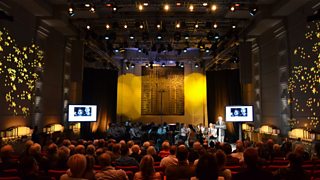
A celebration of Eddie Braben's work, held in the BBC Radio Theatre
Eddie Braben’s 50 years in the comedy scriptwriting business spans generations. Selling his first jokes to Charlie Chester and Arthur Askey back in the late 1940s. From 1960 until the 90’s, Braben’s credits appeared on Ken Dodd’s It’s Great to Be Young, The Worst Show on the Wireless featuring Alison Steadman, Someone and the Grumbleweeds and Jimmy’s Cricket Team. In the late seventies he also appeared on air himself in shows including Sound’s Natural, The Easter Egg Parade and The Show with Ten Legs.
But it was his work on the Morecambe and Wise show – itself an opportunity which arose when Eric and Ernie’s previous writers finished working with the performers – for which he is best remembered. Also speaking at the event, Angela Rippon said that the Morecambe and Wise show is the product of a “golden triangle of talent – the three ‘Es’ – Eddie, Ernie and Eric.”
One of Braben’s most famous creations was the Grieg Piano Concerto sketch for the Morecambe and Wise show. It is a masterful creation. It’s played out during the celebration event. Familiarity with the famous line doesn’t deaden its impact. “I’m playing all the right notes; but not necessarily in the right order.” We laugh like we’ve been reunited with an old friend.
We assume of course that if we continue to laugh at it that it was an effortless creation - that writing itself is a simple process. That’s what effortless performances do with deftly written scripts. They meld performer and writer together, as the Now Show’s Steve Punt puts it, “so we can’t see the join between them.”
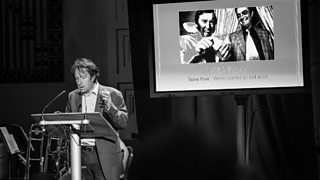
Steve Punt speaking at the Radio Theatre
Jon Culshaw, also speaking at the event, points out how Morecambe’s look to the audience as if to brace himself for the confrontation ahead, is a TV sitcom technique now employed in the likes of Mrs Browns Boys, Miranda and Not Going Out has its origins in Braben’s sketch. Culshaw, now appearing in Radio 4’s Dead Ringers, acknowledges Braben’s legacy in his own work, “It’s not enough to just do the voice, or deliver the catchphrases of the people we impersonate, we have to create characters around them too, like Braben did with Morecambe and Wise. We have to ‘Brabenise’ them.”
In the piano concerto sketch, there’s a Tom and Jerry element to proceedings. Morecambe and Wise are knowing innocents, cheeky but never disrespectful. Calling Previn ‘Mr Preview’ - something never responded to by the conductor - shows sophisticated characterisation, underlining he is complicit in proceedings. Morecambe’s shameless attempt at deflection of responsibility is followed by the immortal line “I’m playing all the right notes in the right order,”. It takes the audience to a precipice. We’re only dragged back when Previn relents and joins in with his own comedy version of the music. The lines in the script are surprisingly sparse, but they have over time transcended the sketch itself. Forty or so years on, we (still) laugh, but the phrases are so engrained in popular culture that we can’t say or hear them without thinking of Morecambe and Wise, Andre Previn or even Grieg’s Piano Concerto. Even a Proms 2014 performance of the concerto saw the programme note make reference to the sketch – such is the way the work has become synonymous with Braben’s work.
Remembering Eddie Braben
The images of the young Braben, gelled fringe hanging over his eyes, pen gripped between his teeth, slaving over his old Imperial typewriter, leaves us with a potent image. Writers toil – Braben later admitted to Miranda Hart in a 2013 interview that he hated writing – to create work which sometimes surpass their own expectations, breaking out of the script they formed a part of, to create a life of their own.
There’s melancholy in that image: a man in a tiny room, creating one-liners which will, potentially, be uttered by a whole generation unaware of where it comes from or who was responsible for it.
Jon Jacob is Editor, About the BBC website and blog
- During the celebration event, Kate Rowland, Creative Director from the BBC Writersroom presented an award in memory of Eddie Braben. The award which supports up and coming comedy writers was given to Steve Burge, writer on various BBC shows including Tittybangbang, The Fast Show and Shooting Stars.
- On Saturday 27 September Radio 4 Extra broadcasts Somebody Laughed: Eddie Braben brought you sunshine – a selection of excerpts from shows he wrote.
- Discover more clips, features and anniversaries on the History of the BBC website.
