The centenary of Hartlepool Bombardment – how we covered the stories of 100 years ago

Dan Thorpe
Editor, BBC Tees
Tagged with:
On 16th December 1914 Hartlepool on the North East coast was the site of the first civilian deaths on UK soil during the First World War.
More than 100 people were killed as a thousand shells blasted the town for 40 minutes from three German ships (Blucher, Seydlitz and Moltke) shortly after 0800. Among the casualties was Theo Jones – the first soldier to be killed on British soil in the First World War.
BBC Tees’ coverage of the centenary of the Hartlepool Bombardment was one of our most ambitious projects to date, and one that was months in the planning.
We realised early on in that planning that it was a vast project likely to appeal to a national audience as well as those served by the BBC local radio station for Hartlepool, BBC Tees. It was also clear that to do justice to the events of that day, our coverage would need to cover not just radio, but also television, online and social media.
Two journalists led on covering the stories from the Bombardment – Jonathan Swingler and Lee Johnson - and whilst researching their stories they came across the Teesside Archive and a collection of around 600 tapes containing previously unheard audio. These tapes contained stories recorded in the 1980s of elderly Hartlepool residents, many of whom were children when the shells struck the town. A broadcast assistant sifted through all the material and pin pointed what was the most important and emotive recollections. They all recalled what they were doing at the exact moment of the first shelling, as the fear and enormity of it all began to take hold. To uncover this unheard audio was an exciting discovery for our team and it proved to be the starting point of our Outreach project.
After digitising the stories, we then took them to Dyke House School in Hartlepool and played them to a group of teenagers who had all volunteered to be part of the BBC Outreach project. Kate Fox, a performance poet and writer based in North Yorkshire, led a weekly discussion at the school working with a history teacher and Helen Amess from the BBC Outreach to discuss the audio, and what the teenagers felt when they heard the accounts.
What struck the school children most was that the people telling these stories were no longer alive and that many of them had been teenagers at the time of the attack – the same age as themselves. They all said they felt they had a responsibility to tell these stories and to keep the memories alive for future generations.
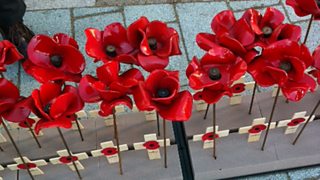
Ceramic poppies form Hartlepool Bombardment memorial
They produced a poem which they performed as part of the moving ceremony which saw a new war memorial unveiled to the civilian casualties of the Hartlepool Bombardment. The 130 people who died that day were publically named and remembered, as children from a local primary school planted a ceramic poppy, originally part of the Tower of London installation, one for each casualty.
Our coverage of the Hartlepool Bombardment started early in the morning on 16th December with a special Breakfast Show presented by Ali Brownlee, taking listeners back to the day with real-time reports to coincide with the historical timings of the attack. At around 0750, just as the sun was coming up, we managed to pull off a successful broadcast from a small fishing boat out at sea containing one of our reporters, David MacMillan.
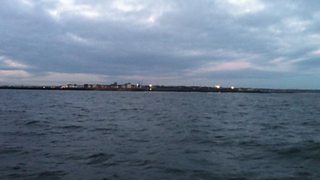
David MacMillan broadcasts from the North Sea, where the Germans fought from on December 16th, 1914
The idea behind this report was to give the perspective of the German boats out at sea, looking back inland towards Hartlepool just before they started their attack on the town. It was a great relief to pull this off as it was probably the part of the broadcast with the biggest potential to go wrong.
The logistical and technical challenges didn’t end there, with a total of six different live sources and six local presenters and reporters across Hartlepool and Whitby contributing to that hour. Our Engineer John Proudler deserves great credit for the smooth overseeing of such a difficult live broadcast.
Later in the afternoon, BBC Tees’ Afternoon Show came live from the Borough Hall in Hartlepool where guests assembled to enjoy an afternoon tea dance, exhibition and poetry recitals.
In the months prior to the centenary, we had successfully secured funding to send our reporter Jonathan Swingler out to Germany to visit Heligoland naval museum to speak to historians about the German mood before and after the Bombardment. He managed to secure access to one of the ships Commanders’ diaries and read inside how the commander felt before the mission to Hartlepool
Jonathan also looked at archive material of German newspapers reporting on the attack and even took a piece of shrapnel found 100 years ago from Hartlepool back, to place in situ next to one of the gun barrels from the war ships.
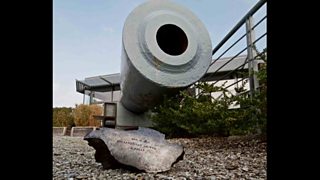
Photo by BBC reporter Jonathan Swingler of Hartlepool shell fragment next to Seydlitz gun barrell in Germany
The material he gathered in Germany ran across BBC outlets including the national BBC bulletin at one o’clock, BBC Look North, BBC Tees and online and were a good example of original journalism which we wouldn’t have been able to do without the additional funding.
These examples of looking at the Bombardment from the German perspective were seen as a new way to cover this well-known local story and received praise from many people including Mandy Southcott, Vice-Chair of The Heugh Gun Battery in.
The dedicated Local Live web page of the Bombardment, delivered by Kristie Kinghorn with Rachel Kerr, was the second most viewed page on the BBC website on the afternoon of 16th December.
As well as real-time reporting of historical events as they unfolded, the website also contained ‘Then and Now’ images showing the damage and after effects of the bombardment alongside present-day images of the buildings.
It also carried video footage of several reports including the Imperial War Museum material (also played out on BBC Look North) of a joint funeral of two previously unknown sailors who were buried in Middlesbrough. Hartlepool Borough Council’s history expert, Mark Simmons, revealed to the BBC that his research had finally identified it as the funeral of Ralph Weston Hook and George Charles Martin Flynn.
It’s been thrilling to be part of such an ambitious project, and inspiring to see how imaginatively and authoritatively the BBC Tees’ team delivered it. BBC Tees was honoured to be named ‘Station of the Year’ (under one million) at the Radio Academy Awards this year, and the judges commented that the station was clearly “dedicated to serving their audience with flair and passion”. I believe the team demonstrated that with their work on this coverage.
We are now planning a radio documentary from the Hartlepool Bombardment coverage to go out over Christmas on BBC Tees, and we’ve had discussions about some of the audio and pictures we gathered being used as part of the display at the Heugh Gun Battery visitor attraction. Dyke House School are continuing to develop the Outreach work using the poem the children wrote with Kate Fox for educational purposes.
BBC Tees had to creatively approach a story from 100 years ago, which was well known to many locally, and do it justice. We worked in collaboration with several organisations and partners and thanks must go to Hartlepool Borough Council, Teesside Archive, Imperial War Museum and Heugh Gun Battery.
With their kind support, we hope that we honoured the momentous events of a hundred years ago.
Dan Thorpe is Managing Editor, BBC Tees.
