
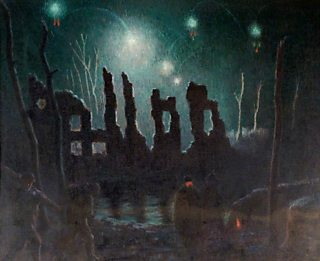
Boesinghe Chateau by Carey Morris (Photo Credit: The Regimental Museum of the Royal Welsh, Brecon)
Former MP Kim Howells is presenting Visions of World War One on BBC One Wales tonight (Monday 11 July), the programme considers how Welsh artists portrayed World War One, from the morale raising prints of 1914 to the poignant memorials that still stand in towns and villages across Wales. Here, in a blog originally posted on BBC Wales, Kim shares his experiences of making the programme.
With the BBC Wales film crew, I looked across a field at Mametz Wood on the battlefield of the Somme - a dark and sombre prospect in the February rain. Trees, tall and bare, grown from the seed of a forest obliterated by British artillery in July 1916, rise, now, from a tangle of bramble and hazel, rust-coloured in winter, like century-old barbed wire.
I walked up the gentle slope to the forest, over the claggy chalk soil, unable to imagine how young men, burdened with equipment and weapons could have made the same, short crossing of open ground under a deadly hail of German machine gun fire. There was nowhere to hide.
In the forest, hidden by the tangled thorns, is a floor pitted with the concave evidence of shell-holes. I wonder how any German soldier could have survived such a barrage. But they did and, when the British shells ceased landing, the German machine-gunners emerged from their bunkers and commenced their slaughter of the advancing Welsh and English infantry.
It was here that the artist and poet David Jones was wounded in the savage hand-to-hand fighting. Mametz Wood was the Welsh Division’s fiercest and most costly engagement of the Great War. Lloyd George commissioned the Maesteg-born artist, Christopher Williams, to paint a version of it – a huge, dramatic canvas of savagery and killing that was to hang in the drawing room of No.10 Downing Street, perhaps as a reminder to visiting generals, diplomats and politicians of the human consequences of failing to keep the peace in an age of industrial, total war. I doubt that any photograph could have fulfilled that function so vividly.
The paintings and drawings fulfil a different role, now. They give us an insight into the reality of life in the trenches a century ago – not just of the blood and guts, fighting and shelling but also of the long periods of sitting around, waiting and watching. David Jones and Carey Morris (an artist from Llandeilo) sketched their fellow soldiers in the dugouts boiling kettles, cleaning guns, preparing food or just sitting, smoking and chatting.
There is a small, dark painting by Morris of a ruined chateau on the front line, near Ypres in Belgium. It portrays the war continuing into the night. British soldiers are hidden in the darkness, their presence indicated only by the glow of their cigarettes, as the night sky over no-man’s land is lit by flares. Morris could only have painted it because he was there, as a soldier, seeing men seeking some solace from tobacco in the darkness. I know of no photograph that captures such a moment and such telling detail in the terrible years of battle around Ypres.
The tiny fragments of the wars that I saw first-hand in Iraq and Afghanistan and in countries torn by sectarian violence and civil war were enough to convince me that artists, writers and composers – as well as brave photographers, film-makers and journalists – can add greatly to our understanding of these events by communicating their own, special perception and interpretation of the conflicts into which they find themselves pitched. That is why it is so important to explore the work of these remarkable Welsh men and women during the Great War.
Visions of World War One, part of World War One from BBC Wales.
Watch Visions of World War One on Monday 11 July, 10.40pm BBC One Wales
