
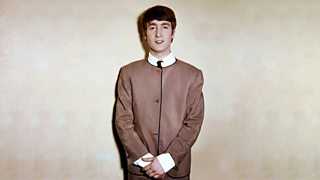
Had he lived, singer, songwriter and founding member of The Beatles, John Lennon would have turned 75 this year. On Thursday October 8th, the eve of Lennon’s birthday, BBC Radio 2 will broadcast ‘John Lennon’s Last Day’. Here, the docu-drama’s writer, Stephen Kennedy, talks about what inspired him to create a play about the 24 hours leading up to the former Beatle’s assassination on December 8th, 1980.
The truth is I‘ve never written a blog before – and I’ve read very few – so I really haven’t a clue what to do here. But I promise I’ll do my best to try to stay focussed on the subject at hand.
I suppose the key question to start with is why did I write a play about John Lennon’s last day?
There were two main reasons. Firstly, I wanted to put together an accurate account of the events that happened to John Lennon on the day of his murder. I’ve been a massive fan of The Beatles all my life – and I’ve read countless books about John, Paul, George and Ringo – but I could never find a complete account of the things that John Lennon did on his last day. I wanted to rectify that. I think I’ve succeeded. At least I hope I have. After all, I spent well over a year doing the research for this play. I read various books, newspapers and magazines; I listened to old radio interviews; I watched hours of documentaries and relevant footage online; and I even had to double-check some ‘facts’ with people who were with John Lennon in New York in 1980. I owe Shelley Germeaux a big thank you for her help with that.
Shelley runs the John Lennon Examiner in the US. She is a huge Beatles fan and has some contact with people who knew John Lennon directly. I was able to ask Shelley to check certain ‘facts’ for me with people in America. For example, a lot of books state that Lennon went to La Fortuna (his favourite café) on the day of his killing. But that didn’t add up for me. I knew Lennon was killed on a Monday – and I vaguely remembered reading somewhere that that café was always closed on Mondays. So I asked Shelley to check this with Fred Seaman (John Lennon’s personal assistant before his death) and sure enough Fred confirmed that La Fortuna never opened on Mondays.
The other main reason I wrote this play is because I wanted to highlight the senseless tragedy of John Lennon’s murder. I genuinely hope I’ve succeeded on that front too.
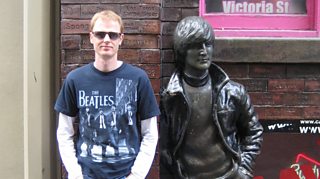
Stephen alongside statue of the late John Lennon
John Lennon’s Last Day was originally written for the stage. It was first performed over two years ago by a superb Irish actor called Seamus Brennan – and since then it has gone on to enjoy successful runs in Dublin, Belfast and Berlin. I could see that the play worked well on stage. Everywhere that we put it on, the people in the theatres were clearly moved by it. But I didn’t know what to do with my play next. So I sent the script to RTE in Dublin to see if they’d be interested in recording it – but it was rejected. Then I sent it to the BBC as a long shot and I was lucky that my script landed with James Robinson. Like Shelley above, James is a real Beatles fan. He read my play, liked it, and took it to BBC Radio 2.
When it came to editing my script – to transform it from a stage play into a radio play – I really didn’t need to make a whole lot of changes. Obviously I had to remove some of the visual elements (overhead projections, etc) and I cut some small parts from the script – but apart from that, there is very little difference between the stage play and the radio play.
For the radio play, I wasn’t at any of the rehearsals, readings or recordings. I live in Ireland, and the budget wasn’t big enough to cover my travelling over to the UK for that. I probably would’ve only been in the way anyway.
And – yes – I’m really looking forward to hearing the finished audio, especially since I found out that my play is going to be performed by the great Liverpool actor Ian Hart. In my opinion, no actor has ever captured John Lennon’s character better than Ian did in the film Backbeat.
Finally, I’d like to point out that the most important thing I discovered while touring with this play is that there is a huge amount of love and respect out there for John Lennon – and that love and respect seems to be growing stronger with each new generation. And that’s a good thing. A very good thing. We all know that John Lennon was no saint, but he was certainly a person who had a positive influence on the world, and he deserves to be remembered for a long time to come. So let’s end this ‘blog’ on that upbeat note and I’ll slyly squeeze in a quote from my play (yes – I really am that shameless).
“The story of John Lennon doesn’t end on the 8th of December 1980. The truth is that this story never ends – because the music of John Lennon and The Beatles will live on forever. It will still be here – playing in every part of the world – long after we’ve all gone. And long after that too.”
I would like to thank producer James Robinson at the BBC for making the broadcast of John Lennon’s Last Day a reality.
Stephen Kennedy is a Playwright and Director of the Dublin Beatles Festival.
- John Lennon’s Last Day will be broadcast on BBC Radio 2 at 10pm on Thursday 8th October, 2015, and will be available to listen back to again on the BBC iPlayer Radio.
- The Dublin Beatles Festival runs from November 6th-8th.
- Read Jeff Young’s blog ‘Writing When Elvis met the Beatles for BBC Radio 2’.
