In Conversation with Sakari Oramo

Jon Jacob
Editor, About the BBC Blog
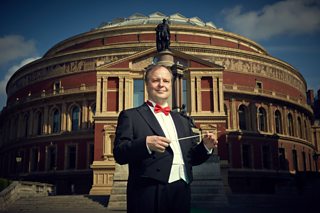
Sakari Oramo is the BBC Symphony Orchestra's Chief Conductor and will be conducting the First Night of the BBC Proms on Friday 15 July 2016.
Sakari Oramo conducts the BBC Symphony Orchestra in the opening concert in this year’s BBC Proms this Friday. Jon Jacob talked to the Finnish conductor before rehearsals for the opening night of the season got underway at BBC Maida Vale studios earlier this week.
Tell us three surprising things about you
First is that I own a vintage car – Citreon DS with a black leather interior that I’ve had for about six years. The second surprising thing is that I’ve followed a vegetarian diet for a year and a half. I feel very good for having done that. The third surprising thing is that most of my education happened in French but in Finland. I went to a French school in Helsinki and the first four or five years of school mostly happened in French.
That really does surprise me. How did that come about? What impact did that have on you?
At the time I think it was probably the thing to do – my parents thought it was a good idea at the time. It was actually the nearest school to where I lived as a child. One has to know that in the early 1970s Finland was still pretty much a closed country. It was culturally very closed back then. So, all this for my parents was about predicting a more international future for the coming generation. That was very much on the agenda for my parents and for many others.
Did you feel at the time that you were having a broader education? Did you feel at the time that your horizons were being broadened?
Absolutely. We had native French teachers who kept changing very often. Getting to know these people and learn how they thought certainly broadened my horizons quite a lot. Although I haven’t worked in France that much, or indeed with French speaking orchestras, it still gives me a sense of comfort with French music. It connects me with the French culture – with music, literature and other arts as well. It certainly gave me a much broader experience in many ways.
What do you think you connected with in terms of French music? What elements of French music makes your heart beat faster?
It’s the whole kind of way of thinking – it’s so far from the German way of composing. For instance, where you have musical motifs which develop over a much longer period of time. In French music its much more about colour or points of interest rather than long tracks of musical development. In French music is more about savouring the moment; music for the senses. Of course there has been cross-breeding between the cultures. But here I’m referring to the most extreme examples.
When you talk about French music in that way I think about impressionism, Debussy, for example.
Yes. Debussy. Rameau. Dutilleux. Various others, contemporary composers too. They share that feature – that’s quite clear in the study of music history. Even in the French Baroque composers you can see that characteristic too.
What was going on when you were first introduced to classical music?
Well, I had it all the time at home. My mother is a pianist. My father is a musicologist. I heard music, basically, from the moment I was born.
Was there a key moment? Do you recall a key moment?
There really can’t be when it’s that early in your life experience.
Was there a moment when you decided ‘classical music is definitely for me’?
Not really, no. I really did drift into classical music right from an early age – it was always a part of me.
And you’ve never questioned it? Was there ever a moment when you’ve thought “Oh, this isn’t working for me”?
Not seriously. Not long-lasting. Maybe there was one point when I veered away from being a violinist to a conductor. That was the late 1980s. Even then, I don’t think I can give one moment when everything kind of clicked either way. It’s all been a sort of flow of thoughts and feelings.
From your perspective as a Finn, can you tell me what it is that’s special about the BBC Proms? What is it that you see that perhaps the rest of us overlook?
The BBC Proms is an institution. What really makes the Proms stand out is that it’s managed to withstand a lot of the pressures of modern days, say commercialism. What makes the Proms so very valuable is that the festival is all about the music. It’s great, of course, that the big names are there. They lend the whole event an aura. But, even when Simon Rattle, Daniel Barenboim, or Murray Perrahia perform at the Proms, it’s always about the music.
Is there any difference in how you or the musicians in the orchestras approach a concert because it’s a Prom concert?
I’m sure, yes, for the BBC Symphony Orchestra and the Chorus. The Proms is the big showcase of the year. We do concerts all year – at the Barbican, for example – but the range of audience at the Proms is incredible. Our high profile touring is very successful – but it’s always a very local experience. But at the Proms, we experience what it’s like being a focal point of the musical world’s attention. It still remains an arena where you really want to do well, more than anywhere else.
What do you particularly love about the Proms?
For me, one of the things I really lovely about the Proms is the build up – and I feel it from the beginning of the season - to the climax to the Last Night. The Last Night is a real people’s party. It’s an event which releases all of the pressure which has gathered throughout the season amongst those devoted Prommers who have attended each concert.
What was your first experience of the Last Night?
It was hilarious. I really enjoyed it. For any conductor conducting the Last Night, the most scary part is the speech. Not being a professional speaker yet having to speak in front of an audience of millions, live, is unique I think.
What adds a slightly unwanted extra pressure is the expectation for it to also be funny. Because that’s not something we Finns do very well.
But Finland did win the Eurovision with Lordi though, didn’t you?
Yes, but I am not going to dress up in a costume like that to give my speech.
Tell us about one of the works which features in the First Night of the Proms – the Elgar Cello Concerto. It’s regarded as quintessentially English, a work a lot of British people identify with. What’s your take on it? What is it that’s seen as English? Do you get that sense of Britishness from it?
I’m interested in that notion of Englishness in music. I think a lot of it is that audiences have been exposed to the sound of Elgar’s music very early on and repeatedly. The same applies to Sibelius and the Finns. For me, there isn’t any ‘traditional’ Finnish folk music in Sibelius’ music. There are elements, of course, but it’s not focussed on traditional Finnish music. And it’s the same with Elgar’s music.
Englishness in music for me, is mostly to do with tradition, and how audiences are exposed to music in this country. The modal elements in Elgar’s music – that musical link to medieval times you can hear in the work, for example. You can hear it throughout history in English music. That’s certainly one English element.
There is too, in the Elgar Cello Concerto, a certain kind of melancholy in Elgar’s music. It’s not necessarily part of a British person’s psyche. If people hear melancholy in Elgar’s music then that’s might be something the listener is attaching to it themselves when they listen to it.
The fact that Elgar wasn’t a part of the British establishment is also important for me. He was lower middle-class. He fought very hard to get the position he ended up with on the top of the nation’s league table of composers. And when he got there he wasn’t very happy about it. In that respect too its difficult to ascribe Englishness or Britishness necessarily to the sound in Elgar’s Cello Concerto.
So you’re saying that if we as listeners describe Elgar’s music as ‘British’ then that’s our perception? In the same way you were suggesting with Sibelius ? So you don’t listen to Sibelius and think of home?
No. Not at all. It is a perception, of course. And perceptions shouldn’t be downplayed. But where Sibelius is concerned, some of his music is rooted in the so-called Finnish mythology – its really Karelian mythology, which is completely different. I think what that says to me is that the borders we see on the map today are totally artificial. So, to ascribe a national sound to a composer’s musical language isn’t very helpful.
Jon Jacob is Editor, About the BBC Blog. He spoke to Sakari Oramo on Wednesday 13 July 2016.
- The BBC Proms gets underway on Friday 15 July 2016, at 7.30pm on BBC Radio 3, and later on BBC Two (7.30-8.30pm) and BBC Four (8.30-9.20pm)
- Read more information about BBC Proms TV coverage on the About the BBC Blog
- Further information about the Proms season can be found on the BBC Proms website
- Follow @BBCProms on Twitter and on Facebook
