MOTD at 50 - a reflection by Barry Davies

Barry Davies
BBC Sports commentator
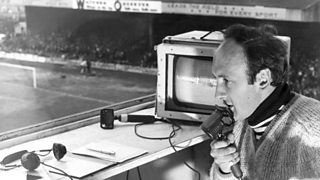
Barry Davies
Match Of The Day was five seasons old when I joined the team. When I left it had just reached 40. Come August the 22nd it will celebrate its 50th birthday. That a highlights programme has survived in an age when immediate gratification is expected, when live football can be watched somewhere on television just about every day of the season and newspapers carry full page advertisements disputing whether Sky or the new-born BT offer the best selection of Premier League immediacy is, to use a favourite expression of David Coleman’s, “quite remarkable.”
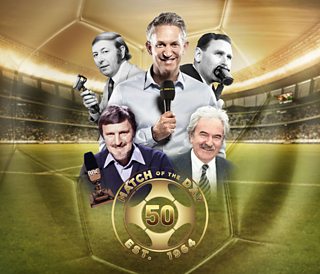
It has not always been an easy journey. Having produced the regular call of “time gentleman please” as an audience of 10million plus headed home to watch the programme, MOTD was unceremoniously put out to grass on Sunday afternoons at the start of the Eighties. Later, the Football League contract was twice lost to ITV and for a while the suffix ‘the road to Wembley’ was added to the title. There were doubts about the value of highlights, and live FA Cup matches were tried on Friday evenings and Sunday afternoons. But throughout, the MOTD ethic has stayed strong and that without question is a major reason for the programme’s success. The quality of those who work behind the scenes, editors, producers and assistant producers, has remained consistent and true. The viewers, with their love of football, recognise that. Familiarity has bred contentment.
By the time I arrived MOTD, born of the determination of the Head of Sport, Bryan Cowgill, had moved on from the pioneering days. But the programme was still evolving. Instead of just the one match, there was to be a second as the regions opted out on a set cue to show teams in their area. This was my chance. But the opt-out idea was not a success. The ‘mad movies’ we began to call it in the north-west, as technical problems and limited facilities made life quite hairy.
Film was still sometimes used in the regions, but not with the main match for which video tape was well established, though the editing bore little relation to the modern electronic sophistication. Some ‘dodgy edits’ made ‘the real’, usually preceded by a phone call to the gallery in the hope of distracting the producer and editor. There was a moment when Brian Kidd passed to himself and a match when the replays of three goals were inserted in the wrong order. Such mistakes were a rarity but the miscreant would be taken to task the following Monday, and that applied every bit as much to mistakes by commentators.
It was a few years down the road when I made my worst mistake. I credited Gerry Gow with a goal for Bristol City which was scored by Geoff Merrick. It was not a close call, just an aberration. After the match I had to stand in the middle of the Ashton Gate pitch, microphone in hand, as the sound supervisor tried to insert my correction. Precisely on cue Merrick walked round the ground and shouted “I wouldn’t mind, but I don’t score many of them”: as John Motson might say: “10 goals in 367 appearances over 15 years, if you don’t mind me saying so.”
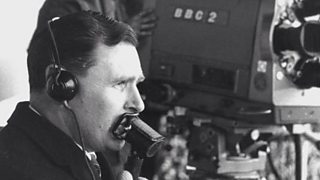
If I had made that error in my first commentary for Match of the Day I might have been forgiven. On second thoughts, probably not; but I would have had an excuse. I began the day in Leeds fully prepared, if rather nervous, to cover Leeds against Spurs, but before the breakfast toast had been consumed everything changed. Ken Wolstenholme (pictured above), the original presenter, who with beautiful simplicity provided the definitive commentary line at the greatest moment for English football, was ill. David Coleman awoke with laryngitis. As a result I was taken by car back to London, to Selhurst Park, to cover newly promoted Crystal Palace against Manchester United. With the guidance of Alec Weeks and his Outside Broadcast team I named the right goal scorers in a 2-2 draw and then went back to Lime Grove Studios to assist Frank Bough with the presentation. Quite a start for the ‘new boy!’
Now the ‘old boy’ looks back from a distance of 10 years since he did his last commentary, after so many matches that I am reluctant to pick from an unknown total.
Commentary has changed much since the days of Ken Wolstenholme, each generation, perhaps, has the style of its age, but dare I suggest the expression ‘silence is golden’ has on occasions, been rather lost. Of course it can be argued that there is more to talk about with the output of 15 plus cameras and replays from all angles. The producers of the early Seventies had only four cameras and Motty and I summarised a goal or significant moment in our mind’s eye, the slow motion being added when the match was over. We survived and over the years, despite efforts by some in the written press to have us at each other’s throat, enjoyed a friendly rivalry. It could be that our different styles assisted our longevity.
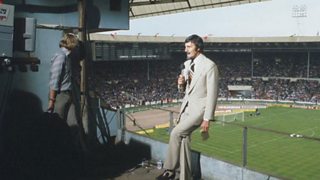
Over the years the presenter’s chair has been filled by characters, each endowing the programme with something a little different, and, since Jimmy Hill (pictured above) began it, pundits have played an increasingly important part. It has been, and will continue to be, a team to be proud of.
Barry Davies is a BBC sports commentator
