
As this year's Woman's Hour Power List of 'influencers' is announced, Jenni Murray - who has been at he helm of the Radio 4 programme for 28 years, reveals why her job is as exciting today as ever and explains why the Power List is important.
You've been 28 years in the presenter's seat for Woman's Hour - clearly it's a satisfying job - what about it keeps you excited?
I grew up with Woman’s Hour. My mother used to have very strict feeding routines for me, and they coincided with Woman’s Hour. So we would listen to it together. If there were any parts that included a health warning she’d send me into the kitchen – to put on the kettle or get something. So it’s always been a part of my life.
My first time in the studio presenting it was incredible, because I’d heard over the years “Woman’s Hour presented by Sue MacGregor”. So the first time they said “Woman’s Hour presented by Jenni Murray” I got very excited. And people will think I’m silly but I still get that same excited feeling every time I hear those words. It’s a wonderful job, I’ve always loved broadcasting, I’ve presented some TV programmes and written books, but I feel most at home in a radio studio so I feel very, very lucky.
Why do you think that in the digital age spoken work radio is still important to people?
I think it’s because it’s a guilt free pleasure. You can have a radio in every room in the house and not feel bad about that – it’s not extravagant. And when you listen to it you get a bit of everything, some more serious topics and other, lighter things. Right now I’m sat with my iPad, my coffee and my computer, I’m researching my new book at the moment, and all the time I have my radio on in the background. It’s always on whatever I’m doing, whether I’m cooking or working or throwing the ball to the dogs. And it always educates, informs and entertains.
People will think I’m mad but when I go out to work I leave the radio on for my dogs… I always think they’ll hear my voice when Woman’s Hour comes on and know it’s me.
What has been your favourite piece on Woman's Hour?
Well, I’ve interviewed some incredible people: Hilary Clinton, Theresa May, the home secretary - but no one would believe me if I said anyone but George Clooney.
I’m a huge fan of his, ever since he was in ER – I watched every episode, and I’ve wanted to interview him for years. Then suddenly two weeks ago I got a call from the office saying, “Are you free on Monday?” – I wasn’t actually, I had a hospital appointment, so I said I couldn’t go in. “That’s a shame,” they said, “because we’ve organised a meeting for you with George Clooney” – well you can imagine within two minutes I was on the phone to the hospital rearranging my appointment.
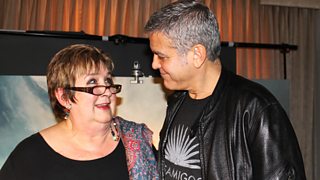
Jenni Murray meets George Clooney
So my team and I headed over to Claridges to meet him. And of course he’s gorgeous but he was also very open and answered all my questions intelligently. He has an incredible ability to look at you and make you feel like the only woman on the planet. That’s only ever happened to me once before – when I met Bill Clinton.
At the end of the interview I asked for a picture, for the website of course, and he agreed and asked if any of the rest of the crew would like to have a photo. But then, then he did something quite extraordinary, when our technician was clearing up he offered to help her. Never in all my years of interviewing has that ever happened before.
What about the most difficult interview?
It’s always very difficult when you are interviewing people who have had terrible experiences, like parents whose children have been killed. It’s a very fine line to tread – you need to ask the tough questions but be sensitive, it’s quite an important skill to acquire.
How did the Power List come about?
I can’t remember exactly how it started, but the initial list, in 2013, was 100 women who were in powerful positions. And HM the Queen was at the top. Then last time we decided to look at “game changers” and women who had really affected the world around them and of course Doreen Lawrence, whose son Stephen was murdered and who worked so hard to change the way people perceive racism, was at the top of that list.
This time we decided to think about influencers. There are so many people who influence us every day in ways we may not think about, there are people who influence everything we do - what we wear to work, what we eat – they might be chefs whose recipes we follow or even the supermarket buyers who decide what will be on the shelves. We wanted to consider these women and the effect they’ve had on our lives.
Why do we need the Power List in this 'post-feminist' age?
I hate the term ‘post feminism’ – what makes anyone think we are ‘post’ or beyond anything. Feminism is more vital today than ever – just look at campaigns like “Everyday sexism” and you can see why. In the Eighties feminism was a bit of a dirty word – we used to call it "the f word" - it had a negative connotation and women would say: “I’m not a feminist – but”…
Then a new generation got hold of feminism and reclaimed it, asking questions - why aren’t there more women in powerful political roles? Why isn’t there adequate childcare provision when I want to go back to work? Why are male counterparts paid more than me? And doing something about it – like Caroline Criado-Perez, who asked, “Why are there no women on British bank notes any more?” and started a campaign to make that right.
And what we’ve done on Woman’s Hour consistently is chart and explore that relationship between women and society, to empower and educate and it’s what we will continue to do with every broadcast.
Jenni Murray is a presenter for Radio 4's Woman's Hour.
- Find out more about the Power List on the Woman's Hour website
- Read the press release on the Media Centre
