Building something special in the north of England

Helen Boaden
Director, BBC Radio and Executive Sponsor for myBBC
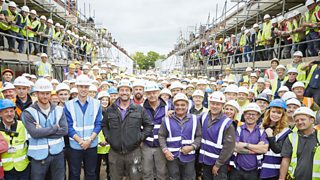
The BBC has been busy building something quite special in the north of England. The DIY SOS: Homes for Veterans project - the programme's biggest project in its 16 year history, watched by 10.9 million of you across both episodes - saw an entire street in Manchester transformed and homes for ex-service personnel and their families created out of empty houses, aided by our partners Manchester City Council, charity Walking with the Wounded and Haig Housing. Even Prince William and Prince Harry helped out, rebuilding a community in which the military veterans are now enjoying their new lives in their new homes.
It’s an amazing example of what the BBC can do. But it’s not the only thing we’ve been building in the north lately. It’s now more than four years since the BBC’s move to MediaCityUK. In that time, our north HQ, created in a corner of Salford close to the Ship Canal, has become an internationally significant media hub and a northern powerhouse.
BBC North is the BBC's second biggest creative hub, the biggest news centre outside of London, home to five of the BBC's flagship digital products and a base for some of the biggest BBC brands - including BBC Sport, Children's, Radio 5 live and the BBC Philharmonic Orchestra.
In total there are 24 BBC departments represented at MediaCityUK including drama, comedy and entertainment. Match of the Day, BBC Breakfast, Dragon’s Den, Songs of Praise, You & Yours, Blue Peter, Football Focus and Newsround are just some of the famous programmes made in Salford.
An independent report from KPMG, commissioned by the BBC Trust, has looked at the impact of the BBC’s move north. KPMG found the BBC’s move to Salford: “has had a positive contribution… in terms of employment, increased skill levels and spill-over effects.”
The report found there are approximately 6,500 people employed at MediaCityUK, with 40 percent being BBC employees. That means the majority don’t work for us and are instead employed by companies that have moved to the Salford site since the BBC set up.
Our impact on the city is significant. The creative industries now account for five percent of total employment in Salford, up from two percent in 2010. KPMG also forecast an extra 1,700 jobs will be created in the creative industries in Salford by 2034.
The report says: “The BBC’s move to Salford can be seen as what Paul Krugman describes as a 'small historical accident' which has started a path of attracting investment in creative activities.”
It compared the effects of our move to those seen in other industry hubs. “These ‘agglomeration’ and ‘network’ effects are observed in many sectors: from scientific research in Cambridge, to Formula 1 teams in the M4 corridor, to financiers in the City of London. There are signs that the BBC’s relocation to Salford has triggered the beginnings of a similar network in the North West.”
As endorsements go, that’s pretty good.
The BBC faces extra scrutiny at the moment as our future size, shape and scope is debated. Our recent experience in the north proves what a strong BBC can build, from a media hub to homes built for heroes.
Helen Boaden, Director of BBC Radio and BBC England
