
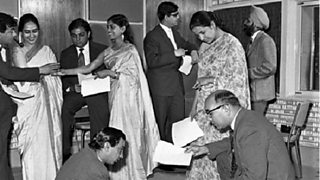
The production team for Make Yourself at Home, the first BBC programme for the Asian community.
In the wake of the recent Windrush scandal, many people have been discussing what it means to be British in the post-Imperial era.
When that famous ship dropped anchor at Tilbury Docks in 1948 it heralded a new era for both the UK and the BBC, as the Corporation rose to the challenge of representing a new and unfamiliar audience.
Now, seven decades on, BBC History has launched the fourth release from its Oral History Collection, showing the way staff at the BBC created programmes for a diverse and multi-cultural audience following World War II. The results are interesting and often surprising.
Created in partnership with the University of Sussex, 100 Voices that Made the BBC: People, Nation, Empire looks to shed new light on what is a complex and sometimes highly contentious subject.
John Escolme, BBC History Manager, explains: "What we're doing is bringing some of the BBC's hidden treasures into the public realm, including some of the 600 interviews with former members of staff, few of which have been available until recently."
Dual-identity
The records provide a fascinating insight into decision making at the BBC from that time, including minutes showing the initial reluctance of the Corporation to speed-up integration, and a recording of the first episode of Make Yourself at Home from October 1965, the first BBC programme for the Asian community.
Speaking about the programme, guest reviewer and Newswatch presenter Samira Ahmed comments: "I have a special affection for Make Yourself at Home…That whole idea of spoken Hindustani being broadcast on the BBC was really significant, it was addressing a minority in their own language but it also made me aware for the first time that there was this dual-identity."
There are a number of fascinating case studies looking at this concept of dual-identity, including Una Marson. Una was the first black producer at the BBC, way back in 1941. The prejudices she faced at that time are examined in a number of her documents and interviews, as well as comments showing the high esteem she was held in by some of her superiors.
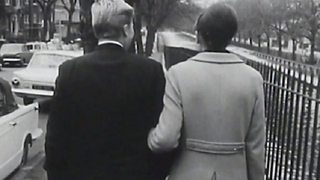
Man Alive (1967) was one of the first TV programmes to speak to lesbians about their lives.
Reflecting the LGBTQ+ audience
As well as the subject of race, 100 Voices looks at the efforts made by the BBC to engage with people from the LGBTQ+ community: from the initial, church-dominated discussions on radio in the 1950s, to tentative efforts to document the lives of gay men on TV in the 1960s, right up to the bold lifestyle programming of the 1990s.
John explains: "The language used in many of these early programmes is often blunt and reflects the attitudes of the time. The seven BBC programmes covered really exemplify the change in the BBC's understanding of its LGBTQ+ audience from 1957 until the present day."
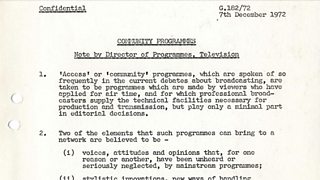
A letter from Sir David Attenborough advocating greater representation for minorities.
Confidential letters
Some of the recently released letters look at the BBC's first efforts to engage with minority communities. The letters reveal that many BBC journalists initially found it difficult to fully reflect and report on the lives of Britain's black communities and had to work hard to earn the trust of people in many UK cities.
Committee documents from the 1970s also show that the Corporation often struggled with the balance between increasing representation for minorities and a journalistic duty to report on prejudice and conflict.
While the debate around representation continues to be a challenging subject, one thing the documents make clear is the number of people at the Corporation who lobbied for change and pushed for greater equality in BBC content.
This cause is best summed up in a number of newly-released accounts detailing the behind-the-scenes decision to hand over editorial control to outside interest groups for a pioneering series called Open Door in 1973.
These include a memo from Sir David Attenborough, then Director of Programmes in TV, making the case for the series and advocating representation of minority voices on the BBC.
You can find out more about 100 Voices on the History of the BBC website.
This article originally appeared in Ariel, the BBC's in-house digital platform.
