
A change to the BBC HD channels on satellite on 27 September
Post categories: BBC HD
 |15:35 UK time, Tuesday, 4 September 2012
Alix Pryde, Director, BBC Distribution blogs on changes to the BBC HD channels
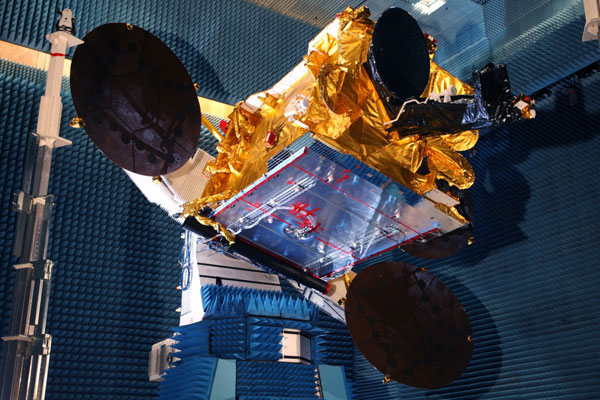
This fantastic picture (courtesy of SES) shows satellite Astra 1N during testing. As you may recall, we moved many of our services on satellite over to Astra 1N earlier this year . I thought I'd share it with you as I have some news to tell you about a forthcoming change to the transponder on Astra 1N that carries BBC One HD and BBC HD.
During the summer last year we made a significant change to our HD transponder, upgrading the transmission mode of the BBC's signal from "DVB-S" to "DVB-S2".
This change meant that we were able to make more efficient use of the valuable satellite capacity available on our HD transponder. It gave us the ability to broadcast at 1920 resolution and conduct 3D trials on satellite for Wimbledon, Strictly Come Dancing, Street Dance, the London 2012 Olympic Games and, most recently, Planet Dinosaur.
Over the last year, we have worked closely with our colleagues at Sky, Freesat and SES to investigate how we can continue to make the most efficient use of our satellite capacity in light of improving technology. As a result, we are now able to make a further modification to the DVB-S2 operating parameters which enables us to access additional capacity. This will support the forthcoming launch of BBC One HD for Scotland, Wales and Northern Ireland.
We will be making this change during the early hours of 27 September 2012 and will update our reception advice page which details all our satellite tuning details at that time.
The change will mean different things to different people:
- If you watch TV using Freeview or Virgin Media, or can't currently view HD channels you will not be affected.
- If you have Sky, you should not notice the change and shouldn't have to do anything on or after 27 September. If you do have an issue receiving the BBC HD channels from this date you can try unplugging your Sky set top box, waiting 30s and plugging it back in again. If that doesn't resolve your problem it's best to contact Sky on 08442 411 653.
- If you have Freesat you may need to put your HD box or TV into standby for 30 seconds and then switch it back on again to continue to receive the two BBC HD channels; if the channels are still unavailable then carry out a 'Freesat channel retune'. During last year's changes we found that a small number of devices didn't store the information after a Freesat retune so if that happens try a 'first time installation' or 'full factory reset'. Full instructions can be found in the manual for your digital TV or box. Further help with retuning can be found at www.freesat.co.uk or by calling their customer support team on 08450 990 990.
- If you have any other kind of satellite receiver that can currently receive the BBC HD channels then you should use the new parameters below to tune manually into the services. The current and new parameters for Astra 1N tp.50 are:
| Parameter | Current | New |
|---|---|---|
| Frequency | 10,847 MHz (vertical polarity) | unchanged |
| Modulation | DVB-S2, QPSK | DVB-S2, 8PSK |
| Symbol Rate | 23.0 MSymb/s | unchanged |
| FEC | 8/9 | 2/3 |
We have also contacted satellite and aerial installer trade associations - the CAI and the RDI - providing them with information with which to brief their members in case anyone experiencing a problem contacts an installer rather than their platform operator. We will also be putting information about this change on the satellite BBC Red Button page 998 a bit nearer the time because we know not everyone has access to the internet.
If you watch our HD services on satellite, I hope this change won't cause you any worry.
Alix Pryde is Director, BBC Distribution
Follow @AbouttheBBC on twitter for all the latest updates.

Comment number 1.
At 09:00 5th Sep 2012, D Bowskill wrote:Hi Alix, Will the bitrate for any of the channels alter, and if so what will the new bitrate be?
Complain about this comment (Comment number 1)
Comment number 2.
At 12:44 5th Sep 2012, brightondancer wrote:Hi Alix,
After September 27th will you still be broadcasting at 1920 res on the HD channels?
Complain about this comment (Comment number 2)
Comment number 3.
At 14:13 5th Sep 2012, popeye13 wrote:With the increase in bandwidth, and the fact the encoders are coping more than well enough on DTT, i would be both shocked and stunned if you now reverted back to 1440 from 1920.
I am still amazed though that you have issue after issue with HD res and bandwidth, yet nothing like this for the HD services you broadcast to Europe, through GlobeCast. So why is this a UK only issue?
It shouldn't be and i implore you BBC, to give the Licence Fee payer the HD we so badly deserve to get, from one of the greatest broadcasters global TV has to its name.
Id also get on my knees and beg you to ditch the silly and inane platform neutrality (bleep) you insist upon, but ive got more chance of you giving me lifetime tickets to watch TopGear being recorded than that.
Complain about this comment (Comment number 3)
Comment number 4.
At 19:30 5th Sep 2012, NSM_HD wrote:Thanks for the post Alix
I and some others over on DS were just wondering how having four HD channels showing mostly the same content will cope under statisticle multiplexing?
Also will the nation HD BBC One's be on the sky EPG, as under the current EPG there is no way to manually tune in DVB-S2 transponders on SKY?
Is there any plans to launch bbc three/ four HD as I have missed out on HD shows from BBC three such as Wilfred and Family Guy which don't seem to be shown on BBC HD any more?
Many thanks as always,
Nathan
Complain about this comment (Comment number 4)
Comment number 5.
At 20:44 5th Sep 2012, neil201 wrote:Alix, given the high field strength and improved carrier to noise figure on the 1N transponders (and soon to be even higher on 2F once it launches) I'm surprised you haven't gone for a FEC of 3/4 as this will provide about 55Mbps bandwidth and greater baseband use, be it for future BBC or capacity rented services - such as ITV1HD which uses some BBC transponder capacity.
Complain about this comment (Comment number 5)
Comment number 6.
At 23:04 5th Sep 2012, Muzer0 wrote:Alix,
I know this isn't your decision, but I do think it's a horrid mistake launching the BBC One variants. Surely it'll completely mess up the statmuxing and make it all look awful during BBC One sporting events.
I think a much better idea would be to have BBC News HD, BBC Three HD/CBBC HD, and BBC Four HD/CBeebies HD launching instead of the three extra BBC One variants. Alternatively, if you must have the BBC One variants, it would kill two birds with one stone to rent an additional transponder and also launch the three other suggested channels.
Of course, that's not going to happen for a while. It's just, if launching an HD channel is now *so cheap* that you can launch three that are essentially the same as one that already exists for the vast majority of the time, the budget can stretch to launching three others with actual different content...
But I'm just a viewer with an opinion.
Sorry for the rant.
Complain about this comment (Comment number 6)
Comment number 7.
At 09:50 6th Sep 2012, Martin In Yorkshire wrote:So BBC 1 HD Scotland, Wales, and Northern Ireland are somehow considered a priority over BBC1 HD Yorkshire (which incidentally, at 5.3 million has a larger population than any of them)
Oh and another thing, if you can't be bothered to show a program in HD, patch in to the News Channel or Cbeebies feed or something other than a ridiculous red screen with birds tweeting.
Complain about this comment (Comment number 7)
Comment number 8.
At 10:22 6th Sep 2012, xm11 wrote:interresting to be signal after switch to dvbs2 from spain
Complain about this comment (Comment number 8)
Comment number 9.
At 16:19 6th Sep 2012, Rodders_EID wrote:Hi Alix
Can you please add some additional technical info on this change: i.e. what is the current data capacity / payload at QPSK and what will the new one be under 8PSK?
We're all interested in what data rates are being allocated for the 3 extra HD channels... and will it be 5 or 6 streams in total from the 27th?
Best regards to all in Distribution who know me ;)
Rod
Complain about this comment (Comment number 9)
Comment number 10.
At 18:55 6th Sep 2012, Briantist wrote:@Rodders_EID: See https://www.satellite-calculations.com/Satellite/bitrates.htm
Basically, it's 12% more bits.
Complain about this comment (Comment number 10)
Comment number 11.
At 20:40 6th Sep 2012, Briantist wrote:Basically, it's
DVB-S on "old" satellite - 33.8Mbit/s
DVB-S2 on "old" satellite using QPSK - 46 Mbit/s (36% more)
DVB-S on "new" satellite - 44.4Mbit/s
DVB-S2 on "new" satellite using 8PSK - 58.8Mbit/s
Compare DVB-S2/8PSK to DVB-S2/QPSK -> 28% more
https://tech.ebu.ch/docs/techreview/trev_300-morello.pdf has a nice explanation
Complain about this comment (Comment number 11)
Comment number 12.
At 23:04 6th Sep 2012, neil201 wrote:Briantist: these figures all depend on the chosen FEC. The BBC are going for 2/3 so quite high for what, as described in post 5, is a now high power EiRP transponder with over 15dB carrier to noise, much better than 2D ever was, let alone 2A or B.
Personally I think they should raise the FEC to 3/4, certainly once 2F is here as the C/N should see a 3dB improvement over 1N - 57dBW versus current 54dBW EiRP (data from SES's site). Alix, out of interest, are there plans to lower the FEC at a later stage once 2F is in place?
Complain about this comment (Comment number 12)
Comment number 13.
At 23:15 8th Sep 2012, wednesday83 wrote:What a waste. We do not need a BBC1HD channel for each country. just pathetic political correntness from the beeb. What we need is BBC 3 and maybe 4 HD.
All this means from what i can see is lowered bit rates and sub standard picture quality, all for no reason what so ever.
Complain about this comment (Comment number 13)
Comment number 14.
At 12:56 11th Sep 2012, RODABOD wrote:Regarding the satellite parameters, the current versus the future parameters will provide a very similar downlink margin. We also don't know how some viewers' equipment will handle the 8PSK modulation which is more susceptible to phase-noise which can afflict some LNBs. Regarding the statistical multiplexing issue, if it indeed is one, the only solution I can think of is if delay units are used to stagger the content. This could potentially be quite expensive.
Complain about this comment (Comment number 14)
Comment number 15.
At 15:12 13th Sep 2012, pklong wrote:As others here have mentioned BBC2, BBC3 and BBC4 HD would have been a much better use of the bandwidth....
Complain about this comment (Comment number 15)
Comment number 16.
At 17:10 3rd Oct 2012, Alix Pryde wrote:First of all, thank you for reading my blog and for the varied questions and lively debate.
I've just posted a new blog about some further changes and I've used that as a good place to answer some of the questions you raised:
https://www.bbc.co.uk/blogs/aboutthebbc/posts/Satellite-Shuffling-reducing-BBC-Red-Button-and-expanding-BBC-One-HD
* How will you broadcast four versions of BBC One HD and maintain picture quality (quick answer - by splitting them across two transponders!)
* What EPG numbers will the nations versions of BBC One HD be found at? (quick answer, where you currently find BBC One HD)
* Why are you launching versions of BBC One for the nations and not for big(ger) English Regions? Or other BBC services? (that's not a quick answer)
So please do have a read.
In answer to your other questions…
1920
@D Bowskill, @brightondancer and @popeye13: at the heart of each of your questions is resolution (but see also the statmuxing answer on the new blog). I recognise that 1920 resolution is an important issue for many respondents to BBC blogs in this area. And I also recognise that some receivers in the market are less good at scaling 1440 pictures to 1920 than others are. 1920 is an ambition for us but one we have to set against the high costs of capacity. So it can come down to a choice between 1920 or an additional stream. We are in the process of looking at future capacity requirements for HD services and the technical development of encoders in the market. So there are a number of moving pieces. But while we work this through, we will stay for now with the 1920 resolution we moved to in May.
Complain about this comment (Comment number 16)
Comment number 17.
At 17:16 3rd Oct 2012, Alix Pryde wrote:Tech parameters
@neil201, @Rodders_EID, @Briantist: Our choice of mode was taken after considering both theoretical and practical reception from Astra 1N, ensuring that we provide robust coverage across the whole of the UK. Should there be more margin from future satellites then we would consider a change of mode to ensure we were making best use of the capacity available to this, although at the moment we’ve no plans to make such a change.
Red screen
@Martin In Yorkshire: I can see that you're not a fan of the infamous red screen on BBC One HD during the opts! So I thought you might appreciate some explanation. The decision to show that and not, say, the BBC News channel, is a very carefully considered one that has been discussed at the highest level. Our concern is to ensure that we protect viewing of our national and English regional news programmes. And without being able to afford to make all variants of BBC One available in HD, we use the red screen to encourage viewers to go back to the standard definition version of BBC One where they will be able to watch the news from their area. We are looking into ideas to improve the experience cost-effectively. But for now, I'm afraid the red screen stays ... although watch out for a temporary change in the next week or so... (You heard it here first!)
Complain about this comment (Comment number 17)