
The new BBC Archive Centre at Perivale
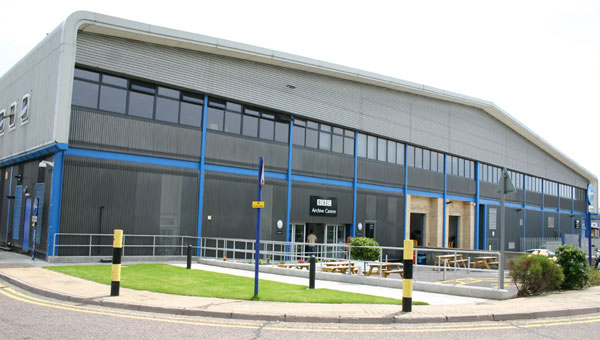
The BBC Archive Centre at Perivale
The BBC archive was for some years housed in a building within an industrial estate in Brentford. Eventually this building became unfit for purpose and to ensure the protection of the history within it my team and I drew up a plan to re-house the collections in a new purpose built facility in Perivale.
The BBC archive is a rich historical resource that can track the evolution of broadcasting in documents, radio programmes, television programmes, photos, sheet music and vinyl collections. It really is one of the largest broadcast archives in the world (well over 12 million items in total). It is held on multiple tape/film/sound formats and it needs to be housed in appropriate climate controlled vaults in order to prevent the tape and film stock degrading over time. The new BBC archive centre has 9 climate controlled vaults which can be individually adjusted for temperature and relative humidity. If all the racking in the vaults in Perivale was laid in a straight line it would extend for over 60 miles.
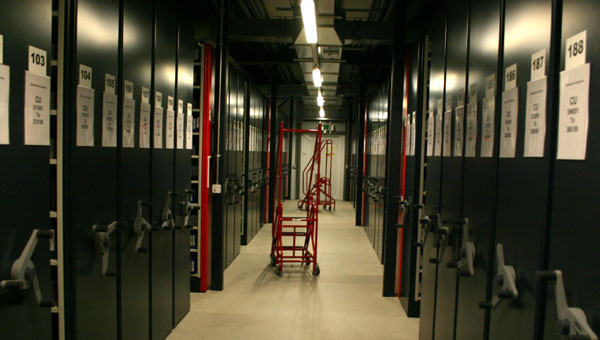
The climate controlled vaults in BBC Archive Centre at Perivale
The archive is not just a rich record of our broadcast history. It is also a working resource that is in great demand across the BBC everyday. In fact, the service we operate delivers over 4,000 items every week around the UK for transmission, for reuse in new programmes, for research and for business use. The content continues to grow at the rate of over 6000 hours of Radio and over 1500 hours of TV each month. It is a living breathing collection that is in constant demand and is incredibly precious.
As you may have heard in a recent Guardian Technology Podcast and may also have read in posts by my colleagues across the BBC's blog network this week, we are intent on making as much of our archive content available to our audiences as possible in the coming years.
Sarah Hayes is the Controller of Information & Archives.

Comment number 1.
At 17:54 13th Oct 2011, Kit Green wrote:It would be interesting to have an article at some point looking at the obsolete technologies that you need to keep available to access the media that you have preserved.
Complain about this comment (Comment number 1)
Comment number 2.
At 21:58 13th Oct 2011, WilIiam wrote:Good to see the BBC devoting resorces to preserving its archive. I'm not clear what 'we are intent on making as much of our archive content available to our audiences as possible' means. Is the aim to ultimatly provide the public with access to the full archive through this facility? What's the point of storing recordings if it isn't?
I assume the catalogue is digitised. When will the listener/viewer have direct access to the complete catalogue to see what broadcasts have been retained by the BBC?
I would hope to see these points addressed by the BBC soon.
William.
Complain about this comment (Comment number 2)
Comment number 3.
At 12:06 14th Oct 2011, Heather Taylor wrote:As one of the blog editors, I thought I'd answer some of your questions.
Kit - your questions can be addressed by the Guardian Technology podcast from last year about the BBC Archive which has a interview with Richard Wright preservation expert in BBC R&D talking about exactly the technologies Kit is interested in. https://www.guardian.co.uk/technology/blog/audio/2010/aug/18/bbc-archive-roly-keating-windmill-road
Also there is a post by Richard on the R&D blog which may help https://www.bbc.co.uk/blogs/researchanddevelopment/2010/08/intimations-of-the-archive.shtml
William - This episode of the Guardian Technology podcast on Digital Public Space should answer your questions https://www.guardian.co.uk/technology/blog/audio/2011/sep/28/tech-weekly-digital-public-space-audio?tw
As well as Bill Thompson's post on the Internet blog https://www.bbc.co.uk/blogs/bbcinternet/2011/10/digital_public_space_partnersh.html
Complain about this comment (Comment number 3)
Comment number 4.
At 08:36 19th Oct 2011, Sue_Aitch wrote:Please would you ask the Ceefax Editor to update Ceefax page 695 accordingly?
Complain about this comment (Comment number 4)