
Bruce and the bomb
Post categories: BBC History, Broadcasting House, World War Two
 |14:51 UK time, Thursday, 14 October 2010
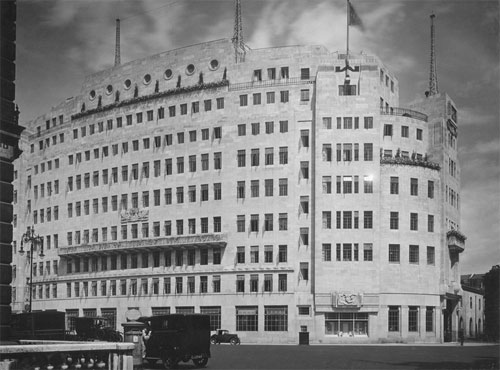

But in spite of this, hit it did – with all the force of a 500lb delayed-action bomb. Smashing in at a seventh floor window, it came to rest in the music library two floors below, killing seven members of BBC staff – but barely disrupting the unflappable news reader Bruce Belfrage. He gave a slight cough as the ceiling fell around him, then continued courageously with his reading of the 9pm news bulletin.

One of the BBC staff, describing the aftermath of the bomb attacks on Broadcasting House, called it ‘a scene from Dante’s Inferno’ (obviously a member of the Arts department!), but the BBC was only sharing what the rest of the UK was experiencing: the horror, the danger, the arbitrary nature of the Blitz, where one street survived, another next to it fell to the ground. Who lived, who died, was all a matter of chance.
But of course, broadcasting was identified early in the war as one of the obvious targets – hence its green-grey camouflage. Whole teams of broadcasters were evacuated to less urban parts of the UK, and strategies were put in place to ensure – whatever the eventuality – that broadcasting would carry on. Eventually in 1942, a bunker (or ‘stronghold’ as it was sometimes referred to) with walls 17 inches thick was built under the extension of Broadcasting House, so that vital broadcasting could persist.
Broadcasting House is not the only BBC London building to have been the target of bomb attack. More recently, Television Centre was hit in 2001 by an IRA bomb, leaving the front facade in mangled pieces. And nowadays the BBC, as many other public bodies, has to tread that difficult path between wanting to keep its buildings open and accessible to the public who pays for them, and protecting them from invasive attack, come when it will.
Robert Seatter is Head of BBC History
See and hear the full story on BBC History's audio slideshow.


Comments Post your comment