
Life in Seoul: 35 miles from the border
It’s 1am, and under the neon lights of Seoul’s shining skyscrapers, people are laughing and chatting, heading to eat barbeque or drink tiny glasses of soju. Being just 35 miles from one of the world’s most dangerous borders isn’t playing on the mind of anyone here tonight.
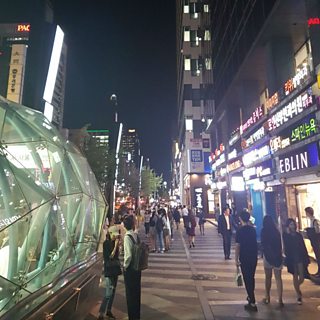
The bustling city of Seoul at night
For me, that's one of the most striking things about the mood in South Korea right now. The swirling fear that's enveloping other parts of the globe isn't in evidence here. People know this threat, they recognise it, but they've lived with it for a long time already.
The conflict between North and South Korea is nothing new. Technically the two countries are still at war, and simply living in a state of armistice. So why has world attention – and fear – grown so fast in the last few months?
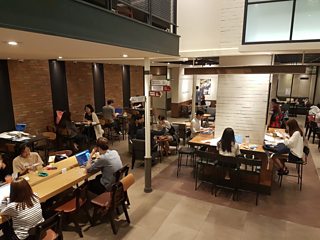
A Seoul coffee shop full of young people who come to socialise - but also work
In Seoul, people’s response to the North Korean threat tends to fall along generational lines. For those who are too young to remember the Korean War, it feels like more of an abstract threat. While they can’t see it, and it has no effect on their daily lives, they spend little time worrying about it.
What's life like for South Korea's K-Pop stars?
The Korean Peninsula is a place of contrast. In just a few decades, the South has clawed its way back from almost complete destruction to become the fourth-largest economy in Asia. I wandered through the Gangnam district packed with colourful statues celebrating the booming K-pop music scene. Even after midnight half the floors in Samsung's towering glass headquarters had lights on and people at their desks. This prosperity is bourne of hard graft.
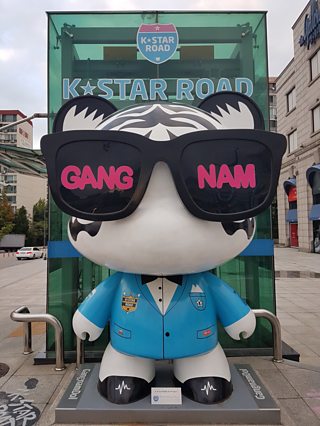
A 'GangnamDol' on K-Star Road - famous K-pop groups have their names printed on these human-scale bear dolls.
Escaping North Korea
For some though, the fear of ongoing tensions in the North is never far from their minds. Hyeonseo Lee grew up in North Korea but escaped to China in 1997 where she hid for 10 years. She has now settled in Seoul, but still fears for her safety.
"They hate me, they want to remove me," said Hyeonseo. "Every day, I see a police car on the street, I am very scared, I think they are coming for me."
Hyeonseo has written a book called 'The Girl With Seven Names', based on the number of times she has had to switch identity since defecting.
North Korean defector: My life could end instantly
The border: People living on the edge
There's no outward show of wealth in the North. Driving along the border, hearing the heavy thumps of South Korean army target practice and the return of clattering gunfire from the north, two worlds are colliding. A quick check of my smartphone map app shows a featureless expanse. No roads, no towns. What goes on here is shadowy and secretive.
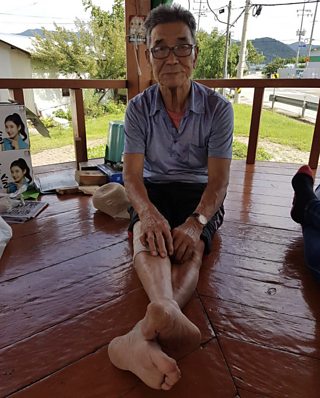
Mr Ong, 77, stepped on a land mine in the demilitarised zone, losing every toe on his right foot.
I travelled to the closest village to the Demilitarised Zone, just three miles from the barbed wire. Its men have special permission to farm inside the DMZ, and one of them, sprightly 77 year old Mr Ong, showed me where he’d lost every toe on his right foot standing on a landmine. He described the day he heard a bang and looked down to see his leg mangled and twisted. Even then he felt lucky, nine men in his village had stood on mines and he was the only one of them to survive.
'The most dangerous border on Earth'
Preparing for the worst
Unlike in Seoul, where subway stations and apartment block basements double-up as emergency shelters, this place has a clean, new, purpose-built bunker sunk two storeys below ground behind an eight-inch thick door.
The Defence Secretary Sir Michael Fallon used the Andrew Marr show to highlight the fact that London is closer to Pyongyang than Los Angeles.
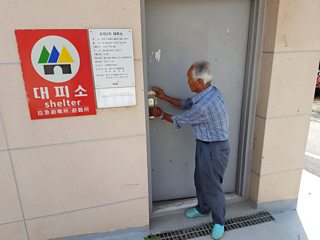
Mr Lee, who is in charge of the emergency shelter in the nearest village to the border
They’re so untouched that I ask if they’ve ever even been practised with. “We haven’t had a real emergency yet”, says Mr Lee, the village elder in charge of the shelter. “If we need them there are directions on the wall”. Does this lack of urgency suggest the threat of imminent war has been overblown? “I am worried”, he replies, “just last week someone from the city came to check on us”.
A look inside a South Korean public shelter
As the world watches - what next?
Many analysts though, believe Pyongyang has its eye on prizes far bigger and further away than its southern border. The Defence Secretary Michael Fallon used the Andrew Marr show to highlight the fact that London is closer than Pyongyang than Los Angeles. “This involves us”, he insisted, which is true – but perhaps more in a diplomatic sense than as a target
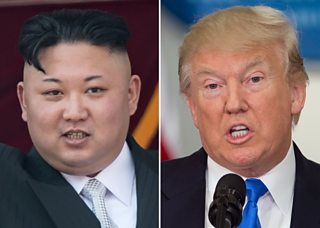
North Korean president Kim Jong Un (Left) and US president Donald Trump (Right)
When I put his comments to South Korean journalist Jungeun Kim, she was taken aback. “Does he understand what he’s talking about? I can’t remember a time when Kim Jong Un has threatened the UK. His argument is with America”.
Of that, there is no doubt. In Itaewon, I asked a uniformed US soldier, one of more than twenty thousand stationed on the Korean peninsula, what he thought of the current threat. Did he feel safe? “Yes I do, I’ve even brought my family here.” When I pushed him on President Trump’s response to the crisis, his answer was brief, but damning. “He’s dealt with it like a chump”.
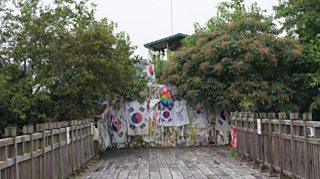
A South Korean military check point visible from the 'Freedom Bridge'
It's not hard to find others who agree. But any disdain felt towards the president is of course as nothing compared with the reputation of his North Korean counterpart.
And most here believe it will be the actions of the latter that will determine how this unedifying stand-off ultimately plays out.
