The team time trial – a test of speed, technique and technology

Graham Jones
5 live cycling summariser
Tagged with:
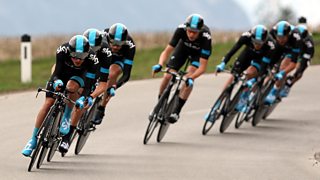
The last time the Tour de France had a Team Time Trial (TTT) in Nice was in 1981 - and I was riding in it. Today’s test is a far cry from those days. Back then TTT’s were still a fairly new addition to the Tour, having been re-introduced in 1978 with a huge stage of 153kms. Today’s Stage 4 is a much faster, shorter distance – just 25 kilometres.
That said, most riders would prefer to ride 200 kilometres rather than put their legs and lungs through half an hour of intense, high-gear speed cycling.
Today is primarily about nerves and technique. No one wants to be the one that lets the team down, and this is one of the toughest days in the Tour.
The winning team will the one that gets the optimum performance from every rider, and the key to this is timing. Deciding when to switch your lead rider (the one at the front creating the slipstream for the rest of the team) is critical.
The whole team of nine will start, and the Team’s time is taken when five of them cross the line - but all riders must finish, and finish inside the time limit. In this instance the limit is 25% of the winner’s time, around 7 minutes.
All riders, particularly in the top teams, will have at some time had wind tunnel tests on their time trial bikes. This will help in finding the optimum position, where your head low. However, in a TTT it can’t be as low as low during an individual time trial, as concentration and an eye on the wheel in front is vital. Your back must be straight, keeping those elbows tucked in, but the guy behind needs some shelter as well. Ideally the smallest rider would not be in front of the biggest, but on the road these things change.
We already know that Team SKY will be weakened by the injuries to Geraint Thomas. He would have been one of the team’s strongest riders, but now they have to be careful how they manage him. It also needs a quick mind and calmness within the team to manage punctures or mechanical problems; whether to wait or not will depend on who has the problem and where into the stage the incident occurs. It’s vital the team is coordinated.
Technology is another way to optimise “marginal gains”, to quote Sky’s Sir Dave Brailsford. Special low-profile bikes have thinner frames and are more aerodynamic – but they would not use these for the long stages are they are simply too uncomfortable to ride.
Another noticeable difference you would see is that the back wheel will be a disc. This covers where you would normally have spokes on a normal road bike. Again, this helps with the overall aerodynamics. These would not be used if in windy conditions, as they would destabalise the rider.
Aerodynamic suits and helmets are all tested in wind tunnels, and some teams even discard drinking bottles, preferring a camelback system. All these items are now scrutinised and have to be approved by the UCI, the world governing body for cycling. Even the spare bikes have to be weighed and measured.
Whilst it’s short race, it will feel like one of the longest for the riders.
Coverage of the Tour de France continues from 3pm on Tuesday 2 Julyon 5 live Sports Extra. Download the BeSpoke podcast for daily analysis from commentator Simon Brotherton and the team.
