

Victoria Derbyshire: Broadcasting from Guantanamo Bay
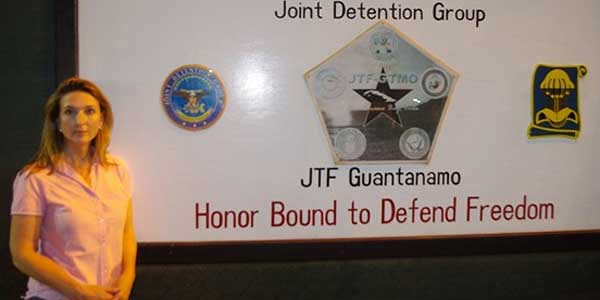
Last week we spent three days in the prison camp that's said to hold some of the world's most violent terrorists, Guantanamo Bay, Cuba. It's where Khalid Shaik Mohammed, the self-professed chief plotter of the 11 September attacks is incarcerated along with Abdal-Rahim al Nashiri, a Saudi accused of planning the bombing of the American destroyer Cole in Yemen in 2000.
Yet we were astonished to learn that even most the dangerous detainees had a Sony Playstation at their disposal, could watch 22 satelllite TV channels, play football and were given food not dissimilar to that on offer in top hotels. Such privileges led to a "calmer atmosphere" according to the senior military officer in charge of the camps.
Welcome to one of the controversial legacies of 9/11 - the military prison established in the immediate aftermath of the terrorist atrocities on New York, Washington and Pennsylvania in which nearly 3,000 people were killed. Here hundreds of men who were arrested by American soldiers in the mountains of Afghanistan and Pakistan were brought to be questioned about Al Qaeda and its leader Osama bin Laden. It became known for its brutal interrogation techniques and detainees in orange jumpsuits with hands shackled, on their knees in open air cages.
We approached the south eastern tip of this Caribbean island on a small boat just as the sun was setting and disembarked to the sound of crickets chirruping beneath the palm trees. A two-foot long iguana stared at us nonchalantly as our military escort drove us the 15-minute journey to where the detainees are imprisoned. We passed officers' villas surrounded by manicured lawns on cul de sacs named Caribbean Circle and Iguana Terrace, a covered children's play area, McDonalds and Starbucks, and signs to Windmill Beach. The temperature during the day had been in the 90s - and it was very gradually starting to cool down.
Then we reached the checkpoint which divides this US Naval base, 45 square miles of land and sea leased from the Cubans. It felt tense as guards armed with assault rifles examined our ID before waving us through. As we drove down the hill, there suddenly loomed before us intimidating 18-foot tall mesh wire fences on which rolling barbed wire sat. Hundreds of floodlights illuminated the watch towers which sprung up every 200 yards. It looked like a concentration camp from the Second World War.
Watch highlights from our Guantanamo programme
In order to see this content you need to have both Javascript enabled and Flash installed. Visit BBC Webwise
We were led through huge mesh-wire gates protected by green synthetic "sniper fencing" followed by several thick steel doors before we reached the inner sanctum of Camp VI (the authorities specifically asked that I didn't reveal how many gates and doors for 'operational reasons'). We were asked to speak quietly as we opened some wooden venetian blinds which were hung over one-way sound-proofed glass, and I wasn't sure what we were about to see - would it be the famous orange jumpsuits which some detainees do still wear? The shackles? The interrogation rooms? I held my breath - and witnessed a very ordinary scene: groups of detainees wearing white flowing tunics, sandals and in some cases white prayer caps, eating and chatting.
They were sitting at hexagonal metal picnic tables in a dimly lit circular area surrounded by their single cells; a balcony ran all the way around the second floor off which there were more cells. Seven detainees, some with beards, were sitting cross legged on the floor around food which had been laid out. We couldn't hear anything and they had no idea we were observing them. It felt like we were watching a silent movie and if it hadn't been for the security paraphernalia and guards stationed at various points around the perimeter - it looked like a group of friends socialising. We weren't allowed to interview the detainees because it would break the Geneva Convention (exposing prisoners to extreme curiosity), so why isn't observing them breaking the Convention? "It's about us being transparent Ma'am". But it isn't it voyeuristic? "It's about us being transparent Ma'am", came the repeated response.
I spoke to a guard who'd been assaulted by a detainee who threw a 'cocktail' at him. "Imagine the worst bodily fluids mixed up in a polystyrene cup and thrown in your face", he explained. How could he not feel resentment, disgust and hatred towards that inmate?" We're professionals trained to do a job" he told me. "But you're also a human being with normal emotions like the rest of us", I pressed, "you can't pretend that wouldn't affect your attitude to him?". Silence. "So because of you're training, incidents like that don't get in the way of you carrying on with your job?". "Roger, Ma'am".
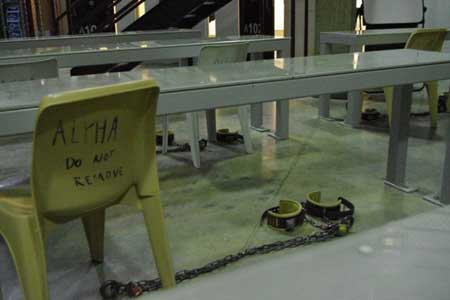
Close to the central living area was a 'classroom' where they could take language or art classes, learn computer keyboard skills (with no connection to the internet), all the while sitting at metal tables with their ankles shackled. Their artwork adorns the library walls - pastel drawings of ships, fruit, a cell and tropical islands. 17,000 books were available in Urdu, Arabic, Farsi, English, French, Punjabi and Pashto although unlike your local library, customers here don't go to choose books themselves, the librarian delivers them to the guards who pass them on. All the Harry Potter books were available in eighteen languages but the most popular were on Islam.."Islamic Civilisation", and "Let's Learn to Recite the Qur'an" as well as Agatha Christie and John Grisham thrillers.
As we left this medium security facility of "compliant detainees" (hence their white uniforms), we witnessed a surreal sight: a guard with a long stick trying to poke out a football from the tunnel of barbed wire on the high fence which had been kicked up there by the detainees who were playing football in their recreational area. We heard cheering and laughing as the ball was finally freed and they could continue their game.
"Non-compliant" detainees wore the infamous orange tunic tops and loose elasticated trousers although we weren't allowed to observe them. They lived in the maximum security facility, Camp V, spending 20 hours each day in their single cell which was 6ft by 8 ft (it took me 3 steps to walk from one side to the other). The window was long and thin on the back wall under which a blue mattress lay on a concrete bed, opposite a flushing metal loo and small sink. Even here, those convicted of terrorist-related crimes were allowed watch TV alone, while seated in a deep comfy armchair with ankles shackled to a bolt on the floor. The rules stuck up on the door of the TV room included, "don't move the furniture".
Touring the industrial-sized kitchen while food was being prepared, we saw the menu for the next seven days. For breakfast detainess will be offered scrambled eggs, sliced cheese, humous, cereal, reduced fat milk, pitta bread, cucumber & tomato salad, black olives, a variety of fruit, fruit yoghurt, tea or coffee, peanut butter, cream cheese, honey, butter, organic olive oil, jam, sugar and cream. Pepsi was offered as a treat and I was told the inmates regularly argued amongst themselves if one was given slightly more to drink than another.
The camp authorities were keen to show the living conditions the detainees now "enjoy". But when I asked Admiral David Woods, the chief of the camps about the psychological torture of being imprisoned for upto 10 years without charge - not knowing if you would ever be tried or released like the remaining British inmate Shaker Aamer - he said he wasn't an expert in mental health problems. So what interrogation techniques were still used? Duct tape to quieten a detaineee? "No." Interrogators shouting in an aggressive and overbearing manner? "No." Moving an inmate every few hours to a deprive him of sleep and lower his ability to resist questioning? "Not to my knowledge are detainees moved without a planned and prepared operation" - so that technique is still used then? "Not unless it's been planned and there's a thought-through strategy". Pouring water over a detainee's head? "No". Playing Britney Spears and Metallica music loudly for prolonged periods which happened in the early years of GTMO? "Not to my knowledge". He then claimed that a third of interrogations these days are voluntary. Could 10 years in solitary make even talking to an interrogator an attractive diversion?
Admiral Woods couldn't confirm if intelligence gathered here about the pseudonym of Osama Bin Laden's trusted courier had helped lead to his whereabouts but was clear that information collected over years was highly valuable. Hamilton Peterson who lost his father and stepmother in the 9/11 attacks and who's visited Guantanamo Bay was also clear : "Make no mistake, I'm proud of the Americans for what they've done at GTMO - protecting citizens around the world from heinous terrorists."
You can download all of Victoria's programme from Guantanamo as a podcast and hear her programme every week day on 5 live from 10am

Comment number 1.
At 21:54 13th Sep 2011, carrie wrote:You were shown what they wanted you to see. You heard what they wanted you to hear. Your questions were answered by rote. You seemed surprised by the good things you found, but that is what they wanted you to discover.
Complain about this comment (Comment number 1)
Comment number 2.
At 12:53 14th Sep 2011, liontwins wrote:Or maybe the good points are actually true? Oh no, they can't possibly be...
Complain about this comment (Comment number 2)
Comment number 3.
At 14:39 14th Sep 2011, carrie wrote:I am sure the good points are true. That is what the US wanted to show the world. The sad thing is the human price paid for them to finally open up a manicured facility to allow us to see what is there now. I'm sure the people presenting the facility to Victoria wouldn't have thought: "now we can tell the world everything using this BBC programme" because most of it is still top secret and off limits, probably to half the people that work there too.
Complain about this comment (Comment number 3)